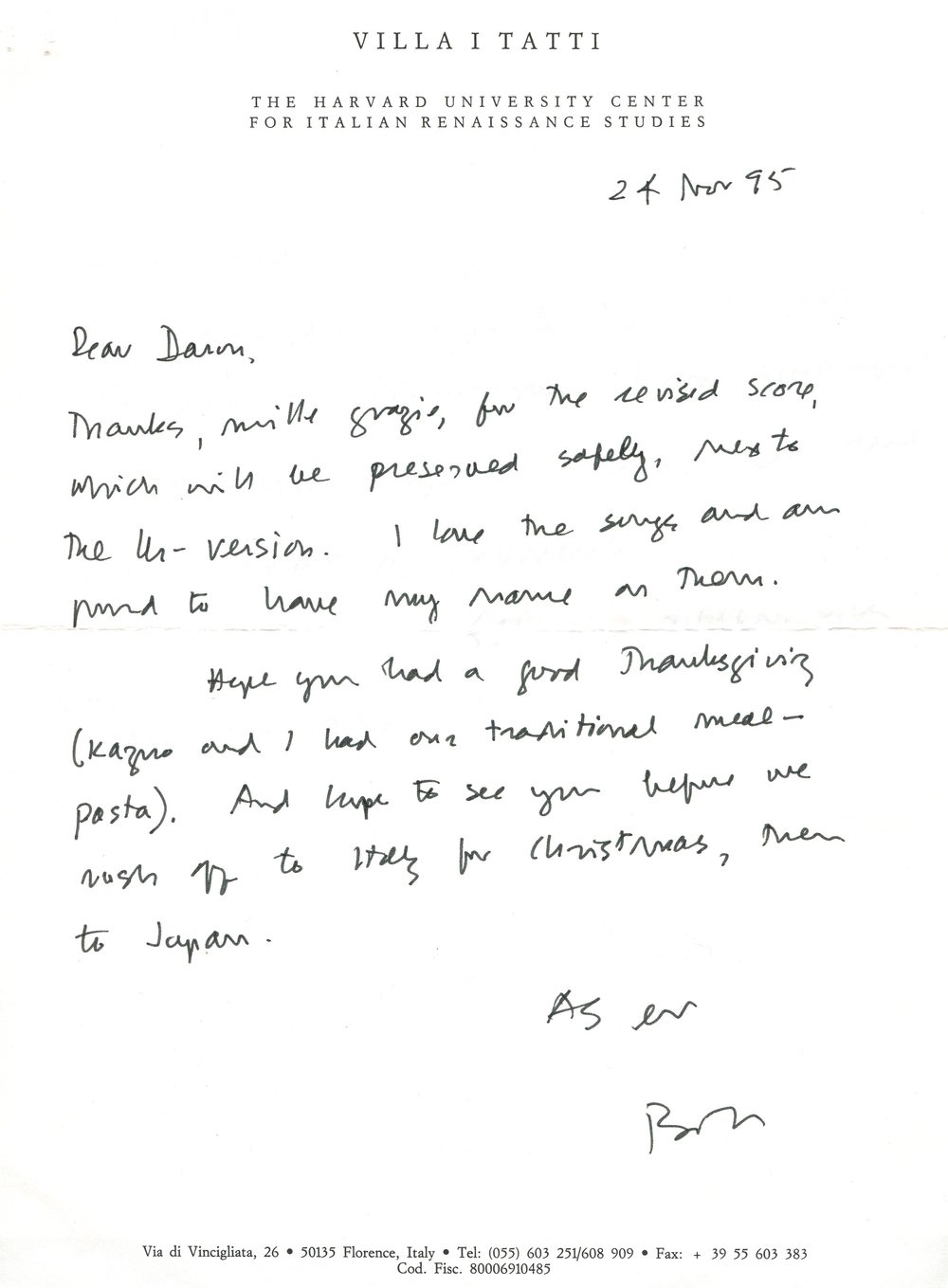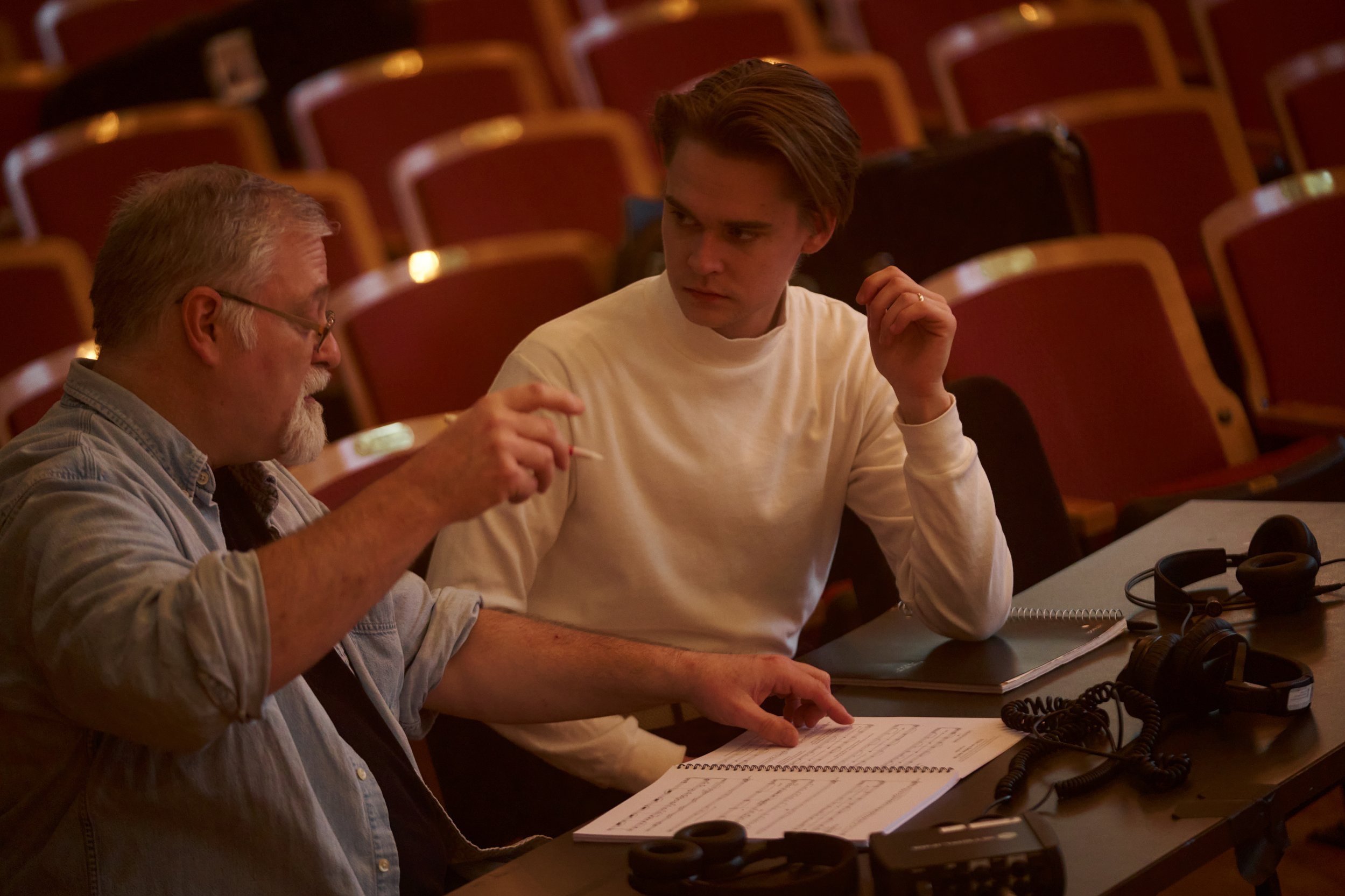
On Performing

Beginnings

A prepubescent boy of 12 bathed in dazzling stage lights in 1973 sings Norman Dello Joio’s 1948 setting There is a Lady Sweet and Kind accompanied at the piano by his fearsome teacher, a man named Wallace Tomchek, at some rural high school in Wisconsin for three non-descript oldsters checking off boxes without looking up until the end when it is revealed that one is weeping.

In the beginning, performance is what you make of it. In the end, when you finally become what a lifetime of performing has made of you, you’ve become a means of transmission, an instrument. In between comes the performing. And the bear. More about the bear later.

Public Performing: the ritual for which one dresses up (or not) in concert blacks, hits the deck, and participates as performer or auditor in a transformative exercise facilitated by music-making, is undeniably an opportunity to enjoy and explore peak human and aesthetic experiences that, in their rightness, touch peoples’ souls and enrich their lives.

Christmas 1978, as a tenor in the choir during a recording session of, among other seasonal pieces, Holst’s Lullay My Liking I am moved to secret tears of gratitude and joy by the sudden, staggering understanding of how very much I love all the people with whom I am singing, that we are good and that, no matter where everyone’s paths will take them after graduation, we can take gentle, youthful pride in our performances; that our conductor Kay is excellent, and that she and Tomchek have taught us well; that this is a memory, a peak moment, if I can hold on to it, an instant that, if correctly remembered and left unadorned, might help carry me into the future.

Listening to the recording just now, I can still identify individual voices in that long ago chorus, and I am transported in time to who I was then, able to examine the skein of memories that ties the man I am and the boy I was in a way that consoles and admonishes, celebrates and memorializes.  Memory is what makes us human; it is the Madeleine. But it is performance that activates memory and compels us to act.

Private Performing: composer (and former chef) Carlos Jaquez Gonzalez observed to me during filming of the operafilm 9/10: Love Before the Fall (in which he sang the role of Tony) how alike Family Meal in the restaurant world, chamber music with friends, and ensemble building in the theater are. I have leaned into that with my New Mercury Collective.

I am with stolid deliberation working my way through a new French language edition of Marcel Proust’s À la recherché du temps perdu — a gift from the Camargo Foundation’s resident director, Michael Pretina — side by side with my mother’s nicotine-stained 1934 English language edition. It is November 1989. The Mistral is marching stiffly down the Alps and sweeping across the Côte d’Azur on its way to North Africa, so I am wrapped in jeans and a shocking pink woolen Benetton sweater purchased a few weeks earlier in Venice with money I don’t really have and in which I have sweated. It still looks good, but it smells a little funky. A few days earlier I had set Paul Muldoon’s poem Holy Thursday to music, and have volunteered to perform it, along with a few other songs—some Barber, Rorem, Bernstein, and a couple of my own—at a soiree Michael is throwing for some donors. I can hear the rhythmic crashing of the waves on the limestone cliffs below the villa and, on a lark,  synchronize to them the thrumming chords of the piano part of my setting of Paul’s poem. As I play for an instant I realize the moment for what it is.

The riskiest performing of all, the ultimate gift that performers can offer one another, is the sharing of unfinished drafts or unpolished performances. Complete trust and inclusion of others in one’s creative space. As a composer who performs, mine is the music room at Yaddo, the artist retreat in Saratoga Springs, New York.

Sitting next to David Del Tredici, giddily charging through Mozart Symphonies four handed arms like spaghetti on a summer afternoon in the early 90s; David accompanying me as I roughhouse my way through Now You Know — a song with words by Antler and dedicated to me about, among other things, how male babies in the womb get erections, and how many, and how often — to a roaring audience of guests in summer 1998; David’s exquisite accompaniment as I sing my setting of Gardner McFall’s Amelia’s Song in September 2005 for the rest of the guests after dinner while composing the opera; accompanying Gilda Lyons myself in my arrangement of the hymn Angel Band before dinner during an annual board meeting sometime during the aughts; weeping, a few days after Ray Charles’ death in 2004, while singing and playing my setting of Stephen Dunn’s Elegy for Ray Charles (were Stephen or David aware yet that they had Parkinson’s?) for him in the middle of the night.

I may have thought that I was a pianist, singer, or conductor before I landed in conservatory, but that nonsense was knocked out of me the first time I walked down the second-floor hallway at Curtis lined with the sepia-colored group graduation photos (of Gary Graffman, Jorge Bolet, Leonard Rose, Jaime Laredo and…) to the sound of kids younger than me crushing repertoire that I’d never have the technique to perform. From that moment on, I thought of myself as “a composer who plays the piano,” despite all the piano lessons and some really terrific teachers, with whom I am grateful to have studied — beginning at 7 with a stern Polish Holocaust survivor named Adam Klescewski; then Duane Dishaw at the Wisconsin Conservatory of Music; and then Jeannette Ross at the University of Wisconsin; ending with Marion Zarzeczna, a pupil of Horszowski’s, at Curtis, who taught me finally how to not play “like a composer.”

Just as composing requires a safe, secure space from whence to create, performing requires that you feel safe onstage. Every one of my teachers observed with wonder how comfortable and at ease I was at the keyboard. It was because, when I was fifteen my mother made my father promise that, if I were at the piano, then he could not summon me to perform any of the numerous random tasks that he demanded of all three of his sons when he was home in what we decided was a conscious desire to keep us from relaxing. For me, the result was that the moment I took to the bench I felt safe. In performance, charged with lifting up and protecting a singer, I was always and have remained, entirely in command of myself as a performer because I’m not there for me: I am a man on a mission.

I made the most of the technique that I had. I performed on hundreds of concerts as a collaborative pianist, made records, coached, and put over from the piano a dozen operas to collaborators, producers, and colleagues. I’ve always acknowledged my place. After hearing me premiere some songs with Douglas Hines, Vladimir Sokoloff told me, “You’re a fine collaborative pianist. Soloist not so much.” I am grateful for that.

Middles

Putting over Frank Lloyd Wright’s “Balsam fir” aria from Shining Brow for Lenny on his beautiful Baldwin at the Dakota in 1990, knowing it was good stuff; the absolute I-can’t-believe-this-is-happening thrill of hearing him channel my compositional voice and manipulate it without corrupting it, singing and playing through the same material in his gravelly-schmoozy voice, and by doing so, teaching.

A colleague once turned to me just before I was about to perform on a benefit concert at Alice Tully Hall and groaned, “Please just don’t play like a composer, okay?” I have encouraged dozens of proteges over the years to perform their own music so that they will learn this tough lesson firsthand. Accustomed to filling in the blanks, focused on the larger musical argument, composers typically forgive themselves for their technical inadequacies. When we compose at our instrument, we hear the music we are making as it ought to sound instead of the way we are playing it.

“Playing like a composer” is one thing. Among serious composers and pianists both there is a stigma attached to the ability to “put a song over” at the keyboard — what composer Tevi Eber reminds me is dismissed as playing like a “theater pianist.” It happens that I am very good at it, though I stopped doing it when arthritis made performing more painful than it was worth. When he first landed in New York City in the early 40s, Leonard Bernstein did some work arranging, transcribing, and notating jazz improvisations for Harms under the pseudonym Lenny Amber. (I did the same thing, for another publisher, during the late 80s.) Distancing oneself from “hack work” is one thing, but LB was (besides being a terrific soloist) a super-practical musician, and proud of the fact that he could “put over” his shows “the way that Marc [Blitzstein] did” and function as a first-rank professional performer. 

Afternoons every couple of months with Paul Sperry over the years in his studio at the Majestic on Central Park West in New York City reading through the stacks of song cycles that composers sent him, enjoying the adventure, the challenge, the overview of what was happening in the art song world, the bits of wisdom imparted, the thumbnail critiques of the vocal writing, the laughter, the wine, quite simply … the playing.

Concert music composers often bring unexpected, fascinating, and enchanting aspects of the music they perform in public — particularly their own. One legitimately wonders whether or not their performance is somehow more authentic. (“I meant those wrong notes.”) Setting aside commercial issues like when musicians are compelled to “cover” their own songs the same way every time to "preserve the brand,” the conventions of pop music allow us to enjoy composer Paul McCartney’s teenage demo performance of When I’m Sixty-Four and a performance he gives of the song at the age of … sixty-four equally.

Procedural memory is a crucial aspect of being an effective performer. That’s why one practices scales, which, aside from keeping one physically limber (more about that later), create a wealth of repetitive motions that can be executed without conscious management, increasing suppleness of execution, improving one’s technical precision, and even storing history itself in the retained motor skills.

Teachers transfer their muscle memory to their students by passing along to them their personal fingerings. This practical aspect of the oral tradition has a lot of history and poetry to it. Consider that Tchaikovsky was assisted by his composition student Iosef Kotek (a violinist) who provided practical advice that helped his teacher make the solo part more idiomatic. Tchaikovsky offered the piece to Leopold Auer, who rejected it (a ding the piece had to overcome in order to get legs), so the premiere went to Adolph Brodsky; but then Auer picked it up later and passed along his fingerings and interpretation to his students — Elman, Heifetz, Milstein, Shumsky, and Zimbalist, among others.

Concert musicians are typically unforgiving of “wrong notes” mainly because playing all the “right” ones is at least empirically provable (“He can play all the notes in Brahms, but he doesn’t understand him,” I once heard a cruel violist quip) and someone’s got to play them. Because immaculate technicians who play consistently need to exist in order to feed the musical ecosystem in which orchestras function more than inspired ones who play “wrong” notes, the best string players at conservatory often sit at the back desks. (And why every concerto competition has an etude round to eliminate competitors.) This was pointed out to me in April 1983 when, as students in Philadelphia, my girlfriend and I heard Vladimir Horowitz in recital at the Academy of Music. Age and wisdom rendered moot the issue of “wrong notes.” The colors, the artistry, the vision of his performing were mind-blowing. Notes be damned.

Hmmmm, that’s nice. No wonder the celli sound so plump there, I muse, hearing a bass clarinet doubling hitherto buried in the orchestration. Looking and sounding good during a rehearsal of Gershwin’s I Got Rhythm Variations with JoAnn Falletta and the Denver Chamber Orchestra in 1987, I’ve relaxed just enough during some passagework to let my mind wander. Up I go, my fingers rattling on by muscle memory, hearing things I’m not supposed to be hearing because I am not listening to myself. Even in the moment I am thinking “this is so cool” until I notice JoAnn glancing at me and I plunge back down into my own brain.

In the operafilm I Hear America Singing I have the composer wonder, “Where do people go when they go ‘up?’ Is it heaven?” If the moment of silence between the final sound and the first clap is where the bear lives (more about him later), then I think that the spirit of whomever composed the piece might live “up there,” with angels like Wenders’ Damien and Cassiel, observing and remembering. That’s why I’ve never “gone up” while performing my own music. If I ever do go up playing my own music, who will I meet there?

Just as there is a strict protocol governing the relationship between choreographer and dancers, there is an etiquette associated with composer-virtuoso soloist interactions that respects the roles to protect the people. Nearly every one of the soloists for whom I’ve written came to the first orchestra rehearsal with their part memorized. My job was to stay out of the way. Respecting the process, whatever their reservations, is their honor as a musician, just as it is the composer’s honor to give the work created for the soloist everything they’ve got.

Ideally, the soloist knows the piece so well that they take “ownership” of it, perform it as though they had themselves written it, in front of the composer, who actually knows when they are not hitting their mark. You can’t bullshit the composer, if the composer is the real deal. The soloist must lift up and protect from the bear not just the music but the composer by serving as an avatar, advocate, and champion. Accordingly, protocol dictates that the composer does not have the right to tell the soloist that they are not cutting it. Everyone knows that it is offensive to the paying audience, one’s colleagues, and to music for either the soloist or composer to think of, worse use, an engagement with one orchestra to workshop one’s performance before an appearance with another orchestra. What’s more, the soloist — whose fee to play the piece probably exceeds the composer’s fee to have written it —  must responsibly and respectfully navigate a Green Room and dinner after with the donor, orchestra manager, and conductor.

In no other genre of concert music composing and performing do so-called “high art” conventions and expectations of the past so brutally collide (thereby exposing poseurs) with contemporary performance expectations. A concerto presented as an amicable exchange between equals sounds lovely, but the audience came for a bullfight. (Oscar Levant, in Humoresque: “A concerto is a contest between a solo instrument and an orchestra, in which the solo instrument always wins.") It is one thing to “put a score over” to give an idea of what the piece will sound like in the hands of a performer; it is quite another to accept a soloist’s fee and then to poorly perform one’s own or another composer’s work in a professional setting. The former is woodshedding; the latter is an unforgivable betrayal of not just the audience’s and the composer’s trust, but the conventions and history of the composer-soloist relationship.

After the premiere, much depends on how the premiere goes, and how people came to be hired. If the soloist initiated the commission, or is famous enough and likes the piece, they will then presumably tour with it. Management isn’t necessarily thrilled with this, because it is the point when the soloist is putting their reputation on the line for the concerto. That’s truly when one finds out of the piece has legs.

Orson Welles captures perfectly the effect that performing the same piece in different venues and for different audiences either on tour or over the span of decades feels like to me in the funhouse mirror sequence of The Lady from Shanghai. “Of course, killing you is killing myself,” says Everett Sloane, aiming his pistol at Rita Hayworth, who he sees in reflection with her gun aimed at him, along with his own face. “It’s the same thing. But, you know, I’m pretty tired of both of us.” Every shot that rings out causes another reflected version of Sloane, Welles, and Hayworth to shatter into a million pieces.

I’ve had this experience in my own small way with songs like Holy Thursday, which I’ve played, sung and accompanied hundreds of times in different situations. I am fascinated by (because I can’t imagine how) Anne-Sophie Mutter or Joshua Bell feel performing the Beethoven Violin Concerto in the hundredth city, or Paul McCartney performing Hey Jude, but I’d make an operafilm about it in a hot New York minute.

Ends

Because I came to music first as a singer — that prepubescent boy of 12 bathed in dazzling stage lights in 1973 — I’ve always been entirely at ease as a choral conductor. Hartzell, Tomchek, and Robert Fountain were excellent role models, and I’d been doing it without effort for years by the time Louis Karchin engaged me as his assistant with the Washington Square Chorus at New York University (an interesting bunch comprised of NYU students and community members) during the late 80s and early 90s. When I took over as music director, we had a run of several years during which I joyously deepened my appreciation and love of exploring the rapturously singable part writing of  Monteverdi and Gesualdo by teaching them, week after week; picking up the stick to conduct Mozart — all the great repertoire I had been gifted to sing growing up.

Like most composers, I’ve been called upon to serve as conductor for various reasons, with ensembles large and small, fairly often over the years. I had excellent teachers: Catherine Comet was both terrifying and inspiring; and the help that I got from Lukas made me a respectable technician. Because I’ve only conducted when I needed to, I cannot in good conscience consider myself a conductor.

Stepping off the podium in Milwaukee and shaking the concertmaster’s hand after conducting Suite for a Lonely City— music that, via Bernstein, landed me on the east coast — in 1978 and intuiting that it was the beginning of something; bowing to Norman’s grieving parents in the little balcony in Curtis Hall after conducting the one and only performance of the memorial symphony I wrote for Norman in 1983, crushingly aware of the callow impertinence of my gesture; the feeling of disenchanted vindication I had when stepping off the podium in Las Vegas after having gotten my opera Bandanna in the can in 2000; thirty-eight years after looking down into the faces of my teenage contemporaries and feeling atop Mount Pisgah at the beginning of my story in Milwaukee, leading my fifty-something contemporaries and Gilda Lyons — in music that Bernstein once wrote as a young man for Tourel  — on my birthday in 2016 in Philadelphia, relieved that it would probably be my last time on the podium.

Once Tin Pan Alley gave way to broadcast pop, songs usually ended by repeating the chorus or the hook while the music faded out, facilitating crossfades on the radio and enabling the band to improvise solos on the “ride out.” Odd how songs just end again in the Internet era. Most importantly, fade outs avoided the dreaded “full stop.” Full stops are downers. Full. Stop. See what I mean?

Transitions are where development and drama happen. Anybody who spins a narrative on some sort of timeline fusses with the transitions between set pieces, the reasoning being that, if you allow an audience to applaud, they’ve been released from the moment and must be pulled back in and their disbelief resuspended. “Exit, pursued by a bear” — the all-time greatest stage direction.

Concert music generally comes to a full stop (either it ends “up” or “down”) when the piece is finished. As a performer one hopes to have been so much in the moment that one’s behavior at the double bar is too crass a thing to consider, just as composers suppose — correctly or not — that the audience will be moved to reflect on what has just transpired and that their anticipation of the opportunity to express their appreciation will mount during whatever silence follows the last note. In that space lives the bear.

Seated at the piano in Curtis Hall in Philadelphia in April 1984, finishing the world premiere of a big song cycle called Three Silent Things, the performance of which would mark my last appearance as a student on that stage, looking up from my finger on the A key as the pitch decayed first at Rob’s face, hearing the B of his cello, then at Lisa’s face, hearing the D of her viola, and then Michaela’s as she held the F# on her violin, and finally at Karen as she sang, “this shallow spectacle, this sense,” on the tonic, I understood for the first time that Wallace Stevens’ poem A Clear Day and No Memories, which I had read as an elegiac, innig meditation on mortality, was in fact a clinical description of existential emptiness, the loss of love, and the end of memory. After I nodded the final cutoff of that simple Gmaj9#7 chord, it felt as though the silence that followed stretched on and on. I hadn’t until that moment had the conscious self-awareness to accept that we were all basically quits, and that, although our narratives would of course continue, they would diasporate.

At that moment, I was eaten by the bear. I was genuinely unprepared for the emptiness, the sense of loss, of, well, what Karen had just been singing about, to feel so viscerally awful. In this place a performer hears not one beat of applause, one word of congratulations; feels not one hug, smells not a single flower in the bouquet that has appeared in one’s hands. Stage Managers are the caretakers of this liminal space, guiding otherwise capable people past the bear and into and out of the wings, gently but firmly telling them to walk slowly or to rush. The bear has a huge repertoire: the imposter syndrome, performance anxiety, the fear of being deemed unworthy, judged, all the feels; for some performers, the hardest part is never having come to terms with the fact that there will never be enough applause, and that the Real World is still out there past the bear, waiting.

Making myself as small as I can at the piano in Philadelphia, sometime in fall 1982, I am aware that I am not here to perform, but to witness. Periodically, I am called upon to play a few measures of accompaniment, but otherwise I am superfluous. I try to commit to memory everything that Szymon Goldberg is saying to my violinist friend during her lesson. He isn’t just passing along fingerings, bowing, style, bow speed and pressure, and tradition, he is summoning the aesthetic world in which Debussy lived for her and gently referencing for her the way that a half dozen other great violinists have played the piece — some for Debussy himself — so that, as she commits the great Sonata in G minor to memory she will inscribe it in her own poetic memory. As she puts her violin to her neck, the spirits of Gaston Poulet, who premiered it, David Oistrakh, who recorded it, and more join her.

“The Germans were advancing on Paris,” I recall Goldberg observing, “and you can feel the end of the world in it.” Like Messiaen’s Quatuor pour la fin du Temps, the Debussy Sonata captures in music some essential quorum of understanding of the actuality of the end of time. Even in my early 20s I appreciated the coolness of her hand in mine as we walked home together that fall evening, and how superficial my grasp of Debussy’s last piece was. Understanding it would require a lifetime of study and experience. “To think he died only a few months after writing it,” she mused. “But he left us some breadcrumbs at least,” I replied.

Ned and I have finished a couple of games of backgammon at the red dining room table in January 1999 the day after Jim died and I say, “I’ll throw together something to eat” and he pushes the board away, saying, “I’m going to play something.” His retreating back. I move to the kitchen. When I hear him playing and singing a Hoagy Carmichael song in the living room, I stop what I’m doing, bow my head, weep stupidly, and listen.

Performing is praying, lullay-ing, baying, and kyrie-ing. Sometimes it even involves playing. In the beginning there is the swaddling band and the infant’s reflexive whimper; then, the Whitmanesque song of oneself; at the end there is the winding sheet and the survivor’s keen. Or is it the other way around? William Blake’s “piping, loud” arrival; Dylan Thomas’ raging “against the dying of the light;” T.S. Eliot’s ending “with a whimper.” In the end, when you’ve finally become what a lifetime of performing has made of you, you’ve become a means of transmission, an instrument.

Thanksgiving 2017, I tease out the first few notes of Copland’s dignified, soulful setting of the great hymn Shall We Gather at the River, look up at my partner Gilda Lyons and wait, contentedly, for her to begin. She raises her hand slightly as she often does when she begins a song. I think of the countless times I’ve held that hand; I think about the anticipation of restoration, and how her love and acceptance has transformed my sorrows into joys. Together we perform.

On Teachers

This essay appeared first in the Huffington Post on 11 August 2016. Click to read it there here.

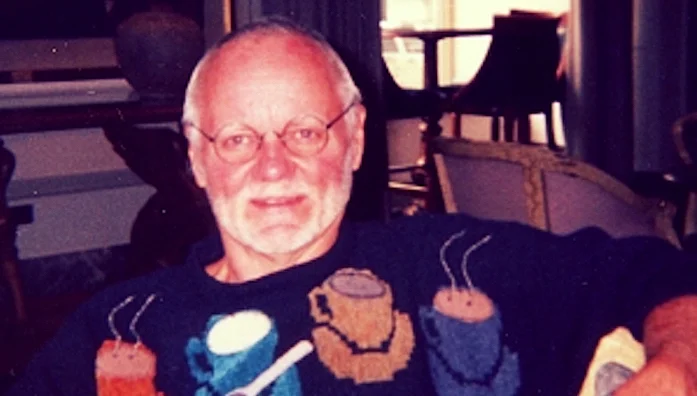
Wallace Tomchek at the Chicago Hilton, summer 1997. (Photo: Earl Hagen)

Wallace Tomchek at the Chicago Hilton, summer 1997. (Photo: Earl Hagen)

THEME

I was drawn to the piano at the age of seven because my older brother Kevin, whom I idolized, was a gifted pianist. At the beginning of my first lesson, our piano teacher Adam Klescewski sat me down on the piano bench backwards and commanded me to sing an A, which I did. I possessed absolute pitch. I grasped immediately the concept of sharps and flats, and demanded to know what was between the notes. I now retain excellent relative pitch—where did the “perfection” go? I wonder. He taught me the names of the lines and spaces in the treble and bass clefs: “Every Good Boy Does Fine; FACE; Good Boys Do Fine Always; All Cows Eat Grass.”

I didn’t like practicing. (I still don’t.) I began paying my other brother Britt—who ratted me out anyway—a dollar to tell our mother that I had practiced. He’d tell her anyway. Then, he’d say, “No-no-no, this time I promise I won’t tell her you didn’t practice!” So, what began as a bribe turned quickly into extortion. Even early on, Britt had skills. After a few months, the little spinet with the feather-light action lost its appeal. During my final lesson, I noticed digits tattooed on my teacher’s forearm. The same afternoon, I discovered on a very high shelf, along with a lot of other books about the Holocaust, an oversized book of tenebrous, horrifying concentration camp photographs called Despotism. I returned to the book obsessively. That a man who had experience such horror could make such beautiful music, create such beauty, despite all, seemed unimaginable—just impossible to me.

VARIATIONS

Shortly after that, I quit the piano for trumpet. Well, I longed not so much to play the trumpet as to be Herb Alpert. I thought there was no cooler man. Anyway, I at least wanted to be the sort of boy that played the trumpet.

Between gigs, dashing, floridly over-qualified Harry Shoplas taught band at Linfield Elementary School. He played a shiny Selmer trumpet, which he often carried tucked under his arm as he walked the school’s halls, leaving behind him the smell of Aqua Velva and valve oil. The female teachers must have regarded him ravenously. Between classes, he smoked cigarettes in a basement lair that he shared with Norman Cummings, the second-coolest teacher at the school.

Harry sized me up and handed me a euphonium I think because I was overweight and looked like I could lug it back and forth to school. He quickly switched me to alto saxophone—Britt played the baritone saxophone in Harry’s dance band and I aspired to playing with him. I loved the smell of wet reeds, and the taste of the cane, but I could never get the thing to play softly. Our fifth grade band concert closed with a Bert Kämpfert tune called Spanish Eyes, which I recall vividly because it was the last thing I played on the saxophone.

One afternoon, Shoplas took our band to a Milwaukee Symphony Orchestra concert that included the Largo of Antonin Dvořák's Ninth Symphony. Nixon had just won the ’68 election and my favorite toy was a plastic Apollo 7 model. But it wasn’t snowing; it was warm, and raining pitchforks. Small and awestruck in a plush red velvet seat in Uiehlein Concert Hall, I was mesmerized by the conductor, Kenneth Schermerhorn. He cut a strikingly handsome, athletic, charismatic figure, and when he raised his arms it was easy to imagine that he was celebrating the Eucharist. In fact, he radiated the authority of a minister, but his back was to us, and there was a sensuality to his movements when he initiated the glittering array of brass instruments, sumptuous strings, and bird-like woodwinds that stirred me. The concert hall was like a cathedral, the audience like a congregation, and the communion—despite the profane context—spiritual. As Stephen Colburn played the ravishing English horn solo in the Largo of the Dvořák, I felt a lump in my throat, a profound sense of longing, the feeling of being tugged out of myself and suspended in midair. That was the moment, at age seven, that I knew that, no matter what, I would be a composer.

On a September afternoon 35 years later, Kenneth and I lunched before a concert on which he conducted my Much Ado overture with his Nashville Symphony. Did he remember the fan letter from the dazzled child who couldn’t find a word grand enough to describe how moved he had been by the experience? He laughed and said no. I told him what I had written: “Dear Maestro, your performance last week was just superfluous!” He exploded in grainy, rueful laughter, and mused, “How like coming home it feels to finally work together.” “And how ironic, under the circumstances,” I replied, “that the Largo was adapted into a song by Harry Burleigh called Going Home.” “Indeed,” he agreed, smiling. We swapped stories for another hour, laughing until we cried. “I am neither a young nor a healthy man,” he sighed, wiping his eyes, “but I am glad that we are finally sitting together now at this table.”

In retrospect, I’m not surprised that—sitting in Uiehlein Hall trying to decide which of the many instruments on stage I would most like to play—I decided to become a composer first and a performer second. It was because Father had unintentionally taught me that although Power can compel, it does not last; Mother had by example taught me that Authority could inspire, and therefore last forever. Like Love, Authority must be earned. Every time a new piece of music is read for the first time the composer starts with all of the Power and no Authority. If the music inspires and moves the performers, then the composer’s Authority grows. If it does not, well, as Virgil Thomson once told me, “Don’t worry about withdrawing pieces, baby; they have a way of withdrawing themselves.”

I received a lot of encouragement from my grade school teachers. When Jesus Christ Superstar dropped in the States, Kevin bought the LP’s. Mr. Germanson allowed me to play it for the class. When I followed that up by playing the “God Said” trope from Bernstein’s MASS, though, letters from angry parents prompted a telephone call from the principal, Mr. Buege (pronounced “biggy”) to Mother, whom family lore holds told him that it was 1968 and that he had better get hip.

At ten, when the other adolescent Lutheran boys were getting their first frisson from contact with the King James Bible, Nicolai Rimsky-Korsakov’s Principals of Orchestration called out to me at the Brookfield Square Mall Walden Books. I carried it around everywhere the way a gunslinger packs his pistols.

Music was my religion, but I had still to find a proper celebrant. Wallace Tomchek was the first person I met with the requisite charisma. Wally taught chorus and drama at Pilgrim Park Junior High School. A short Jewish homosexual who closely resembled Norman Mailer with curly auburn hair and a slight potbelly, the ferocity of Wally’s passion for—and absolute commitment to—musical excellence was terrifying and irresistible. I loved him for it. When I was 15, He taught me, and accompanied me in performing, the first art song I learned and sang—Norman Dello Joio’s 1948 There is a Lady Sweet and Kind. Wally introduced me to the world in which poetry and music inextricably intertwine.

One afternoon, he called me into his office and commanded me to recite my (then) favorite poem. I launched into James Weldon Johnson’s great narrative poem The Creation. After I had declaimed about ten lines, he cut me off. “Really?” he asked, incredulous. “That’s your favorite poem?” I shrugged. “Well. Okay,” he said. “Now set it to music.” Over the next few months, I made of it an ambitious piece of juvenilia—a 25-minute-long cantata for four soloists, mixed choir, five violins, piano, and large symphonic band.

I began setting poetry to music, grafting my tunes with the poetry I have most loved. My first settings were of poetry by Poe, Whitman, Rossetti, Frost, and Joyce from a Harcourt anthology of British and American poets edited by Louis Untermeyer that I turn to for poems to this day. I have since set over 250 poems short and long, written dozens of works for chorus and multiple voices, and set libretti by Edward Albee, Barbara Grecki, Rob Handel, J.D. McClatchy, Gardner McFall, Paul Muldoon, and myself.

The challenging, college-level choral repertoire Wally taught us was both sophisticated and eclectic—Gesualdo madrigals, slick “swing choir” arrangements of tunes like Johnny Mercer’s Dream in nine part close harmony, and a yearly fully staged musical with orchestra which he designed, directed, rehearsed, and conducted. He also encouraged me to direct: I recall with particular fondness directing, among other things, a production of Thornton Wilder’s The Happy Journey to Trenton and Camden for him.

I was fifteen when Wally took our class on a field trip to a screening of the movie version of the musical 1776. William Daniels’ portrayal of John Adams—part Orson Welles, part William Shatner—enthralled me. I adopted as my credo an actual Adams quotation: “There are only two creatures of value on the face of the earth: those with the commitment, and those who require the commitment of others.” I solemnly swore to myself that for the rest of my life whatever I lacked in musical talent I would make up for in hard work and commitment.

It being the bicentennial year, Wally mounted a patriotic pageant called Spirit of ’76, “a rock celebration for young Americans,” with music by gospel songwriter Paul Johnson. Our troupe toured around the southern half of Wisconsin, performing it in American Legion halls, high schools, and nursing homes—even the Milwaukee County Mental Health complex. I recall a performance there, gazing out over the audience of six hundred psychiatric patients, gripping my microphone in as close an approximation of Mick Jagger as I was able, and squealing “let freedom ring” in my white polyester pants and bicentennial logo tee shirt. Halfway through my number, careening up the center aisle, arms flapping like the wings of a pelican, a lone patient joined me—delirious, rapturous—in song. He was exquisite, florid, a soaring thing in his own universe. I couldn’t take my eyes off him. As I launched into the chorus, I glanced at Wally, whose arms flapped also like a pelican’s wings in front of the little pit orchestra. At that instant, two orderlies converged on the patient. Every eye onstage and in the audience followed him as he was frog-marched out of the auditorium, ecstatic.

Afterward, Wally drew me aside . “Did you see that?” he exulted, eyes glittering. “Did you?” “How could I miss it?” I answered. Wally continued, ignoring me, “Remember that moment! Look at what he achieved! Think about what you just witnessed, what you—what we all—just went through … together we made that moment! Sure, the stakes change, but the hands don’t! Now that’s live performance!” Whether seated in a Greenwich Village piano bar covering show tunes while coping with “handsy” patrons, putting my own operas over from the piano for wealthy commissioners, being admonished to keep better time by ballet teachers, playing at villas in France and Italy for diplomats and scholars, performing onstage at Curtis or countless other concert halls, accepting the condescension of famous singers with big egos while coaching them, accompanying Gilda in Nicaraguan folk songs on a frail German spinet for a tombola in Nicaragua, or guiding my sons’ small fingers through “Twinkle, Twinkle” at the family piano, Wally’s exhortation has never been far from my mind.

That year Wally raised the money to bring the Florentine Opera’s young artists out to Pilgrim Park Junior High School to perform Gian Carlo Menotti’s The Medium. It was the first opera I saw live. The performance, the entire student body, was riveting. To this day I remember the haunting refrain, and the music to which it is pinned: “Toby, Toby, are you there?”

The next year, I began putting together a music curriculum myself to run in tandem with my high school classes, enrolling in advanced music theory instruction at the Wisconsin Conservatory of Music. I was the youngest “adult student” division pupil of Judy Kramer, a no-nonsense, practical musician of great gifts and determination. She assigned Roman Numerals to chords in order to chart harmonic progressions. I bought Arnold Schoenberg ’s Fundamentals of Musical Composition at Schwartz’s second-hand bookshop on Wisconsin Avenue. “Why,” I asked her, “are the numerals Schoenberg assigned sometimes different from Vincent Persichetti’s, or Bruce Benward’s, even though the music is the same?” “Good question,” she replied. “It cuts to the problem with musical analysis.” I sprang the answer I’d formulated the night before: “So you’re saying that music theory is sort of a confidence game. If you can intimidate people into thinking your analysis is correct, then you are correct.” Judy looked out the window and thought a moment before answering. “No theoretical analysis can be empirically proven to be correct except by the terms of the system in which it is defined,” she said slowly. “And, even then, argument is possible.” “So,” I pronounced, gimlet-eyed, with all the grim cynicism I could muster at fifteen, “music theory is people talking about music instead of making it.”

I began composing during classes. (I still dream that I haven’t graduated high school for lack of attendance.) How peculiar I must have seemed, corralling friends after school and asking them to show me how their instruments worked, telling my best-intentioned math teacher (a fascinating man, really, who had taught in Nigeria, Indonesia, and Brazil) Max Hilmer, that “a composer doesn’t need to be able to do trigonometry” when he wondered how someone who could teach himself FORTRAN and COBOL over the weekend in order to ace a computer science exam could exhibit no interest in (or talent for) higher mathematics.

My good friend (Kay's successor) Phil Olsen sent me this scan of a 1979 arrangement of Carole King's 1971 song "You've Got a Friend" that I did for Kay and the chorus. I had just turned 16. I think I based it on a tremendous arrangement that Kay had a recording of -- was it the Air Force Men's Chorus? Anyway, there are a couple of things about having the music that make me smile now. One is my scrawled admonition at the bottom of the page (I was the pianist) "Watch Hartz!" (see, I WAS watching!) and another is my notation "Piano does anything to D-flat over E-flat" four bars before the end.

I’d become so immersed in composing that even the superb musical standard set by my high school chorus teacher Kay Hartzell seemed too low: I was an obnoxious sixteen-year-old, tending bar at night (I was underage, yes), composing during my classes, still fiercely attached to Wally, watching Kay for the slightest musical infraction. I pushed Kay hard to let me write for the chorus, and was furious when she seemed unmoved by the penciled scores that I tossed at her like a young Berlioz before the academy.

When Judy found out that I was having no success in interesting Kay in trying out my music, she wrote a letter to my high school guidance counselor. It read, in part, “I feel that Daron is receiving negative input, as far as his talents go, at school which is a shame. … It is to the advantage of most musicians to read through different styles of music, in addition to material being prepared for performance, and what could be better than the music of one of their peers?” A few months later, Kay relented, and graciously permitted me to conduct in concert the chorus in one of my early compositions.

The instruction I had been receiving from Judy, coupled with the obsessiveness with which I was composing—typically five or six hours a day—vaulted my composing skills way beyond my keyboard skills. To mend that, I began piano lessons with Duane Dishaw, a sweet-natured young man at the Wisconsin Conservatory of Music. Father ferried me to them, forty minutes in each direction. During my lesson, Father waited for me in a tavern and drank. Duane, like my piano teachers, was impressed by how comfortable I was at the keyboard. What he didn’t know was that this was because, the previous winter, Mother had caused Father to agree that, if I were seated at the little spinet in the front room, I could not be disturbed. I began not just composing and practicing at the piano, but eating and doing my homework there.

Because of my love of voices, words, and drama I was drawn to opera. Then, as now, I sang my vocal music, accompanying myself at the piano. Then, I did it because I sensed that the singer and the song must be one. Now, I do it because I know that melody (and by extension all music, arising as it does from the act of singing) must be created acknowledging the physical effort required to produce it. How a singer feels physically when performing a phrase is a crucial manifestation of how he feels. I considered and failed to adapt Cheever’s short story O City of Broken Dreams as a one-act opera, then began sketching a dramatization of Edgar Lee Masters’ Spoon River Anthology. I abandoned that in favor of Through the Glass, into which I poured everything I was absorbing by listening obsessively to Kevin’s LP’s of Benjamin Britten’s Billy Budd, and Peter Grimes, Giacamo Puccini’s Turandot, and Kurt Weill’s Aufstieg und Fall der Stadt Mahagonny.

I was also composing for orchestra, but I’d never played in one. It was time to change that. Harry Sturm, assistant principal cellist of the Chicago Symphony under Fritz Reiner, was hired by the City of Milwaukee to run something called the Park Promenade Youth Orchestra. I played piano in it that year. He must have liked the rake of my sails, for he took me under his bow, devised for me an introduction to the ways of the orchestra. First, I was to play piano in the ensemble for a concert. Second, I was to station myself in various parts of the ensemble and listen to how they interacted as he conducted rehearsals for another concert. Third, I was to take lessons in the rudiments of conducting from his assistant, Michael Kamenski. Fourth, I was to compose, rehearse, and conduct the premiere of a new composition. The result was Suite for a Lonely City—the piece that Mother sent to Leonard Bernstein that inspired a letter from him that changed my life. In his review of the concert, Jay Joslyn, the Milwaukee Journal critic then, wrote that I must have felt like Moses atop Mount Pisgah, looking down from the podium into an orchestral Promised Land as I led my fellow teenagers in the premiere. I really did.

A few months after graduating from high school, I proudly accepted my first professional fee as an orchestrator from John-David Anello, the founding conductor of the Milwaukee Pops and the Florentine Opera Company. Anello was one of Father’s clients. I recall vividly his conspicuously large, majestically chiseled head. He had deeply-set eye sockets, thrusting cheek bones, a noble nose, and a very high, broad forehead atop which flowed backwards a leonine mane of hair. His hands were enormous—bony, gnarled joints bulged like rings from his very long fingers. He was so ugly that he was beautiful. Father took me to his gracious home on Milwaukee’s lakefront one evening after one of our rare joint-appearances at a Mensa meeting. He was a true basso profundo, whose velvety voice rolled out like thunder. Really, he was quite grand. He led Father and me into his study and then turned and asked Father to wait in the next room, which I liked. “My boy, I conduct the Milwaukee Symphony in some outdoor concerts each summer for the county—something I call ‘Music Under the Stars’—and I need somebody to arrange a Burt Bacharach tune for one of them. Your dad says that you can do it.” His heavily-lidded eyes met mine: “Can you?” I was thrilled. I still have the municipal pay stub. The same summer Anello also gave me my first professional conducting lessons, and my firstmusic-copying gig—extracting the solo piano part for the Yellow River Concerto. Several decades later, his daughter contacted me, explained that she now conducted the orchestra at my old high school, and commissioned a piece!

CODA

In 1997, the Chicago Opera Theater revived my opera Shining Brow at the 1400 seat Merle Reskin Theater. The Reskin had risen, by way of the Blackstone, from the ashes of the Iroquois Theater, in which 571 lives were lost in a tragic fire in 1903. It was a perfect venue for director Ken Cazan’s revival.

As the opera’s composer, it was indisputably my Green Room, I thought, happy, secure, with my librettist Paul Muldoon at my side. I wore my first tuxedo, picked up from the tailor at Brooks Brothers only hours earlier, and purchased with some of the cash left over from my retirement annuity. I was about to excuse myself in order to attend an alumni event organized by Curtis across the street at the Hilton when my father and Tomchek entered.

My father had driven Wally, the charismatic chorus teacher who first introduced me to music as a religion when I was fifteen years old in 1976, and who I had not seen in two decades, from Milwaukee to Chicago to attend a performance.

“You look like a young Napoleon in that tuxedo,” observed Wally as he hugged me. His snowy white hair and beard, closely cropped, smelled of lavender soap. He wore a baggy blue sweater with coffee cups of various colors embroidered on it. I laughed, asked, “Did Napoleon wear tuxedos?” “It does look good,” admitted Father. “Where did you rent it?”

“Dad,” I said, placing my fingertips to my temples. Wally motioned for me to sit down. I declined, motioning for him to sit down in my place. “Your father Earl dragged me down here,” said Wally, half-serious. “He told me I couldn’t miss a revival of Shining Brow.”

“You know,” I told him, tearing up, “I think of you, Wally, every time the curtain goes up on one of my shows. I think of how you told me that my responsibility was to ‘make beauty, despite all.’ I’ve tried. I’m trying. Thank you for everything that you taught me.” He removed his round, wire-rimmed glasses in order to wipe tears from them. “Well,” he looked away, “you have no idea how proud your Father is of you. You have no idea.”

Wally died a few months later.

Adam, Wally, Kay, Harry Shoplas, Harry Sturm, Judy, Michael, Duane, Maestro Anello, all firmly and with great compassion, laid the foundations for my life as a musician. Looking back now at the age of fifty-four at what they gave me, it takes my breath away: every one of them taught me to create beauty, despite all. 

On Composing "Shining Brow"

p/c: Karen Pearson

In 1989 I  began composing Shining Brow, an opera in two acts and a prologue about architect Frank Lloyd Wright. It explored the intersection of Life and Art, self-actuation and selfishness. At the time,  I asked my librettist to make this conundrum one of Wright's foremost concerns. Consequently, our Man asks a question that the actual One may never have asked himself: “Can a man be a faithful husband and father and still remain true to his art?”

My librettist Paul Muldoon was born in 1951 in County Armagh, Northern Ireland, and educated in Armagh and at the Queen's University of Belfast. The Times Literary Supplement described him as “the most significant English-language poet born since the Second World War.” From 1973 to 1986, he worked in Belfast as a radio and television producer for the BBC. Since 1987, he has lived in the States.

Robert Orth and Brenda Harris as Wright and Mamah Cheney in a concert performance by the Buffalo Philahrmonic released by Naxos. p/c: Chris Lyons

I met Paul at the Saratoga Springs artist retreat Yaddo during summer 1988. He was brilliant, ambitious, quick to skewer pretension, and impatient with mediocrity. Already it was obvious that he had every intention of becoming a celebrity poet. His hair back then looked as though it were trying to escape. He did not speak English; he produced it. You could practically hear him listening to himself as he talked. Paul was and is a virtuoso performer of his own poetry. He could read a list of names, or ingredients, and, through line readings alone, move an audience in any direction he pleased. 

In summer 1989 I received a call on one of the MacDowell Colony pay phones from conductor and artistic director of the Madison Opera Roland Johnson asking whether I might consider composing an opera about Wright. Paul was reading the newspaper a few feet away. Without thinking, I leaned out of the booth and quipped, “Say, Paul, do you want to write an opera?” A beat later, he replied, “Sure.”

When Paul and I began Brow, we first read everything we could lay hands on about Wright. We reconvened a few months later to co-author at Paul's home in Amherst, Massachusetts a filmic treatment consisting of a dozen pages describing what would happen in each scene. 

I then determined how long each scene (and each section of each scene) would last, and the sort of musical form I would use to underpin the action of that scene. Giving the outline to Paul, I asked him to create a number of core images and literary motifs that I could then graft to musical ideas, along with some “parallel” poems for related characters, so that when I shared their music, the words would be easier to adapt. At one point I needed a straightforward hymn, and he responded by creating his beautiful Goethe gloss, Hymn to Nature.

Carolann Page, creator of the role of Mamah Cheney.

Over the course of eight weeks that winter at the Virginia Center for the Creative Arts, I composed the music for the first act. I wrote the most important sections first, beginning with the last three minutes; then the music that would be associated with the four or five most important dramatic spots (what I call the “emotional nuclear reactors”) in the act; after that, I wrote the connective sections, which could and should be the least musically interesting. Each character existed in a “home” key: Wright in B-flat major; Mamah in E major; Edwin and Sullivan in A minor; Catherine in C major. The lovers’ keys were associated, of course, by the tritone, the “forbidden” interval, and the harmonic fulcrum on which modulation depends.

The most affecting, emotionally expressive tool in an opera composer’s kit is the ability to modulate. Aside from being crucial to maintaining large formal structures, it unlocks “gateways” to new emotional states and signals emotional evolution. I did not really learn how to modulate fluidly until I composed Brow, each of whose characters needed to interact with one another harmonically. I have used the modulatory practices used by Richard Strauss and Richard Wagner in their operas ever since I realized just how eloquent they really are, no matter what the surface style of the piece.

When composing opera, my compositional process has changed little since the early 80s. I retype and reformat the libretto to reflect the underlying musical form in which it will be carried, storyboard it on the wall, and illuminate it with various colored pens and pencils—say, red for one character, blue for another, orange for another; musical / poetic themes and motives that I want to “track” also get colors. Standing before the entire opera tacked up on the wall and dreaming on its entirety is as close as I’m likely ever get to understanding how a painter must feel working on a mural. A real sense of the pallet of ideas at hand is literally rendered in the colors arrayed on the storyboard.

Kevin Kees as Wright in the "Fallingwater Brow."

Once the entire opera is “on the wall” I decide what the most important dramatic moments (the “emotional nuclear reactors”) are in each scene; I specify what the climactic moment of the opera is, work downwards in triage fashion to the least important moment. I do not compose “from left to right.” I compose the music for the most important half dozen moments in the opera first. The music for the rest of the piece then spreads outwards from these key moments like concentric ripples.

Paul and I accepted an invitation from Richard (Dick) Carney, Wright protégé and then managing trustee of the Frank Lloyd Wright Foundation, to stay at Taliesin West in Scottsdale, Arizona, for a few days. After lunch with members of the Fellowship (during which Wright’s recorded lunchtime conversation from decades previous played on a boom box), Paul and I settled into the little house Wright built for his daughter. The sun set as we traded impressions and prepared for a formal dinner at which I sat beside architect and Wright protégé Wes Peters, with whom I had a long, intense conversation about Wright’s relationship with Olgivanna. “Was Mamah Cheney the love of his life?” I asked Wes. “She must have been,” he replied, “but I can only say that after her death, for the rest of his life, he never allowed her to be discussed in his presence.”

After dinner, Dick and I took a long walk in the desert and discussed the sort of opera I intended to compose. A fatherly bear of a man, he gestured to me to sit down on a boulder with him. Sighing, he said, “Well, Daron, I don’t think any of us here want you to compose a dishonest piece. Mr. Wright could be a bastard. Promise me you’ll try to convey his essential ‘greatness’ along with the rest.” I didn’t tell Dick that anybody who sings is rendered sympathetic. Instead, I shook his hand. “A promise, Dick.” He picked up some dirt and threw it. “Fine. Come and stay with us as long as you want to. Soak up the feel of the place. Make Mister Wright sing. I promise you that we’ll not stand in your way.”

Daron Hagen and Stephen Wadsworth at the premiere of "Amelia" by Seattle Opera in 2010. (Photo: Alan Alabastro)

Daron Hagen and Stephen Wadsworth at the premiere of "Amelia" by Seattle Opera in 2010. p/c: Alan Alabastro

Shortly before Christmas, I finished the vocal score of the first act. I needed a “green light” from the Madison Opera board before beginning the second. The next step was to present it to the commissioners in Madison.

“Just two hours ago,” President Bush began, “allied air forces began an attack on military targets in Iraq and Kuwait. These attacks continue as I speak. Ground forces are not engaged.” It was 16 January. The United States had just invaded Iraq. In a huge rehearsal hall customarily used for symphony rehearsals, halfway through playing and singing the first act of Brow for the members of the Taliesin Fellowship and the board of Madison Opera, conductor Roland Johnson asked me to stop at 5:45 so that we could all gather around a portable radio to listen to our President address the nation. “Tonight, as our forces fight, they and their families are in our prayers.”

"Shall we continue this another time?” I asked Ann Stanke. She looked to Dick, who asked me, “Do you have a problem with moving ahead with this presentation?” It seemed absurd to me, under the circumstances, but I needed the money, and would not get paid unless, by pulling off this presentation, I fulfilled the terms of the commissioning contract. “No,” I lied, resuming my seat at the piano and picking up where I had left off.

Dick then pledged that the Fellowship would support my creation of the opera, and Roland “green lit” my moving on to the second act. It was my first taste, at twenty-nine, of what the life of a viable opera composer might be like, and I relished it.

The cast and production team of Urban Arias’ chamber version, “Usonian Brow” in Washington, DC in 2017.

I spent some time at Taliesin, in Spring Green. Edgar Tafel, the best known of Wright’s disciples, decided that he was going to see to it personally that I experienced what it was like “really to live in a Wright House—to duck when you pass through doorways, discover your feet hanging over the bottom of the bed at night, feel the rooms flowing from one to the next in the dark.” He conjured for me the poetry that Wright seems to have been able to spin for clients.  His impersonations of Wright’s speaking voice were—aside from being incredibly funny—crucial to shaping my vocal characterization—particularly Wright’s stilted line readings, and what David Diamond, in a letter to me, described as “…the pontification, the affected dress-ugh-y, like Stieglitz.”

My friend photographer Pedro Guerrero’s reminiscences of Wright’s gentler moments also helped me to firm up the conviction that part of his appeal must have been the ability to project immense vulnerability in private. Dick Carney's descriptions of the tenderness that Wright could display also informed my decision to create the gentle music that underpins Wright’s soliloquies. Dick was a humane and generous man. My treasured former pupil and copyist Christopher Hume had a degenerative spinal condition that required his settling in a town with excellent medical facilities. I suggested Madison. I asked Dick to look out for Chris. He took him under his wing. They remained close for the rest of their lives.

Hagen and librettist Paul Muldoon attend the Arizona Opera revival in 2019. p/c: Stephanie Weiss

The following autumn, in a tiny efficiency apartment at the corner of Amsterdam and 74th Street just off Verdi Square on Manhattan's Upper West Side, over the course of a few months, I wrote in one long delicious stretch the second act. Darynn Zimmer, the soprano who years later recorded the role of Mona in Bandanna under my baton for Albany records, was kind enough to sing through the role of Mamah for me as I composed it.

Like baseball pitchers, most composers have rituals. Mine consisted then of making my world very small and simple when I was writing so that I could keep all of the various motives and ideas suspended in my mind. My scrupulously maintained routine began with morning coffee and a chocolate chip scone from the Korean Market just below my apartment at 303 Amsterdam while reading the New York Times seated on a particular bench in Strawberry Fields. While composing—for exactly four hours by the stopwatch—I drank two bottles of San Pellegrino. Then I would run around the Central Park reservoir (twice: 3.2 miles), and then drink a bottle of San Pellegrino afterwards while walking home. I’d devour two slices of Freddy and Pepper’s pizza (an excellent joint in the basement which is still in business) sitting in Verdi Square, and then spend the evening making a fair copy of the sketches I had made during the day.

Robert Orth as Frank Lloyd Wright in Chicago Opera Theater's revival, directed by Kenneth Cazan.

I've written elsewhere about what it was like to consult with Leonard Bernstein while I composed parts of Brow. One example of how he “got” the musical rhetoric of the opera merits repetition, I think. During Wright’s Act 1, scene one pitch to his future mistress, I quoted the New York, New York rising fourths motive that he had first used in Trouble in Tahiti, and then in On the Town, on the word, “suburbia.” Bernstein chuckled appreciatively.  “Nice lift,” he said, “very Strauss. But you followed it up with stuff that sounds like Ned’s [Ned Rorem] little Frank O’Hara opera. Did I steal that from him for Tahiti or did he steal that from me? I can’t remember. In any event, I know you’re talking about theft by putting stolen music in his mouth, so you should come up with something else there.”

Tim Petty as Wright in the Tulsa Opera revival.

At some point, I pointed out that I had been modeling the character of Wright musically on him, and the relationship between Wright and Sullivan on him and Blitzstein. He got it: “That’s Maria. No, it’s the orchestral play-in to the first scene of Marc’s Regina,” he mused aloud. “Well, yes, I stole it from Marc.” Silence. Sudden grin: “But he stole it from Aaron!”

The Madison Opera had asked me to suggest a stage director for Brow. I asked Bernstein to suggest one. He suggested Stephen Wadsworth, with whom he had just written an opera called A Quiet Place.

The Fallingwater premeire by Opera Festival of Pittsburgh in 2013.

“I’ve written an opera about Frank Lloyd Wright,” I told Stephen on the phone. “I’m looking for someone to bring it to life on the stage. Lenny says that you’re that person. Would you like to come over for coffee and talk about it?” I knew that would get his attention.

That April, we sat cross-legged on the floor of my tiny studio more or less under the piano and in front of the six linear feet of opera scores on the bookshelves and began sounding one another out by pulling scores at random from the shelf and discussing them.

It helped that we both had been compelled to figure out how to work with Bernstein—Stephen as collaborator, me as pupil. Stephen could survive (even enjoy) Bernstein's intellectual death marches; I thrived on his musical pop quizzes. We shared an appetite for conversations that functioned on multiple levels.

Michael Sokol as Wright in the 1993 Madison Opera production.

Michael Sokol as Wright in the 1993 Madison Opera production.

I know now that our first meeting was typical of Stephen’s special way with everyone—warm, clever, completely at ease, and intellectually competitive. His probing eyes habitually sought out mine; his compassionate face was extraordinarily expressive. His long fingers moved restlessly when he spoke. I found charming his ability to italicize what he was saying by giving you a hard, quick stare, and then releasing you. He was fun.

At first, it was the confidence and maturity of his opinions as we stuck our thumbs into scores and played “what’s the most important moment in this scene” that impressed me most. In time, as we grew to know one another better, I realized that what I had interpreted as competitiveness was instead an urgent desire to understand: if an idea intrigued him, he reflexively craved an explanation.

The talents that have served him so well in his illustrious career were already in full play as, over the course of six very long work sessions at the apartment in the Village he shared with baritone Kurt Ollmann, I played and sang through Brow’s score. I was defensive, and needed to be “sold” on every one of the dozen or so alterations to words and music (I had to my mind “finished” the score months previously) that he suggested. I’m not certain now why I fought him so hard—especially since I knew even then that his criticisms were always spot on. Possibly, it was because I wanted to see just how right he thought he was.

For the workshop, the cast and company of Brow gathered at the Bernstein family’s apartment at the Dakota to give for Madison Opera’s donors and staff a workshop performance (piano and two dozen singers) of the complete score. Ann Stanke, The company's founde and the driving force behind the commission, worked the room as Roland powwowed with the singers.

Daron and Arizona Opera revival director Chas Rader Shieber in 1993. p/c: Stephanie Weiss

At my suggestion, the company had capitalized upon the New York press’ interest in visiting the apartment one more time to fill the room with eyes and ears (particularly the national press) that might not otherwise have had any interest in a commission, however laudable, of an unknown composer by a small Midwestern company.

The boundary between life and death blurred in a familiar—even comforting—fashion as I listened to the music I had provided for the character of Wright—consciously referring as it did to Bernstein’s music at key points—was performed in Bernstein’s home. It had been impossible, strolling around Taliesin with Dick (like me, an insomniac) in the wee hours, not to feel Wright’s presence. It had been impossible at Yaddo not to feel the Trask family’s. It had been impossible to walk through the Common Room at the Curtis Institute as a student without feeling the benevolent spirit of Mary Louise Curtis Bok. And it still felt, at the Dakota, as though Bernstein slouched still in the chair in the den, sipping a scotch, pulling on his plastic cigarette holder, growling one of the last things he said to me: “Play and sing that part again, baby—the part that sounds like Marc.”

Everyone involved with the April 1993 opening night of Brow knew that it was going to be a success. 25 years and 7 operas later, I now am acutely aware of how rare that is. That night, at “the rail” of the house, behind the audience, where authors traditionally are allowed to pace, fret, enjoy, and suffer, performances of their work, with Stephen, as the tragic ending of Madison Opera’s première production unfolded.

Frank Lloyd Wright’s final aria. Arizona Opera 2019 revival.

Stephen said, “Look!” “Eh?” I said. “Look at them,” he said, sweeping a hand over the audience, who were experiencing the last few minutes of the opera. “They’re all weeping.”

“Yes, that’s where we want them,” I said. “No,” he said. “That’s where they want to be. You did it. I did it. Paul did it. The performers did it. Communion. We all did it. Together.”

The next morning a telegram from Ned arrived at my hotel, saying, “I always said that you would arrive at twenty.” The reviews were strong, and the consensus was that my career had begun.

"Can a man be a faithful husband and father and still be true to his Art?” In the years since I've come to my own conclusion about the Life vs Art paradigm. Art is to my Life as the MacGuffin is to a Hitchcock movie. While I have become music, my family is my Life. So much so, that I've experienced a parting of ways with most of my colleagues who’ve concluded otherwise. Perhaps Wright came to that conclusion sometime after the point at which our opera left him, pledging to rebuild Taliesin in Mamah Cheney’s memory. Perhaps not. In the long run, it shall probably only have mattered  to the people he loved and who loved him. 

First published in the Huffington Post on 8 August 2016. Read it there by clicking here.

On Composing "Bandanna"

This essay first appeared in the Huffington Post on 14 August 2016. Read it there by clicking here.

In the final tableaux of “Bandanna,” Morales (Othello) strangles his wife Mona (Desdemona) and then takes his own life.

In the final tableaux of “Bandanna,” Morales (Othello) strangles his wife Mona (Desdemona) and then takes his own life.

Writing a prescription for Prozac in autumn 1997, my therapist at the time described my condition as “clinically depressed.” Years before, just after my mother’s death, I’d also been prescribed pills—even electro-shock therapy (which I had violently opposed) had been discussed. My family’s appetite for mood-altering substances, and my fear that medication would “blunt my compulsion to create” had kept me from filling the prescription.

I was all too aware that, as Julia Kristeva pointed out in Black Sun, “depression is the hidden face of Narcissus” and that Christian theology, in which I had been immersed since childhood, considered sadness a sin. Dante even consigned the melancholic to “the city of grief” in Inferno. “The loss of the mother,” wrote Kristeva, “is a biological and psychic necessity, the first step on the way to becoming autonomous. Matricide is our vital necessity, the sine-qua-non condition of our individuation, provided that it takes place under optimal circumstances and can be eroticized.”

Came at this time a commission from the College Band Directors National Association (over a hundred colleges ultimately joined the consortium) for a full-length opera on a subject of my choosing (using a librettist of my choice) by way of a phone call from conductor Michael Haithcock.

I chose Othello as my subject matter in order to explore not just the feelings of betrayal and anger that I still felt towards my ex-wife (we had recently terminated a turbulent and nearly entirely disagreeable ten-year marriage) but also the guilt I still felt, and the incomplete mourning in which I felt caught like a fly in a web, as a result of having been called upon by my terminally-ill mother to euthanize her. In other words, I chose to fight my “battle with symbolic collapse” by creating an opera about it.

I decided to recast the Venetian tale of the Moor in a 1968 Texas-Mexico border town. The result was Bandanna, a two act grand opera. The commission required only that I could not use strings (except for basses) in the pit. I asked Paul Muldoon to write the libretto based, as usual, on a detailed co-written treatment in which I determined the exact length of every section of every scene, and mapped out the structural underpinnings of every scene, aria, and ensemble.

I composed the prologue and most of the first scene of the first act at the MacDowell Colony during January 1998 in Chapman Studio, the most remote of the many cabins dotting the property—fully a mile away from Colony Hall. I would have completed the entire first act there but for the fact that there were 26 inches of snow on the ground. For nearly four hours each day, I slogged through the snow in a decidedly non-meditative frame of mind—the walk to and from the payphone, where I was jacking in to check E-mail and to send Muldoon requests for changes, took over an hour each way.

I wrote the balance of the vocal score at home in New York City. Composer Eli Marshall, a former student and friend, stayed with me for much of the time. My work routine consisted of rising at 7 AM, composing until 5 PM, dining at a nearby burrito joint where I spoke Spanish with the waitress, and copying out the fair score in the evening while drinking a bottle of Antinori Chianti. The vocal score was completed in just over four months.

When I co-wrote with Paul the treatment for the last scene of Bandanna I was entirely aware of the agonizing sequence of matricidal, fratricidal, uxoricidal, and suicidal acts that would be ritualistically enacted. Accordingly, in her concluding Willow Aria, the music that Mona sings is written from the point of view that she already knows that she is dead; the strings that accompany her are, throughout the opera, associated with death, inasmuch as they, unlike the wind instruments featured everywhere else in the score, do not breathe.

The transition from Mona’s aria to her murder features three violins, and it tracks Morales as he crosses the stage with excruciating slowness, to her hotel room door. He is Charon, and he is in no hurry. Morales is Orpheus to Mona’s Eurydice. In fact, both Mona and Morales already intuit what must happen and are now just going through the motions: once Morales opens the door, his deputy Cassidy appears. Morales executes his friend. He then turns, as though in a dream, to Mona. He strangles his wife, who does not struggle, with the opera’s eponymous bandanna. Then, without really pausing, except to muse, “Holy Mother of God,” he kills himself by placing his service revolver in his mouth and blowing himself away.

One critic complained later that “the final scene—the climactic murder-suicide—is anguished to a grotesque degree.” If I could have made it even more grotesque, more like a slow-motion nightmare, I would have, so focused was I on capturing my inner state. While composing it, I felt such an intense sense of closure that, at one point, I actually felt as though my mother was standing behind me at the piano, her hand resting on my shoulder. When the chorus crashes in, they sing “Dona nobis pacem” (pun intended: my ex’s name was Donna) to anything but comforting music. The trombones, in fact, are marked, “blaring like the horns of an approaching semi.”

In those days, I used to send a copy of the vocal score of whichever opera I had just finished to Jack Beeson, who would go through it and make marginal comments very lightly in pencil like “You buried a plot point here. This is an intrinsically slow word: why did you set it fast? Courageous! This is the Nieces from Britten’s Grimes! Watch the passaggio!”

Jack, exclusively published by Boosey and Hawkes and ensconced with tenure at Columbia University, was a major behind-the-scenes power broker during the years that I was coming up. I respected his opera Lizzie Borden and particularly liked Hello, Out There, a trenchant one act. Jack’s knack for setting American English in a way that was understandable across the footlights I admired. His operas rarely blossomed into full-fledged song—something I found as a colleague regrettable. Jack, like the many other powerful old guard colleagues I knew then, never did anything for me, and it never occurred to me to ask him to.

During spring 1998, Jack and I played and sang (and argued) our way through Bandanna one afternoon at his spacious Columbia University faculty apartment while his wife Nora kept the tea coming. “You’re going to take a pasting from amateurs for the male ranges,” he predicted. “The men are slung high. I get it: they are all being macho. I know you want them to sound that way. Moreover, I see you are saving up the sound of the female voice for the final scene. However, you are pushing the limits of verismo writing. Maybe too much.”

A page from the Hagen-Muldoon treatment for "Bandanna" with Daron's hand-written notations.

When Jack asked me a few years later to join him as a trustee of the Douglas Moore Fund for American Opera I asked him why. His answer was cheerfully truculent: “Because you’re not one of my former students, threatening to kill yourself if I do not throw a Pulitzer your way. Also, you are sane, you happen to write good operas that get produced and your expertise is required.”

I orchestrated the first act of Bandanna by hand at the Virginia Center for the Creative Arts during June 1998. The second act I orchestrated mainly at Yaddo the following month, completing it in New York that July. It is the last of my operas whose full score is still in manuscript form. I switched to engraving all of my own music shortly after the farrago that correcting vocal score proofs of the vocal score for Carl Fischer became—an incompetent engraver whose work was so slipshod and inaccurate that I was forced to work through five sets of proofs had been engaged.

Bandanna’s first staging, which served as the centerpiece of the College Band Directors National Association’s national convention that February was a calamity. Upon arrival I learned that the University of Texas graduate students serving as lighting and set designers were unequal to their tasks. The student singers struggled with the roles. A few days into production, the poor fellow singing Kane simply stopped showing up. I watched, like impotent Madam Racquin, as tempos shifted wildly from rehearsal to rehearsal, student singers made up music as they went along.

I contacted Paul Kreider, with whom I had recently performed, along with Carolann Page, selections from Shining Brow at the Guggenheim Museum at the invitation of House Beautiful magazine. Paul had initiated the Vera of Las Vegas opera commission, written his doctoral dissertation on my songs. He was a fearless performer, and a trusted friend. If he couldn’t save this situation, it couldn’t be saved. Paul flew in, and learned the role of Kane in three days. With relief and gratitude, I paid his fee myself.

The premiere production did not represent the work I created. Its first performance (half a dozen players were for some reason absent from the pit for much of the first act) was greeted with what seemed to me to be defensive, uninformed distaste by most of the conventioneers.

Since the band and opera worlds are mutually contemptuous, the constituencies most inclined to produce Bandanna cancel one another out. As Tim Page wrote, “neither fish nor fowl—as fierce as verismo but wrought with infinite care, [Bandanna is] a melding of church and cantina and Oxonian declamation.” Catherine Parsonage expands upon this assessment: “[it] is wholly convincing as a modern opera, ranging stylistically from the music theatre of Gershwin, Bernstein and Stephen Sondheim to traditional mariachi music and contemporary opera of Benjamin Britten. Hagen, who served his apprenticeship on Broadway, acknowledges that holistically the piece falls between opera and music theater. Hagen’s style encourages audiences to be actively involved in constructing their own meanings from the richness of the textual and musical cross-references in his work.”

From the start there were also other colleagues who really got it, like Ukrainian-American composer, pianist, and conductor Virko Baley, who had for years conducted the Nevada Symphony Orchestra and was professor of composition at UNLV. A dynamic, thrilling pianist, tough-minded thinker, and musical swashbuckler, Virko and I had had some great adventures together. I admired him: he knew life, and he wasn’t afraid in his music to offend. He had entirely grasped the fact that Bandanna’s score meant to push people’s limits. “These characters are at the end of their shit,” he told me. “They’re in extremis. That’ll make people who like their opera tame uncomfortable. The whole damned score is unsettling. You got what you wanted, baby.”

The partitura from "Bandanna's" Act I, scene 1 "fistfight" sequence.

A few months before the premiere, presenting the great conductor and promoter of the wind ensemble as a performing group Frederick Fennell with a copy of Bandanna, I asked him how he thought the piece would go over in the band world. Eyes twinkling, he told me that he felt that there were three kinds of band conductors: “First, you have what I call the Educators: they teach high school band and play simplified arrangements of pop songs and movie themes. Then there are the Spit and Polish Men: they play marches, and for them music history stalled around the time of Holst. Finally, there are the Maestros: they could have been orchestra conductors but chose to conduct bands because they love them. These men and women are hungry for new repertoire, and can have a better grasp of the symphonic repertoire than their colleagues can in the orchestra world. Almost none of them know anything about opera, my boy, so your opera is doomed.”

The music of Bandanna, to my mind, not only successfully evoked the morally bankrupt world in which it’s Touch of Evil-infused characters lived, but also gave voice to my own inner world at the time: I was an unhappy fellow at the end of his rope, in a dark place, and looking for a way out. Bandanna addressed and expressed what was then my “truth”—that Life was a shadowy, Conradian “horror” glimpsed during flashes of lurid Malcolm Lowry lightning over Cormack McCarthy landscapes. The music was aggressively at odds with the words that it carried much of the time, like a horse that will not be ridden. Even if I removed the band world from the equation by re-arranging it for orchestra in the pit, Bandanna will never find its niche, perhaps because people like categories and the music draws equally from jazz, musical, and operatic idioms.

Thanks to the efforts of Michael Hitchcock, Paul Kreider, Thomas Leslie, and (owner of my former exclusive publisher, E.C. Schirmer) Robert Schuneman, among others, I was able in 2006 to conduct a complete recording of Bandanna (available on the Albany label) that I felt invalidated the criticisms the score had received.

The reception accorded the staged premiere was counterbalanced by the recording’s accolades from major magazines like Opera News and industry experts like Henry Fogel, who understood what Muldoon and I were trying to achieve. “Bandanna,” Fogel wrote in Fanfare Magazine, “is a poignant, dramatic, and moving new opera, one that belongs in the repertoire not because it deals with the politically hot topic of illegal immigration, but because it is powerful music theater.”

Among my operas, Bandanna shall always have been for me that problem child—the one that was too much like me to get perspective on; the one I listen to even now, 20 years later, through rueful tears as it gallops off into its own, self-immolating sunset of love and loss.

Learn more about Bandanna here.