
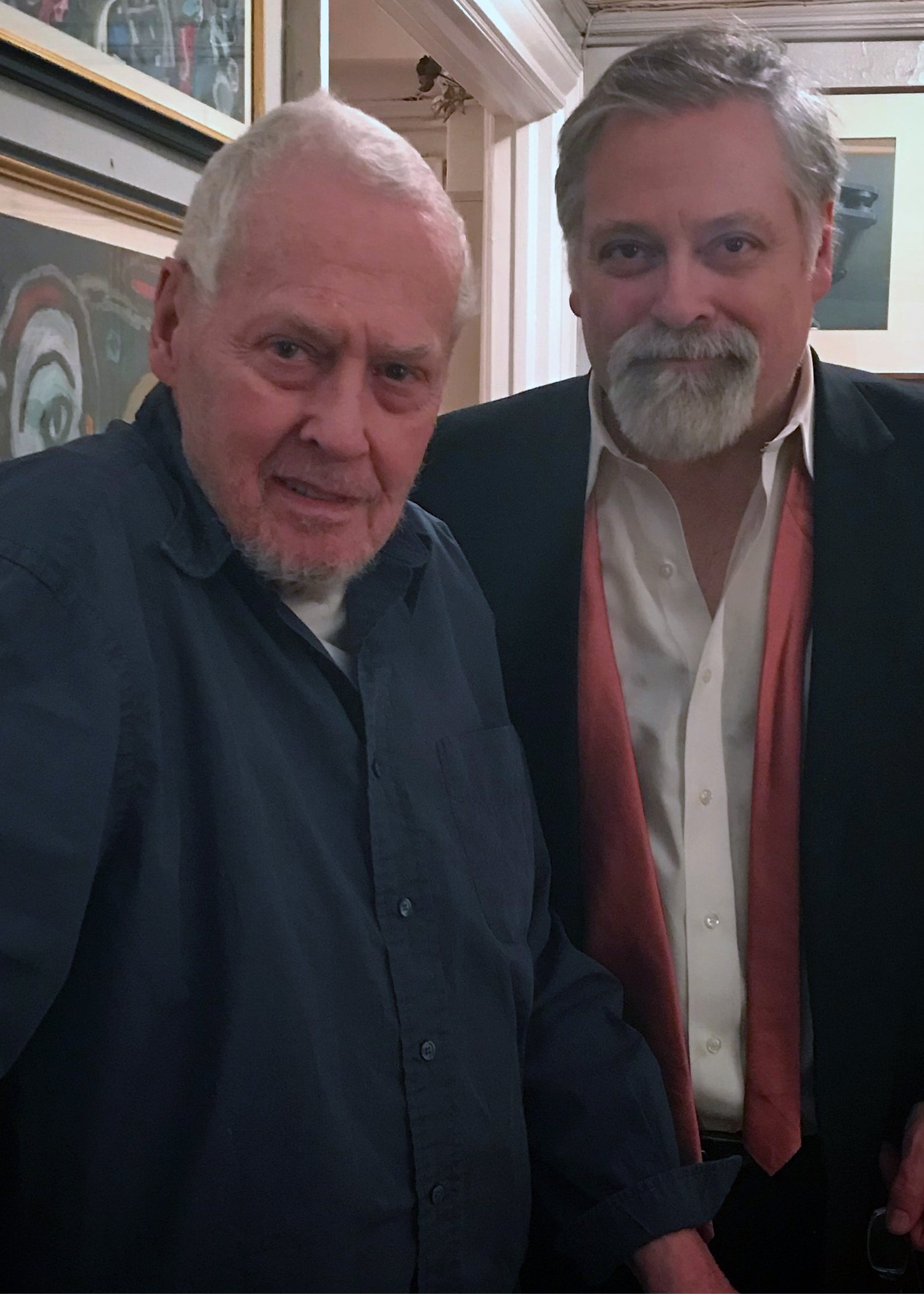
On Ned Rorem (1923-2022)

29 January 2018 p/c: Mary Marshall

From the Minors to the Majors (1981-1991)

Although Ned Rorem remains famous for having an opinion — sculpted into an aphorism — on almost everything, he never said or wrote a word that I know of about baseball. The closest I think he ever got was his setting of his frequent collaborator Paul Goodman’s poem “Boy With a Baseball Glove” in his massive Evidence of Things Not Seen, and that poem’s really about the “effortless poise of youth,” not baseball, which was distinctly outside of his aesthetic universe. Fiercely un-athletic Ned, who I recall demonstrating his physical dexterity only once, but then on the Dick Cavett Show, by walking on his hands, a display I viewed on a four-inch-wide portable television while an undergraduate at UW-Madison in summer 1980.

It isn’t that Ned didn’t have anything to say about baseball.  He didn’t write about baseball because baseball didn’t say anything about him. Just as this article about Ned Rorem will be more about me than Ned, everything Ned wrote was really about himself. But enough about me.

Giving a phone interview just before my lesson three years later, he delivered a biting zinger to the New York Times about avant-garde composers going neo-tonal. He scoffed that they were like people applauded for giving up smoking while those who never took it up were ignored. Yet, standing in the dugout as his pupil, my job was not just to learn how to pitch, but to observe as the Master's own pitch sequence evolved. The early, diatonic, Francophilic lyricism of the songs of his that I loved as a teenager had been enlivened by tone rows and chromatic saturation. Like a veteran pitcher expanding his repertoire to stay in the Show, Rorem's music had evolved as he assumed his place as an elder statesman at Curtis. By inviting me to study with him at Curtis, he had pulled me up from the minors, showing me not just how to survive in the Show, but how to command the mound.

At a place like the Curtis Institute — where every student has been provided with a full scholarship since 1928 — the pursuit of absolute perfection demands a psychological currency, not a financial one. No more sandlot busking; you were handed a locker in the ultimate clubhouse. But that membership required trading the exquisitely mediocre pleasures of the minor leagues for the crushing pressure of being groomed as a thoroughbred. You were prepared for the social and professional elite, then assigned your role in the Show. But the stakes were brutal: you graduated only when your teacher said you were ready. You could be dismissed at any time, sent down to regional orchestras, semi-professional opera companies, or worse — a teaching job.

Ned taught for two years at SUNY Buffalo and two more at the University of Utah, famously declaring that after that amount of time, “a teacher begins to believe what he says.” I was one of his first three students at Curtis, where he ultimately broke his own rule and taught for over two decades. He was quite open about his mixed feelings regarding pedagogy, outlining them in his 1993 Opera News piece, “Learning With Daron.” His brutality as a teacher was no doubt informed by how he, a product of both Curtis and Juilliard, had been treated by his own mentors: Gian Carlo Menotti, who was a massive influence, and Rosario Scalero, whom he found stifling. While he never talked about studying with Bernard Wagenaar at Juilliard, he worked as a copyist for Virgil Thomson in exchange for lessons and occasionally referred to David Diamond as “more than a friend — a mentor.”

“Do any of you write?” he asked my classmates Norman, Robert, and me one afternoon. I hazarded sharing a review of a concert I had written as a freelancer for a local Philly paper. He read it back to us, pausing after each sentence to comment upon it, dissect it, and dismiss it. That was a tough day. I didn’t share my writing with him again until spring 1984, when, having had some success with a manuscript that my friend and writing mentor Emily Wallace had shared with Joel Conarroe, then Dean of the Faculty of Arts and Sciences at the University of Pennsylvania, I presented a copy to Ned. I wrote about it, thirty years later, in my memoir:

Taken aback, he flipped through it and placed it carefully on a pile of papers on his red dining room table. “I’ll read it, Daron,” he promised. I thought myself rather brave. “But I haven’t much hope for it.” I deflated. “Why?” I asked, sincere. He had evidently formulated a summing up of me for my character prior to our final meeting, and now, he delivered it, suavely wrought, an opinion stated with all the simple conviction of fact: “You tell people what you think they want to hear. Since you’re bright, you’re usually right. But sometimes you’re not.” It occurred to me then that I felt psychically the way that I had felt physically the night that I sliced off a knuckle into some corned beef.  There was blood everywhere, of course; but the blade was so sharp that I never felt it. In fact, it was the single cruelest thing that Ned ever said to me —and probably the most therapeutic. A few days later I had Ned’s letter —

“I read your whole diary in almost one fell swoop and was quite impressed. Diaries are dangerous, being the most subjective of literary forms (and subjectivity is boring), but yours makes it, and is the real thing…. When we are next together we can talk more. Meanwhile, know that I was truly moved by much of it.”

Afterwards, Emily took me to lunch and shared Joel’s take. “Tell Daron that, if he’d like to kick off a great literary career and kill his music career at the same time," he had said, "I’ll be happy to pass it along to an agent in New York.” While Ned had secured his place as an “intellectual social arbiter” with the 1966 publication of The Paris Diary of Ned Rorem, times had changed. There was no way I was going to compete with Ned on his own turf. So I kept the manuscript in a drawer, working on it for another fifteen years before parts of it finally ended up in my 2019 memoir, Duet with the Past.

Home Runs (1992-2012)

After establishing myself by fulfilling a handful of commissions from big orchestras and winning some prizes, I officially stepped onto the national operatic stage in 1993 with the success of Shining Brow. I knew it was so because Ned marked the opening night with a charming telegram telling me that it was — literally a telegram, in that old Western Union teletype font, the letters uneven and herky-jerky above and below the horizon, reading: “Congratulations Daron I told you that you would arrive at 23 Love Ned.”

My career began in 1981 when the Philadelphia Orchestra premiered Prayer for Peace. It was an earnest, Transatlantic piece that any serious tonal composer could be proud of — and I was. Though pushed to keep writing that same piece, I rebelled. As my farewell to Curtis, I offered a jazzy Divertimento built on a bebop head by Les Thimmig, the teacher who had launched me as a UW-Madison undergraduate. It was a deliberate provocation. Bringing pop music into Curtis Hall was a mortal sin back then; even George Rochberg’s polystylism was shunned. Yet my piece was a deadly serious attempt to reconcile my Midwestern love for the "low" '70s L.A. Sound with the dominant, "high" academic ideology of the East Coast. In this, I followed Les, who had fought to bridge his Yale modernism with his roots as a jazz saxophonist.

Critics like Paul Griffiths at The New Yorker used Brow’s unabashed eclecticism to point out that I was failing to toe the "Transatlantic" line. I paid them little mind. Louder, more understanding voices like Leonard Bernstein's recognized my sincerity and my use of musical allusions to build a meta-narrative. This metamodernist trajectory began publicly at my final student premiere in April 1984 at Curtis Hall. Even at that early stage, I was drawn to the ebullient stylistic freedom of Lukas Foss over Ned’s curated, late-century intellectual elegance.

During the late ‘90s and early aughts, I worked as a professional hand music copyist in Manhattan. I served as Ned’s personal amanuensis alongside a fistful of other prestigious clients. As a colleague and fellow hard worker, Ned was proud that he had worked for Virgil as a copyist exactly forty years before I had worked for Virgil as an arranger. But this shared history could lead to problems. One night at Yaddo my name came up in conversation. Ned deftly recharacterized me as merely his copyist rather than his colleague. When I heard about it, I yelled at him, and he stopped that sort of thing.

Around that time, Ned’s masterwork, Evidence of Things Not Seen, premiered, launching him into a phase of legacy and summation. While he cemented his reputation with that massive, evening-length cycle, I was carving out a guildsman’s career as a practical, working musician. I focused increasingly on lyric theater, composing operas like Vera of Las VegasBandanna, and Amelia, alongside over a hundred new songs. It annoyed him when I accepted commissions from groups he had just worked with. For instance, a piece I wrote for the King’s Singers made him jealous enough to snark on it in his diaries. But writers settle scores; that is simply the price of knowing one.

Ned, Gary Graffman, and David Diamond took me to dinner across the street from Curtis. We chatted about trying me out as a faculty member to occasionally teach Ned's students. Everything worked out as it had to. Any questions about whether the Curtis Institute was the right fit for me were answered by my opera Vera. Its furious, relentlessly allusive score — coupled with the stylized, filmic subversiveness of my piece Much Ado — moved Ned to acknowledge that, while I was never going to be a manageable, Establishment-affirming team player, what I was doing took real passion, skill, and guts.

In 2003, Ned retired from Curtis after twenty-three years. At that exact time, I was skidding through a divorce while winding down what had become a ten-year stint teaching composition at Bard College. My schedule was relentless; at one point, I was teaching simultaneously at Curtis, City College, the Princeton Atelier, and Bard. Yet our relationship was no longer defined by academic schedules or institutional hierarchies. Ned once told me, “No matter how long we know one another, I’ll always think of you as my student.” But after his partner James Holmes died in 1999, Ned admitted that any debt I felt I owed him for bringing me to the East Coast was paid in full by the care I gave Jim at the end. This was a characteristically unsentimental but deeply moving acknowledgment of how far our relationship had evolved.

In my 40s and Ned’s 70s, we frequently discussed the differing paths our careers had taken. While my focus was on building community — serving as president of the Lotte Lehmann Foundation and running music festivals — Ned became the ultimate establishment figure, serving as president of the American Academy of Arts and Letters and speaking and writing as a revered public intellectual. Even though my metamodernist aesthetic, embracing polystylism and intermedial works was directly in opposition to the traditionalism and cultural elitism that Ned had defended throughout his life, he gave me credit for having found my own voice and going my own way. As arts funding decreased and the old, reliable gatekeepers lost their authority, Ned turned 80, and Gilda and I moved our family Upstate to raise our kids. Fatherhood became my central focus, and my journey into operafilm began taking me way out of Manhattan’s orbit.

Stealing Home (2012-2022)

Between 2013 and Ned’s death in 2022, our trajectories reflected a profound contrast in generational artistic response to aging. For Ned, it was a decade of intentional, quiet deceleration and the peaceful guarding of a monumental legacy. For me, it was a period of deep fulfillment as a father and husband, counterbalanced by relentless, restless artistic reinvention. As the traditional musical establishment declined — or simply took up new enthusiasms — I turned to new visual and technological mediums, actively pivoting from staged opera and embracing operafilm.

As Ned entered his nineties, he famously declared that he had said everything he needed to say and was content to let his enormous catalogue speak for itself. Nearly forty years younger than Ned, and with my sons moving into their teens, my reaction to advancing age and the realities of heart disease was precisely the opposite.

As writers we could not have been more different but, in the end, both perfectly reflect our sensibilities: Ned’s polished, detached elegance reached for sculpted aphorisms; my grounded prose braids memory and technical fluency into raw narratives. Bernard Jacobsen once likened Ned to a fox and me to a hedgehog. I sort of agree. But, if I am a hedgehog, then I am one who dreams a fox’s dreams. Surely then it must follow that the fox dreams a hedgehog’s dreams. Who knows? In the end, Ned and I did the work to meet up somewhere in the middle.

When I published my memoir, Duet with the Past, in 2019, facing heart disease squarely made my own mortality feel like a ticking clock. If Ned's response to the encroaching twilight was Quaker silence, mine was a fierce understanding: to document a complete summation of my theatrical vision, I could no longer wait around for establishment institutions to grant me at-bats.

I concluded that, to leave nothing on the field, I had to abandon it and build my own. I threw myself into developing a new subgenre of opera and film that I called “operafilm”. Acting as an independent auteur, I served not just as composer, but as storyboard artist, director, and editor. This race against time yielded my Bardo Trilogy — a highly concentrated exploration of the threshold between life and death.

Ned’s pleasure in pastry from Soutine’s (now closed), a little pocket patisserie down the street was common knowledge. He loved sweets. Arriving with a box of them guaranteed an impish smile through the crack in the door. That said, the renowned sensualist’s daily lunch of a peanut butter sandwich and a can of Ensure year in and out clearly served him; when he died in November 2022, he had lived but one year shy of an entire century.

Three years after his death, my open-heart surgery stands as a success, the Bardo Trilogy is complete, and “operafilm” has launched with my new manifesto, Exploring Operafilm, to anchor it. With my boys getting ready for college and my strength returning, I am contemplating another major artistic shift — perhaps, having stolen home, I am just going to keep running. But for now, a quodlibet for Ned:

He was pleased when guests arrived precisely at the appointed hour. He liked it when I played and sang my songs for him. He was a suave, quietly enchanting crooner who would play Harold Arlen from memory. He lit up when Barbara Grecki entered the room, and he treasured Mary Marshall and Shirley Perle. He knew everybody. He could be willful, petulant, and nasty. I knew how to make him laugh. He forgave me repeatedly for things I said to him. And I forgave him.

Those of us who knew him all cherish memories of Wallace the cat, Sonny the Bichon Frisé, and Jim serving juice mixtures made by combining whatever was left in the refrigerator. I remember the night Ned visited me in my apartment on St. Mark’s Place, rose from the couch, and brained himself on the low, angled ceiling of my garret — sitting back down, stunned, and then bursting out laughing. I remember how consistently he treated my son Atticus, even at the age of three, like an absolute equal. I remember painting the ceiling of his office blue one summer while he insisted on answering letters at his desk directly below. I remember finding a sliver of raw onion in the whipped cream atop a banana cream pie I had baked and carried up to New York for him and sitting with Norman Stumpf at the red table listening to Robert Convery taking his lesson in the living room. Or performing “Emily’s Aria” from his Our Town with Gilda — getting to be the first people to do that — and treasure his description of my mother’s face when they shared a table at the Barclay before attending my Curtis debut.

He was as kind to me as I deserved, and I was to him. I understood him when he would say, once in a while, that in the end, it was more important to be understood than it was to have been loved.
On Teachers

This essay appeared first in the Huffington Post on 11 August 2016. Click to read it there here.

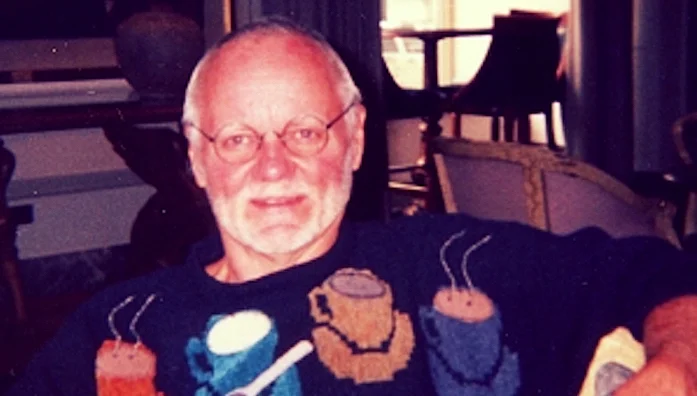
Wallace Tomchek at the Chicago Hilton, summer 1997. (Photo: Earl Hagen)

Wallace Tomchek at the Chicago Hilton, summer 1997. (Photo: Earl Hagen)

THEME

I was drawn to the piano at the age of seven because my older brother Kevin, whom I idolized, was a gifted pianist. At the beginning of my first lesson, our piano teacher Adam Klescewski sat me down on the piano bench backwards and commanded me to sing an A, which I did. I possessed absolute pitch. I grasped immediately the concept of sharps and flats, and demanded to know what was between the notes. I now retain excellent relative pitch—where did the “perfection” go? I wonder. He taught me the names of the lines and spaces in the treble and bass clefs: “Every Good Boy Does Fine; FACE; Good Boys Do Fine Always; All Cows Eat Grass.”

I didn’t like practicing. (I still don’t.) I began paying my other brother Britt—who ratted me out anyway—a dollar to tell our mother that I had practiced. He’d tell her anyway. Then, he’d say, “No-no-no, this time I promise I won’t tell her you didn’t practice!” So, what began as a bribe turned quickly into extortion. Even early on, Britt had skills. After a few months, the little spinet with the feather-light action lost its appeal. During my final lesson, I noticed digits tattooed on my teacher’s forearm. The same afternoon, I discovered on a very high shelf, along with a lot of other books about the Holocaust, an oversized book of tenebrous, horrifying concentration camp photographs called Despotism. I returned to the book obsessively. That a man who had experience such horror could make such beautiful music, create such beauty, despite all, seemed unimaginable—just impossible to me.

VARIATIONS

Shortly after that, I quit the piano for trumpet. Well, I longed not so much to play the trumpet as to be Herb Alpert. I thought there was no cooler man. Anyway, I at least wanted to be the sort of boy that played the trumpet.

Between gigs, dashing, floridly over-qualified Harry Shoplas taught band at Linfield Elementary School. He played a shiny Selmer trumpet, which he often carried tucked under his arm as he walked the school’s halls, leaving behind him the smell of Aqua Velva and valve oil. The female teachers must have regarded him ravenously. Between classes, he smoked cigarettes in a basement lair that he shared with Norman Cummings, the second-coolest teacher at the school.

Harry sized me up and handed me a euphonium I think because I was overweight and looked like I could lug it back and forth to school. He quickly switched me to alto saxophone—Britt played the baritone saxophone in Harry’s dance band and I aspired to playing with him. I loved the smell of wet reeds, and the taste of the cane, but I could never get the thing to play softly. Our fifth grade band concert closed with a Bert Kämpfert tune called Spanish Eyes, which I recall vividly because it was the last thing I played on the saxophone.

One afternoon, Shoplas took our band to a Milwaukee Symphony Orchestra concert that included the Largo of Antonin Dvořák's Ninth Symphony. Nixon had just won the ’68 election and my favorite toy was a plastic Apollo 7 model. But it wasn’t snowing; it was warm, and raining pitchforks. Small and awestruck in a plush red velvet seat in Uiehlein Concert Hall, I was mesmerized by the conductor, Kenneth Schermerhorn. He cut a strikingly handsome, athletic, charismatic figure, and when he raised his arms it was easy to imagine that he was celebrating the Eucharist. In fact, he radiated the authority of a minister, but his back was to us, and there was a sensuality to his movements when he initiated the glittering array of brass instruments, sumptuous strings, and bird-like woodwinds that stirred me. The concert hall was like a cathedral, the audience like a congregation, and the communion—despite the profane context—spiritual. As Stephen Colburn played the ravishing English horn solo in the Largo of the Dvořák, I felt a lump in my throat, a profound sense of longing, the feeling of being tugged out of myself and suspended in midair. That was the moment, at age seven, that I knew that, no matter what, I would be a composer.

On a September afternoon 35 years later, Kenneth and I lunched before a concert on which he conducted my Much Ado overture with his Nashville Symphony. Did he remember the fan letter from the dazzled child who couldn’t find a word grand enough to describe how moved he had been by the experience? He laughed and said no. I told him what I had written: “Dear Maestro, your performance last week was just superfluous!” He exploded in grainy, rueful laughter, and mused, “How like coming home it feels to finally work together.” “And how ironic, under the circumstances,” I replied, “that the Largo was adapted into a song by Harry Burleigh called Going Home.” “Indeed,” he agreed, smiling. We swapped stories for another hour, laughing until we cried. “I am neither a young nor a healthy man,” he sighed, wiping his eyes, “but I am glad that we are finally sitting together now at this table.”

In retrospect, I’m not surprised that—sitting in Uiehlein Hall trying to decide which of the many instruments on stage I would most like to play—I decided to become a composer first and a performer second. It was because Father had unintentionally taught me that although Power can compel, it does not last; Mother had by example taught me that Authority could inspire, and therefore last forever. Like Love, Authority must be earned. Every time a new piece of music is read for the first time the composer starts with all of the Power and no Authority. If the music inspires and moves the performers, then the composer’s Authority grows. If it does not, well, as Virgil Thomson once told me, “Don’t worry about withdrawing pieces, baby; they have a way of withdrawing themselves.”

I received a lot of encouragement from my grade school teachers. When Jesus Christ Superstar dropped in the States, Kevin bought the LP’s. Mr. Germanson allowed me to play it for the class. When I followed that up by playing the “God Said” trope from Bernstein’s MASS, though, letters from angry parents prompted a telephone call from the principal, Mr. Buege (pronounced “biggy”) to Mother, whom family lore holds told him that it was 1968 and that he had better get hip.

At ten, when the other adolescent Lutheran boys were getting their first frisson from contact with the King James Bible, Nicolai Rimsky-Korsakov’s Principals of Orchestration called out to me at the Brookfield Square Mall Walden Books. I carried it around everywhere the way a gunslinger packs his pistols.

Music was my religion, but I had still to find a proper celebrant. Wallace Tomchek was the first person I met with the requisite charisma. Wally taught chorus and drama at Pilgrim Park Junior High School. A short Jewish homosexual who closely resembled Norman Mailer with curly auburn hair and a slight potbelly, the ferocity of Wally’s passion for—and absolute commitment to—musical excellence was terrifying and irresistible. I loved him for it. When I was 15, He taught me, and accompanied me in performing, the first art song I learned and sang—Norman Dello Joio’s 1948 There is a Lady Sweet and Kind. Wally introduced me to the world in which poetry and music inextricably intertwine.

One afternoon, he called me into his office and commanded me to recite my (then) favorite poem. I launched into James Weldon Johnson’s great narrative poem The Creation. After I had declaimed about ten lines, he cut me off. “Really?” he asked, incredulous. “That’s your favorite poem?” I shrugged. “Well. Okay,” he said. “Now set it to music.” Over the next few months, I made of it an ambitious piece of juvenilia—a 25-minute-long cantata for four soloists, mixed choir, five violins, piano, and large symphonic band.

I began setting poetry to music, grafting my tunes with the poetry I have most loved. My first settings were of poetry by Poe, Whitman, Rossetti, Frost, and Joyce from a Harcourt anthology of British and American poets edited by Louis Untermeyer that I turn to for poems to this day. I have since set over 250 poems short and long, written dozens of works for chorus and multiple voices, and set libretti by Edward Albee, Barbara Grecki, Rob Handel, J.D. McClatchy, Gardner McFall, Paul Muldoon, and myself.

The challenging, college-level choral repertoire Wally taught us was both sophisticated and eclectic—Gesualdo madrigals, slick “swing choir” arrangements of tunes like Johnny Mercer’s Dream in nine part close harmony, and a yearly fully staged musical with orchestra which he designed, directed, rehearsed, and conducted. He also encouraged me to direct: I recall with particular fondness directing, among other things, a production of Thornton Wilder’s The Happy Journey to Trenton and Camden for him.

I was fifteen when Wally took our class on a field trip to a screening of the movie version of the musical 1776. William Daniels’ portrayal of John Adams—part Orson Welles, part William Shatner—enthralled me. I adopted as my credo an actual Adams quotation: “There are only two creatures of value on the face of the earth: those with the commitment, and those who require the commitment of others.” I solemnly swore to myself that for the rest of my life whatever I lacked in musical talent I would make up for in hard work and commitment.

It being the bicentennial year, Wally mounted a patriotic pageant called Spirit of ’76, “a rock celebration for young Americans,” with music by gospel songwriter Paul Johnson. Our troupe toured around the southern half of Wisconsin, performing it in American Legion halls, high schools, and nursing homes—even the Milwaukee County Mental Health complex. I recall a performance there, gazing out over the audience of six hundred psychiatric patients, gripping my microphone in as close an approximation of Mick Jagger as I was able, and squealing “let freedom ring” in my white polyester pants and bicentennial logo tee shirt. Halfway through my number, careening up the center aisle, arms flapping like the wings of a pelican, a lone patient joined me—delirious, rapturous—in song. He was exquisite, florid, a soaring thing in his own universe. I couldn’t take my eyes off him. As I launched into the chorus, I glanced at Wally, whose arms flapped also like a pelican’s wings in front of the little pit orchestra. At that instant, two orderlies converged on the patient. Every eye onstage and in the audience followed him as he was frog-marched out of the auditorium, ecstatic.

Afterward, Wally drew me aside . “Did you see that?” he exulted, eyes glittering. “Did you?” “How could I miss it?” I answered. Wally continued, ignoring me, “Remember that moment! Look at what he achieved! Think about what you just witnessed, what you—what we all—just went through … together we made that moment! Sure, the stakes change, but the hands don’t! Now that’s live performance!” Whether seated in a Greenwich Village piano bar covering show tunes while coping with “handsy” patrons, putting my own operas over from the piano for wealthy commissioners, being admonished to keep better time by ballet teachers, playing at villas in France and Italy for diplomats and scholars, performing onstage at Curtis or countless other concert halls, accepting the condescension of famous singers with big egos while coaching them, accompanying Gilda in Nicaraguan folk songs on a frail German spinet for a tombola in Nicaragua, or guiding my sons’ small fingers through “Twinkle, Twinkle” at the family piano, Wally’s exhortation has never been far from my mind.

That year Wally raised the money to bring the Florentine Opera’s young artists out to Pilgrim Park Junior High School to perform Gian Carlo Menotti’s The Medium. It was the first opera I saw live. The performance, the entire student body, was riveting. To this day I remember the haunting refrain, and the music to which it is pinned: “Toby, Toby, are you there?”

The next year, I began putting together a music curriculum myself to run in tandem with my high school classes, enrolling in advanced music theory instruction at the Wisconsin Conservatory of Music. I was the youngest “adult student” division pupil of Judy Kramer, a no-nonsense, practical musician of great gifts and determination. She assigned Roman Numerals to chords in order to chart harmonic progressions. I bought Arnold Schoenberg ’s Fundamentals of Musical Composition at Schwartz’s second-hand bookshop on Wisconsin Avenue. “Why,” I asked her, “are the numerals Schoenberg assigned sometimes different from Vincent Persichetti’s, or Bruce Benward’s, even though the music is the same?” “Good question,” she replied. “It cuts to the problem with musical analysis.” I sprang the answer I’d formulated the night before: “So you’re saying that music theory is sort of a confidence game. If you can intimidate people into thinking your analysis is correct, then you are correct.” Judy looked out the window and thought a moment before answering. “No theoretical analysis can be empirically proven to be correct except by the terms of the system in which it is defined,” she said slowly. “And, even then, argument is possible.” “So,” I pronounced, gimlet-eyed, with all the grim cynicism I could muster at fifteen, “music theory is people talking about music instead of making it.”

I began composing during classes. (I still dream that I haven’t graduated high school for lack of attendance.) How peculiar I must have seemed, corralling friends after school and asking them to show me how their instruments worked, telling my best-intentioned math teacher (a fascinating man, really, who had taught in Nigeria, Indonesia, and Brazil) Max Hilmer, that “a composer doesn’t need to be able to do trigonometry” when he wondered how someone who could teach himself FORTRAN and COBOL over the weekend in order to ace a computer science exam could exhibit no interest in (or talent for) higher mathematics.

My good friend (Kay's successor) Phil Olsen sent me this scan of a 1979 arrangement of Carole King's 1971 song "You've Got a Friend" that I did for Kay and the chorus. I had just turned 16. I think I based it on a tremendous arrangement that Kay had a recording of -- was it the Air Force Men's Chorus? Anyway, there are a couple of things about having the music that make me smile now. One is my scrawled admonition at the bottom of the page (I was the pianist) "Watch Hartz!" (see, I WAS watching!) and another is my notation "Piano does anything to D-flat over E-flat" four bars before the end.

I’d become so immersed in composing that even the superb musical standard set by my high school chorus teacher Kay Hartzell seemed too low: I was an obnoxious sixteen-year-old, tending bar at night (I was underage, yes), composing during my classes, still fiercely attached to Wally, watching Kay for the slightest musical infraction. I pushed Kay hard to let me write for the chorus, and was furious when she seemed unmoved by the penciled scores that I tossed at her like a young Berlioz before the academy.

When Judy found out that I was having no success in interesting Kay in trying out my music, she wrote a letter to my high school guidance counselor. It read, in part, “I feel that Daron is receiving negative input, as far as his talents go, at school which is a shame. … It is to the advantage of most musicians to read through different styles of music, in addition to material being prepared for performance, and what could be better than the music of one of their peers?” A few months later, Kay relented, and graciously permitted me to conduct in concert the chorus in one of my early compositions.

The instruction I had been receiving from Judy, coupled with the obsessiveness with which I was composing—typically five or six hours a day—vaulted my composing skills way beyond my keyboard skills. To mend that, I began piano lessons with Duane Dishaw, a sweet-natured young man at the Wisconsin Conservatory of Music. Father ferried me to them, forty minutes in each direction. During my lesson, Father waited for me in a tavern and drank. Duane, like my piano teachers, was impressed by how comfortable I was at the keyboard. What he didn’t know was that this was because, the previous winter, Mother had caused Father to agree that, if I were seated at the little spinet in the front room, I could not be disturbed. I began not just composing and practicing at the piano, but eating and doing my homework there.

Because of my love of voices, words, and drama I was drawn to opera. Then, as now, I sang my vocal music, accompanying myself at the piano. Then, I did it because I sensed that the singer and the song must be one. Now, I do it because I know that melody (and by extension all music, arising as it does from the act of singing) must be created acknowledging the physical effort required to produce it. How a singer feels physically when performing a phrase is a crucial manifestation of how he feels. I considered and failed to adapt Cheever’s short story O City of Broken Dreams as a one-act opera, then began sketching a dramatization of Edgar Lee Masters’ Spoon River Anthology. I abandoned that in favor of Through the Glass, into which I poured everything I was absorbing by listening obsessively to Kevin’s LP’s of Benjamin Britten’s Billy Budd, and Peter Grimes, Giacamo Puccini’s Turandot, and Kurt Weill’s Aufstieg und Fall der Stadt Mahagonny.

I was also composing for orchestra, but I’d never played in one. It was time to change that. Harry Sturm, assistant principal cellist of the Chicago Symphony under Fritz Reiner, was hired by the City of Milwaukee to run something called the Park Promenade Youth Orchestra. I played piano in it that year. He must have liked the rake of my sails, for he took me under his bow, devised for me an introduction to the ways of the orchestra. First, I was to play piano in the ensemble for a concert. Second, I was to station myself in various parts of the ensemble and listen to how they interacted as he conducted rehearsals for another concert. Third, I was to take lessons in the rudiments of conducting from his assistant, Michael Kamenski. Fourth, I was to compose, rehearse, and conduct the premiere of a new composition. The result was Suite for a Lonely City—the piece that Mother sent to Leonard Bernstein that inspired a letter from him that changed my life. In his review of the concert, Jay Joslyn, the Milwaukee Journal critic then, wrote that I must have felt like Moses atop Mount Pisgah, looking down from the podium into an orchestral Promised Land as I led my fellow teenagers in the premiere. I really did.

A few months after graduating from high school, I proudly accepted my first professional fee as an orchestrator from John-David Anello, the founding conductor of the Milwaukee Pops and the Florentine Opera Company. Anello was one of Father’s clients. I recall vividly his conspicuously large, majestically chiseled head. He had deeply-set eye sockets, thrusting cheek bones, a noble nose, and a very high, broad forehead atop which flowed backwards a leonine mane of hair. His hands were enormous—bony, gnarled joints bulged like rings from his very long fingers. He was so ugly that he was beautiful. Father took me to his gracious home on Milwaukee’s lakefront one evening after one of our rare joint-appearances at a Mensa meeting. He was a true basso profundo, whose velvety voice rolled out like thunder. Really, he was quite grand. He led Father and me into his study and then turned and asked Father to wait in the next room, which I liked. “My boy, I conduct the Milwaukee Symphony in some outdoor concerts each summer for the county—something I call ‘Music Under the Stars’—and I need somebody to arrange a Burt Bacharach tune for one of them. Your dad says that you can do it.” His heavily-lidded eyes met mine: “Can you?” I was thrilled. I still have the municipal pay stub. The same summer Anello also gave me my first professional conducting lessons, and my firstmusic-copying gig—extracting the solo piano part for the Yellow River Concerto. Several decades later, his daughter contacted me, explained that she now conducted the orchestra at my old high school, and commissioned a piece!

CODA

In 1997, the Chicago Opera Theater revived my opera Shining Brow at the 1400 seat Merle Reskin Theater. The Reskin had risen, by way of the Blackstone, from the ashes of the Iroquois Theater, in which 571 lives were lost in a tragic fire in 1903. It was a perfect venue for director Ken Cazan’s revival.

As the opera’s composer, it was indisputably my Green Room, I thought, happy, secure, with my librettist Paul Muldoon at my side. I wore my first tuxedo, picked up from the tailor at Brooks Brothers only hours earlier, and purchased with some of the cash left over from my retirement annuity. I was about to excuse myself in order to attend an alumni event organized by Curtis across the street at the Hilton when my father and Tomchek entered.

My father had driven Wally, the charismatic chorus teacher who first introduced me to music as a religion when I was fifteen years old in 1976, and who I had not seen in two decades, from Milwaukee to Chicago to attend a performance.

“You look like a young Napoleon in that tuxedo,” observed Wally as he hugged me. His snowy white hair and beard, closely cropped, smelled of lavender soap. He wore a baggy blue sweater with coffee cups of various colors embroidered on it. I laughed, asked, “Did Napoleon wear tuxedos?” “It does look good,” admitted Father. “Where did you rent it?”

“Dad,” I said, placing my fingertips to my temples. Wally motioned for me to sit down. I declined, motioning for him to sit down in my place. “Your father Earl dragged me down here,” said Wally, half-serious. “He told me I couldn’t miss a revival of Shining Brow.”

“You know,” I told him, tearing up, “I think of you, Wally, every time the curtain goes up on one of my shows. I think of how you told me that my responsibility was to ‘make beauty, despite all.’ I’ve tried. I’m trying. Thank you for everything that you taught me.” He removed his round, wire-rimmed glasses in order to wipe tears from them. “Well,” he looked away, “you have no idea how proud your Father is of you. You have no idea.”

Wally died a few months later.

Adam, Wally, Kay, Harry Shoplas, Harry Sturm, Judy, Michael, Duane, Maestro Anello, all firmly and with great compassion, laid the foundations for my life as a musician. Looking back now at the age of fifty-four at what they gave me, it takes my breath away: every one of them taught me to create beauty, despite all.