• SHORT
    • MEDIUM
    • LONG
    • CV
    • worklist by genre
    • worklist by year
    • words
    • Duet With the Past (print)
    • Duet with the Past (audio book)
    • Exploring Operafilm
  • operafilms
  • operas
    • discography
    • archive
    • Colleagues
    • Portraits
    • Lagniappe
    • Bibliography
    • interviews / lectures
    • Reviews
  • news
  • contact
Menu

Daron Hagen

  • bio
    • SHORT
    • MEDIUM
    • LONG
    • CV
  • music
    • worklist by genre
    • worklist by year
  • words
    • words
    • Duet With the Past (print)
    • Duet with the Past (audio book)
    • Exploring Operafilm
  • operafilms
  • operas
  • recordings
    • discography
    • archive
  • pix
    • Colleagues
    • Portraits
    • Lagniappe
  • research
    • Bibliography
    • interviews / lectures
    • Reviews
  • news
  • contact

words

On Vocal Scores

November 2, 2025

On a shelf in a hallway connecting the chorus and band rooms at Pilgrim Park Junior High School in Brookfield, Wisconsin in spring 1976 dwelt 30 copies of the vocal score of Georges Bizet’s Carmen. Wallace Tomchek, our charismatic, terrifying, wildly gifted, somewhat mad chorus teacher, told me that he intended to stage it one spring, “if ever I have the voices.” An opera? I asked, dazzled. “Possibly the best,” he answered briskly, pulling a score off the shelf and tossing it to me the way that, three years later, literature teacher Diane Doerfler would toss to me a copy of John Cheever’s short stories with a mischievous grin, singing, “Here, read these; he mainly gets it right.” I don’t think that the biology of mustering enough teenage choral students to mount Carmen ever worked out for Wally, but I already intuited that I would be an artist, probably a musician or writer, when he told me to keep the score only a year or two before my brother Kevin gave me the vocal score of Benjamin Britten’s Billy Budd for Christmas, thereby cementing my love affair with opera. I treasure both vocal scores to this day.

That year, Wally required that our parents all purchase for us copies of the beautiful 1970 gold-covered Williamson edition of Rogers and Hammerstein’s The Sound of Music. Wally had (rightly) determined that I was at best supporting actor material and had cast me as Max, a role so integral to the show that they cut his songs when the movie was made. “Piano Reduction by Trude Rittman,” I read on the title page.

Over time, I came to know (in my heart and in my hands both) and love the smoothly schmoozy feel of playing Frank Loesser vocal scores; the cooly precise, Ravel-like fussiness of Stephen Sondheim’s; the gnarly, saturated chromatics of Richard Strauss’ own piano reductions, with all the heavy lifting in the thumbs and index fingers of both hands; Kurt Weill’s flinty, Hindemith-y piano reductions to his own (European) scores, followed by the more Gershwin-y feel of his (American) scores; Jack Beeson’s scholarly, sensible reductions of his own shows — especially Lizzy Borden; the richly pianistic vocal scores of Marc Blitzstein for his own shows, which feel as though one should be singing them at the piano whilst playing. Things begin to run off the rails with George Gershwin’s own piano reduction of Porgy and Bess, which requires a real pianist — ironically, the hardest music to play is the transitional stuff, which gets all Gaspard de la nuit and requires real chops — to pull off.

Then there are the vocal scores executed not by the composers themselves but by associates: the practical, uninspired, not particularly singer-friendly Erwin Stein reductions of Benjamin Britten’s Peter Grimes and Billy Budd, which I love, but which do not feel good to play; the noble piano reduction by composer John McGinn of John Adams’ Nixon in China — a real achievement — both playable and fun; Noel Coward’s marvelous, splay-fingered vocal scores executed by Elsie April, which always made me want to have a martini at hand; the co-blended vocal score of West Side Story, which is harder to play than it needs to be, and requires the pianistic athleticism of a keyboard jock to get through.

One of the most inspiring things about the lyric theater — by which I mean live theater or film in which people start singing now and then or all the time — is its compulsively collaborative nature. “Composer” can mean the person who wrote the tune, supported by an arranger who either adds chords or serves as an amanuensis to a composer playing by ear, as well as a “dance music arranger” who takes the tune and develops it for a dance sequence. Robert Russell Bennett used to write the overtures to the shows that he orchestrated for Rogers, and for Cole Porter (despite having the chops, having studied orchestration with Vincent D’Indy), for example. Lin-Manuel Miranda’s In the Heights score was powered by Bill Sherman and Alex Lacamoire, who transcribed, arranged and orchestrated the show.

Musical departments gather and congeal based on time constraints and trust: John Williams and Conrad Pope, because of the speed at which musical materials must be generated for film; Leonard Bernstein and Irwin Kostal / Sid Ramin, who were given detailed “short scores” for execution as a 27 piece pit arrangement for West Side Story, freeing up Bernstein’s time so that he could be “in theater” and able to make changes quickly to a rapidly evolving, choreography-heavy show. Or Sondheim and Jonathan Tunick, whose signature sound is as recognizable as was Robert Russell Bennet’s and as important to the success of the shows on which he works. Which brings us back around to the queen of them all: German composer Trude Rittman, whose Sound of Music reduction was just the tip of the iceberg of her involvement in some of the greatest scores in the American Musical Theater.

In fact, the core piano vocal score documents — disciplined, vocally-supportive, easy-to-play while following a conductor’s stick or coaching a singer — of the American MT repertoire are nearly all Trude Rittman’s superb handiwork: Rogers’ great scores (Carousel, South Pacific, Sound of Music, The King and I); Frederick Loewe’s (more ornate, harder to play) Camelot, My Fair Lady, and numerous orchestrations, dance arrangements. What a treat it was to run into her handwriting, and to learn the handwriting styles of all the great orchestrators when I used to hand copy music at Chelsea Music back in the day.

The number of composer executive chefs in the kitchen, the number of sous-chefs, line cooks, and pastry chefs is dizzying and — if one has a taste for playing in a pit or singing on a stage — pretty cool. (The role of composer is entirely different in commercial MT than it is in opera. For example, when Burt Bacharach got the flu and ran behind in delivering songs for Promises, Promises the producer threatened to take on another composer to finish the score.) With all the different crews crafting performance documents in the living theater, there are bound to be myriad variations on what constitutes the best sort of piano reduction for a show. Usually, they come to us like love letters left after the end of a love affair, sitting in a box at a place like Chelsea Music in Manhattan, founded by Don Walker and Mathilde Pinchus, with the name of the show stamped on the side and a big “piano conductor” score bound archivally, leaning hard either to the left or to the right, there to stay until Broadway’s lights (or the office lights) are extinguished for good —  or until the creative teams’ heirs transfer the papers to some university’s archives. Otherwise, they sit, awaiting the next revival.

Piano conductor scores consist of a playable piano part and other lines that contain meaningful countermelodies and “fills” that can be assigned to whomever has been hired for the production at hand. They’re sometimes conducted from (Boosey and Hawkes only brought West Side Story’s conductor score out a few years ago, for example), but, usually, the show’s producers have spent just enough on the music to get the cast album in the can and then — man, I’ve seen shows where the “p/c” and the orchestra parts were just left on the stands at the recording session and then … lost, because the show’s impact was so ephemeral and nobody thought it would ever be revived. Anyone who has played a semi-professional community playhouse production of anything has played out of these books (which have gotten pretty slick — particularly when an outfit like Disney owns the copyright), and which often have the name of the player and the city where the “bus and truck” tour last ended. It is such great insider theater lore.

In the musical theater, pianists accept as a matter of honor that their vocal book is itself a malleable, living, evolving thing, and that errors and inconsistencies will crop up during production(s) over the years as changes for various situations are made and unmade. Cuts are made and sewn up, transitions massaged, songs added and dropped.

American opera composers sometimes emerge from the musical theater tradition and are abashed when pulled up short by opera repetiteurs and rehearsal pianists, who typically expect their scores to have been “frozen” and edited. Opera pianists can’t really be blamed for feeling taken advantage of, since they’re being pulled out of their professional comfort zone if they have never ever coached or played a musical. Their default stance is often (though not always) that the composer didn’t have enough common sense or experience to simplify their short score, either by simply supporting the singers the way Rittman’s scores did or leaving them to their own devices and simply presenting the orchestra parts, as Stein’s did. They can hardly be blamed for feeling that, not only do they have to watch the stick, coach the singers, but also piece together an idiomatic part to play.

There’s a lot to sort out here. Full disclosure: It should be obvious by now that I grew up playing shows and operas from all sorts of scores and truly enjoy coming to terms with the different ways that they come to us. I began my opera career fourteen operas ago by crafting my first piano reduction based on the Britten / Stein model with a dash of Rittman. I’ve come at each score with a fresh ear, hoping to capture the psychology of that opera, but — for better and for worse — I have never “coddled” singers by doubling them in the orchestra unnecessarily and I don’t do it in my vocal scores. Because I have always loved browsing the stacks and learning repertoire from the page, I’ve loved crafting the vocal scores myself to my theatrical works.

I do not use arrangers or orchestrators. It’s just not my way. I have always composed into full (or, if rushed, a detailed short) score, even when the commissioning agreement calls for a piano reduction first to facilitate workshops. Perhaps, one day I will leave making the piano reduction of one of my operas to someone else, because it is a lot of work, or maybe just to see how it feels. It will probably be done better than I could do it. Maybe when I write an opera without words.

In any event, here are a couple of anecdotes that illustrate the level of mutual forbearance, respect and trust required of opera composers and opera coach / repetiteurs to get the work done.

I remember the conductor of an early revival of my opera Shining Brow who added thirds and (often) unresolved 7ths and 9ths to the piano reduction I had made when coaching. He explained that it helped the singers to find their pitches (I had followed the Britten / Stein model). At the first orchestral read-through, the singers had trouble finding their pitches because they had relied on the extra notes he’d been feeding them.

Another time, during a revival of Amelia, for which the original commissioning contract had stipulated that there would be two pianists for rehearsals, the pianist took me aside and said, “With all due respect, you could have given me a piano reduction instead of a short score to coach from.” The next revival, the pianist, playing out of the newly simplified score, admonished me to put in instrumental cue names so that he could tell the singers “what to listen for” when coaching. (In musical theater scores, such cues are common, and I often put them in, but, for that generation of the vocal score I had removed them.)

Coaching the original cast of Vera of Las Vegas from the keyboard (as I had my previous shows) in Las Vegas, I had delighted in getting every articulation right, every musical style just so, every mannerism notated. Twenty years later, during a European tour, I laughed with the band over beers when they said, “Jesus, you were specific. We know what you want. Trust us. Take them all out.” Too late, the score had been “frozen” years previous.

Some operas, like Orson Rehearsed, are modular, and incorporate lots of un-notateable electronica. Imagine my brilliant conductor’s consternation when the otherwise beautiful vocal score he was using to coach his singers didn’t capture exactly what the electronics were doing. “Once I figured that out, I was fine, but before that, it was touch and go.”

The vocal score of The Antient Concert was, first and foremost, a document of the string quartet arrangement with which the work was first premiered. Jocelyn Dueck, the coach and repetiteur for the original workshop at the Princeton Atelier, was comfortable “dropping” phrases when she needed to so that she could support the singers. The result was that she played an opera score like a musical theater score. She really “got” what I gave her, and I was grateful. When the score was published, I wanted to make sure that the fact that it was not a piano reduction was made clear, so I placed on the title page “Vocal Score by the Composer,” which some clever librarian somewhere catalogued as “Vocal score by [sic] the composer.” Everyone’s so smart.

Recently, I returned to the 2013 piano reduction of A Woman in Morocco to transform it into a Rittman-style score that could be used by traditional opera coaches. In my original development score I found notes given to me by Kathleen Kelly during a developmental workshop of the piece years ago in Texas. An extraordinary pianist, coach, and conductor, she had done such an excellent job preparing the singers before I got to town that, when she asked me about some of the French that I had set in the score, I trusted her enough to ask her to “fix” my French prosody as she saw fit and to teach me afterwards what she had done. I remain grateful.

The musical director (conducting and playing out of a “piano / conductor” score) of a revival of Vera of Las Vegas revealed to me that he had had no problem cueing the drummer in one city, but that the current drummer had sworn that the part was unreadable because several of the instruments were on different lines than he was used to. (He was fired and another person engaged.) “He came to look at his part in the piano / conductor score, laughed, and said, ‘this isn’t an opera, it’s a cabaret. I shouldn’t have to play exactly what’s written!’”

One time, during staging rehearsals of another show, I was asked to step in to accompany a staging rehearsal in which the conductor was consistently behind the beat. I took it as long as I could before (I was younger then) started accompanying the singers and ignoring the stick. The scene, which had been slow and aggravating, sprang into motion like a racehorse. I was thrilled. Finally, I had to admit to myself that I was doing the production a disservice because the conductor had just started following me; as soon as I resumed my place on the sidelines, the old tempi returned.

What have I learned? That every vocal score should be accepted on its own merits because it is the result of the development process by which it was wrought. There is no correct way to execute a vocal score, though a “piano reduction” should be idiomatic and only go to three staves when there’s no other recourse. If a pianist is looking at a “piano conductor” score, then they should know going in that they’ll be required to make a lot of decisions about what to play and what not to. There’s no blame to go around.

Our mission from the piano bench is to prepare the singers, protect them, and support them as best we can. We can’t afford to get lost in the weeds. Our job is stressful and for the most part thankless, but we’re working out of living documents created by people in the thick of creating. Mistakes in vocal scores rarely occur out of ignorance; usually they occur because of lack of experience or time. As a retired Teamster copyist, I’d be the first fella to simply blame the copyist — everyone does. As Lukas Foss used to tell me, “Daron, the ink is wet until you die.” Play on.

Tags George Bizet, Carme, Carmen, Wallace Tomchek, Diane Doerfler, John Cheever, Kevin Hagen, Benjamin Britten, Billy Budd, Richard Rogers, Oscar Hammerstein, The Sound of Music, Trude Rittman, Frank Loesser, Maurice Ravel, Stephen Sondheum, Richard Strauss, Kurt Weill, Paul Hindemith, George Gershwin, Jack Beeson, Lizzy Borden, Marc Blitzstein, Porgy and Bess, Gaspard de la nuit, Erwin Stein, Peter Grimes, John McGinn, John Adams, Nixon in China, Noel Coward, Elsie April, West Side Story, Robert Russell Bennett, Cole Porter, Vincent d'Indy, Lin-Manuel Miranda, In the Heights, Bill Sherman, Alex Lacamoire, John Williams, Stuart Pope, Irwin Kostal, Sid Ramin, Jonathan Tunick, Carousel, South Pacific, The King and I, Frederick Loewe, Camelot, My Fair Lady, Chelsea Music, Don Walker, Mathilda Pincus, David Diamond, The Noblest Game, Christopher Keene, Bernard Rands, Vincent (opera), Sacco and Vanzetti (opera), Ned Rorem, Shining Brow, Amelia, Vera of Las Vegas, Orson Rehearsed, Jocelyn Dueck, A Woman in Morocco, Kathleen Kelly, Burt Bacharach, Promises, Promises Primises

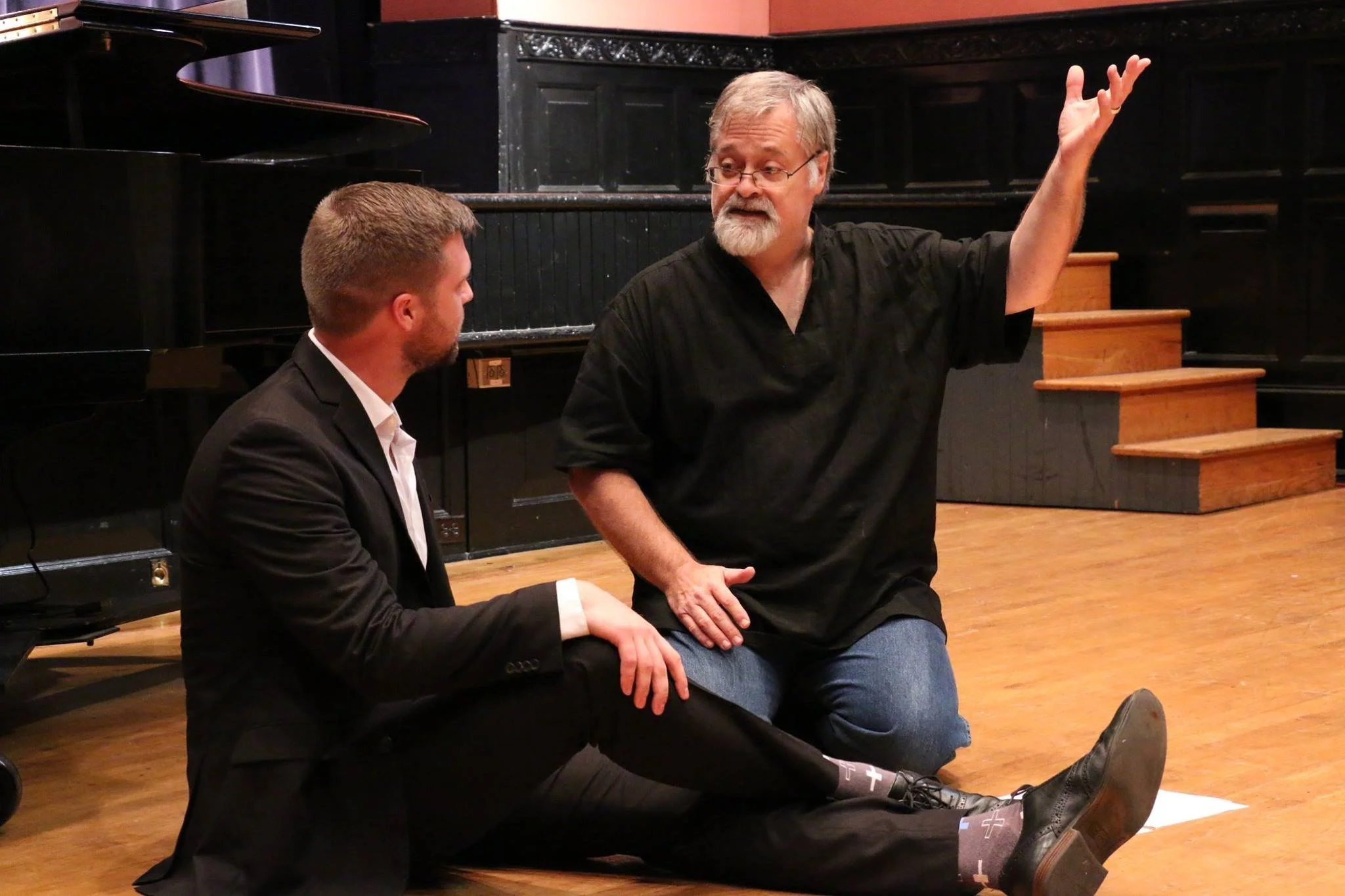
Hagen in Philadelphia lecturing and give masterclasses as a faculty member of Ghenady Meierson’s Russian Opera Workshop at the Academy of Vocal Arts. In this photo he is lecturing on “The Queen of Spades” on 23 July 2012. (p/c: Leonard Meierson)

On Teaching

July 27, 2025

Beginnings

I’ve wondered aloud why and how dogs howl at the moon, described with admiration the raw power of Kurt Cobain shredding “Smells Like Teen Spirit,” described what I feel is the noble sadness of Maria Callas, the rugged craftsmanship of Haydn, the ebullient time-bending of Steve Reich, the timeless idiosyncrasy of Satie’s Socrate, the emotional brutality of Richard Wagner, the insouciance of Gershwin, the unknowability of Bach, the happy-sad of Mozart. (As if the preceding list of a few Western artists begins even to scratch the surface of what music is and can and will be.) For forty years, giving masterclasses, lessons, teaching courses, and offering coachings, I’ve corrected notation, passed along oral history, encouraged creative risk, and asked what I’ve thought were good (or at least pertinent) questions. I’ve cautioned against pleasing aesthetic role models and railed against the way that young composers are often encouraged to put leashes around their own creative spirits. I’ve tried to share the puzzlement and ennobling essence of music’s conundrum — how it is an abstract art that nevertheless channels emotion; how, while being about nothing at all, music is about love.

I am twenty-six years old, sitting cross-legged in a circle with my Bard College undergraduate composition students in October 1988, wrapped in sweaters, drinking coffee sheltered by the leaves at their zenith against an aquamarine sky, making musical instruments out of objects we’ve collected in the surrounding woods. Three don’t read music; one senior has already spent three years studying with Joan Tower and wants to write an orchestra piece; one is a gifted cellist studying with Luis Garcia Renart; one is a singer-songwriter, the son of a famous folk musician; one is a visual arts major thinking about changing majors. “What are we going to play first?” asks one. “We’re going to arrange the first 25 bars of Stravinsky’s Dans Sacral from the Rite of Spring for us to play together.” “When do we get to compose something?” asks another. “We create solo pieces for ourselves first, then perform them for each other; then we each write something for the entire ensemble.” “Do we write them down?” “Yes, this time, but maybe not the next time. Notation isn’t everything. I’ll show you how,” I answer, taking a pull on my coffee and feeling really, really good. Their serious faces intent on their busy hands, as they create their instruments. And me talking to them about the basics — melody, harmony, rhythm, counterpoint, narrative — as we work the way that Mother and I used to when she washed and I dried, not looking directly at one another, but communicating directly while focused on something else, like looking out the window at the trees resuming green.

The eminent New York composer Louis Karchin and I had met at Yaddo, and he needed an assistant conductor. In time, he passed along the role of conductor to me. So, from 1988-90 I conducted the NYU-Washington Square Chorus. It wasn’t really a teaching job, but it remains the first entry on my CV. At the same time, Fran Richard at ASCAP called to tell me that Joan Tower was interested in offering me a job teaching at Bard College. I told her I wasn’t interested, and that I was too young to teach. I’d only just left Juilliard. She told me to do what I was told. I told David Del Tredici about Joan’s offer and he grimaced. Palms extended out and down, he exhaled explosively: “God, how I hate teaching,” he said. “It causes me physical pain. But Aaron [Copland] told me to take the job at Harvard, and I’ve taught somewhere ever since.” Another great American composer pianist, Michael Torke, related to me recently how his mother insisted that he “share his gift” as a child by teaching piano lessons, a task he detested. As though these two extraordinary artist’s musical compositions alone were not gift enough to the world! Michael rightly points out that some artists, like Leonard Bernstein, simply cannot help themselves: they are born teachers compelled to teach.

When Joan’s call came, like David and Michael, I wasn’t interested in teaching, but I agreed to take the train Upstate to Poughkeepsie for an interview. Nobody came to meet me. Vastly relieved, I called Fran and told her that I had been blown off and she said where are you and I told her and she said you got out a stop early, Bard is the next stop, so call them. I called Joan, who told me not to worry, come back next week. I did, and ended up teaching at Bard from 1988-1997, ending my stint as an Associate Professor, having taught the entire undergraduate theory sequence, counterpoint, ear-training, orchestration, score reading, and chamber music. Leon Botstein, Bard’s polymathic president, conducted several graduating seniors’ orchestral works each year in concert with the American Symphony Chamber Orchestra, providing a powerful incentive to the more artistically ambitious students and their composition teachers to get cracking.

“As for the Princeton Atelier, I’m learning more than I’m teaching!” I jot in my journal in January 1999. “8 composers, 8 singers, 8 writers, Paul Muldoon, and me in a room equals magic: I talk about art songs; Paul talks about poetry and reads some; I talk about pop song forms and sing some; we both talk about prosody from opposite directions (very cool); Paul shares lyrics; the composers set the poets’ words; the singers sing the new songs; I coach; Paul critiques —it’s a crazy-effective format I called From Art Song to Parola Scenica and it’s the most fun I’ve had teaching since the 80s.” Sighing, I turn to the 802 invoices coming in from the copyists for the performance materials, and the printout of the news that I am going to have to hire a baritone at my own expense to sing the role of Kane in the upcoming premiere of Bandanna in Austin. “Well,” I write, “the money I get paid for teaching the Atelier will just about cover these costs. But this is what I signed up for.”

During the 1993-94 school year, and again during the 97-98 school year, I guest taught as a Visiting Professor at the City College of New York for David Del Tredici during his sabbatical years — private composition students, of course — but also orchestration and analysis. From 1996-98 I joined the Curtis faculty, giving composition lessons to “non majors” in what was described to me by Gary Graffman as a sort of holding pattern until Ned retired.

I’m thirty-one, teaching Ned Rorem’s students for him in the Barber-Menotti Room at Curtis in 1992, playing and singing through their one act operas and offering feedback. In my diary on the way down to Philadelphia to teach, I write, “I am only about ten years older than they, and I fastidiously eschew Ned’s “Ex cathedra pronunciamenta” as only a middle class, Midwestern Lutheran can. It’s entirely possible that my young charges might interpret this – as David Diamond predicted they would a few years ago – as a lack of stature.” When I arrive, I learn that one of them has musicalized (as had I a decade earlier when I sat where he is sitting) a playlet by a famous playwright friend of our teacher’s. “Did you get the rights?” I ask. “No.” So I launch into a long monologue about the importance of, and the process of, acquiring rights. Immersed in my spiel, I fail to read the room. The prosody is awkward, but the music is brittle and interesting. Feeling pulled off center, I forget to praise the work before I critique it. I make a few comments about strong syllables on weak beats and line readings and then come up for air. I am entirely unprepared for the lesson to have been a flop, but it is.

As for teaching musical skills, I admit to having benefitted from the protégé effect during my first few years on the Bard faculty, when I was essentially only a chapter ahead of my students, unsnarling musical theory nomenclature in order to figure out a way to teach it myself because I had tested out of having to take the courses myself in graduate school at Juilliard, having taught myself theory as a kid from Arnold Schoenberg’s Theory of Harmony, and then again – differently — having learned Bruce Benward’s theoretical system at the University of Wisconsin, and then Felix Salzer and Carl Schachter’s books (heavily into Heinrich Schenker), which were made to make sense — to me, at least — by the brilliant musicians and theoreticians Edward Aldwell and Ford Lallerstedt, at Curtis. The same went for teaching ear training, which I had learned by singing using “moveable do” as a kid at the Wisconsin Conservatory of Music, then scale degrees in Madison, then “fixed do” at Curtis. What a mess.

Can composition even be taught? Ned’s article, “Learning With Daron,” in the April 1993 issue of Opera News, addressed the question excellently. He pointed out that I teach reflexively, the way that I compose and breathe. I find craft easy to impart, and the process of fostering creativity practically impossible. One can go down a thousand rabbit holes through self-indulgence — abusing the use of parable as a teaching tool by sharing stories whose meaning exceed the pupil’s comprehension; allowing practical advice to devolve into cod psychology and so-called “life lessons.” (Mistakes I made for years.) I know that the student must desire to learn, as I desired to learn from Ned, and that good teaching is bespoke. “I’ve never been a parent before,” I admit to my sons occasionally — usually after a particularly spectacular paternal fail. I am still learning how to be a composer myself, still trying to figure out what composing is. That’s a start. It’s been nearly thirty years since I’ve sat through a faculty meeting, despite having been delighted to have served as a guest lecturer, composer in residence, artist in residence, swashbuckler du jour, or whatever, at over a dozen educational institutions, not to mention masterclasses all over the place. Increasingly, I find myself feeling when I teach composition not as though I am singing so loudly that I cannot hear other peoples’ voices, but that the societal din through which I am trying to express myself is almost completely drowning me out. All that is left are unanswered questions.

I am forty years old, doing double days during the sweltering summer of 2001 in Manhattan—jury duty during the day, composing and practicing in the evenings—when the symptoms of appendicitis present: severe pain in the lower right side of my abdomen, taut belly, and cold sweat. Like everyone without insurance, my only recourse is the emergency room. Fortunately, we wrap up jury deliberations that day, and Doctor F., the retired doctor who composes with a passion usually reserved for Byronic heroes, is scheduled for his weekly lesson. He has me stretch out on the Monk Bed. Tapping my belly like a cantaloupe, he asks, “How long?” “A few hours,” I reply. “Probably early enough to address with Cipro,” he says, shaking his head doubtfully. Handing me the prescription, he says, “We will walk to the pharmacist together. If it doesn’t clear up within six hours, go straight to the E.R. You’re taking a grave risk, Daron.” “Why now?” I ask him. He sighs. “I believe you have brought this on yourself, Daron,” he says. “People can make themselves sick. That’s what you have done.” I look at the floor. “Why do you want to die?” he asks, quietly. I look up at him sheepishly. The score of Pierre Boulez’s Répons is spread before us on the table. I am supposed to be teaching him, but he, thirty years my senior, teaches me. He motions at the notes meticulously etched on the oversized pages like maps of neurons in a brain. “You understand these notes. I understand some medicine. The notes add up to more than their sum. Your life decisions do the same. Change your life.”

Middles

From 2005-2013 I served as the festival artistic director and chair of faculty (ringleader?) for the Seasons Fall Music Festival in Yakima, Washington. The two-week festival consisted of three symphonic concerts, eight chamber concerts, three recitals, and three jazz concerts (visiting artists like Karrin Allyson, Gary Burton, Chick Corea, Branford Marsalis, Bill McGlaughlin, and Marvin Stamm). In addition to the administrative service of overseeing the activities of our twelve-member faculty, I performed and coached chamber music and taught composition. I delighted in the creation, with Pat Strosahl and Brooke Creswell, of an overall festival ethos that programmed  jazz and concert music in equal portion, and interspersed performances of new works throughout to eliminate stylistic ghettoization. The curriculum itself centered on the pairing, for the duration of the festival, each conductor with a composer (they even roomed together). The entire cohort attended every masterclass by visiting artists, scholars, and faculty. I programmed films whose scores were then discussed, Pat curated shows by Washington visual artists and emceed wine tastings of local Yakima cheer, and I booked poets to give readings.

Composers mounted the podium; conductors composed. Everyone bonded over their shared dread of movement class first thing in the morning together and were subject to the same expectations. Every participant attended every Yakima Symphony concert, and received lessons from our composers (Gilda Lyons, Miles Hankins, Alberto Demestres, and me) and the conductors (Brooke Creswell, Donald Thulean, Lawrence Golan, and Robert Frankenberry), as well as chamber music time with the Finisterra Piano Trio and guest ensembles like the Imani Winds and Kairos String Quartet. At the final orchestral concert, each conductor led the premiere of their partner composer’s work; the conductors also led movements of standard repertoire. So many premieres. The festival also presented the American premiere of Bernard Jacobsen’s own retelling of the Stravinsky Soldier’s Tale, conducted by Lawrence Golan, with Bernard, glass of local Yakima wine in hand, providing the witty, erudite narration; Michael Wemberly blowing the roof off the place with an enormous percussion ensemble; Seattle Opera’s David McDade discussing vocal preparation; an elegant cabaret night sung by Rob and Gilda for which I arranged and played a setlist that bounced from Weill to Raposo, Mancini to Blitzstein, Rorem to Gershwin to Sondheim to Eisler, Bernstein to Brel,  and on and on. It was fun. Writer and critic Doug Ramsey chronicled it all on artsjournal.com in his column Rifftides, providing context reviews, and a national audience to what we were achieving. The commitment was not just to diversity in programming, hiring, and the choosing of festival students, but to the creation of a mutually-supportive, non-competitive space where creative risk

The function of teaching composition in music’s eco-structure is like sowing wildflower seeds in a fallow field to nurture the soil. Not all of the seeds will grow. Most, in fact, will go out and do something else, having developed a better understanding of what being creative feels like, enhanced communication skills, and an appreciation for the way creative problem solvers think. Learning to grow is the point, not learning to grow like one’s teacher. I was aware in the mid-eighties when I left Juilliard before completing the doctorate that academia was a square hole and I was a round peg. The academic world’s entirely understandable need to require of its citizens (at least semi-empirical) proof of intellectual credibility seemed less important to me back then than immersing myself in an artist’s examined life. I didn’t suppose that I couldn’t be bothered to teach, or that I viewed an academic position as a Plan B, but I knew that my growth as an artist was being hindered by further institutional supervision.

“Shame,” I tell the thirty or so workshop participants and audience of about 200 at the Academy of Vocal Arts in Philadelphia on a gorgeous September afternoon in 2012 as part of the Russian Language Workshop, “is the nuclear reactor that powers the libretto of Pique Dame.” Pausing for emphasis. “Of course it appeals to this Lutheran Boy.“ A few chuckles. “Sha-a-a-m-e,” I sing, sizing the air in front of me as the audience. Rolling laughter. “’Life is a game.’ Now, what does that mean? It doesn’t mean that life is light pickings. It means that games are brutal, like death.” “Marc gave lectures for money,” I recall Virgil Thomson telling me back in the 80s when I worked for him at the Chelsea as I continue to lecture for the next hour. “You shouldn’t do it — it’s part of the ‘associated skills racket’ and too easy. You get a taste for the attention and then it’s all over.” Yet, here I am, lecturing for the fifth year at Ghenady Meierson’s invitation, and learning as much as I am teaching, for how lucky am I to have been paid to spend all those days learning and internalizing Tchaikovsky’s Queen of Spades — a piece I ought to know? Can it be that Ghena has engaged me to lecture on it partly because we’ve known one another from the beginning and he feels I will grow as an opera composer through familiarity with this work? Yes.

As Ghenady quipped to me over dinner at the Art Alliance following one of the lectures for his program, “for someone who isn’t an educator, you sure do teach a lot.” By the time I accepted in my fifties a fascinating position at the Chicago College of Performing Arts from 2017-2023 (during which I composed, mounted, and directed my first two “operafilms”) I’d already done stints at Baylor University (Artist in Residence 1998-99), as the Sigma-Chi Huffman Composer in Residence at Miami University (1999-2000), Artist in Residence at the University of Nevada Las Vegas (2000-2002), as the Franz Lehar Composer in Residence at the University of Pittsburgh (2006-2007), and as a Master Artist in Residence at the Princeton Atelier (1998, 2005). I have come to accept that the most valuable ongoing role I’ve played as an educator is as a visiting artist, not as a faculty member. A flinger of wildflower seeds himself strewn by the resident faculty in their students’ paths in order to invigorate debate, encourage critical thinking, shed light, make good trouble and then, importantly … to leave, having myself grown immeasurably through the process.

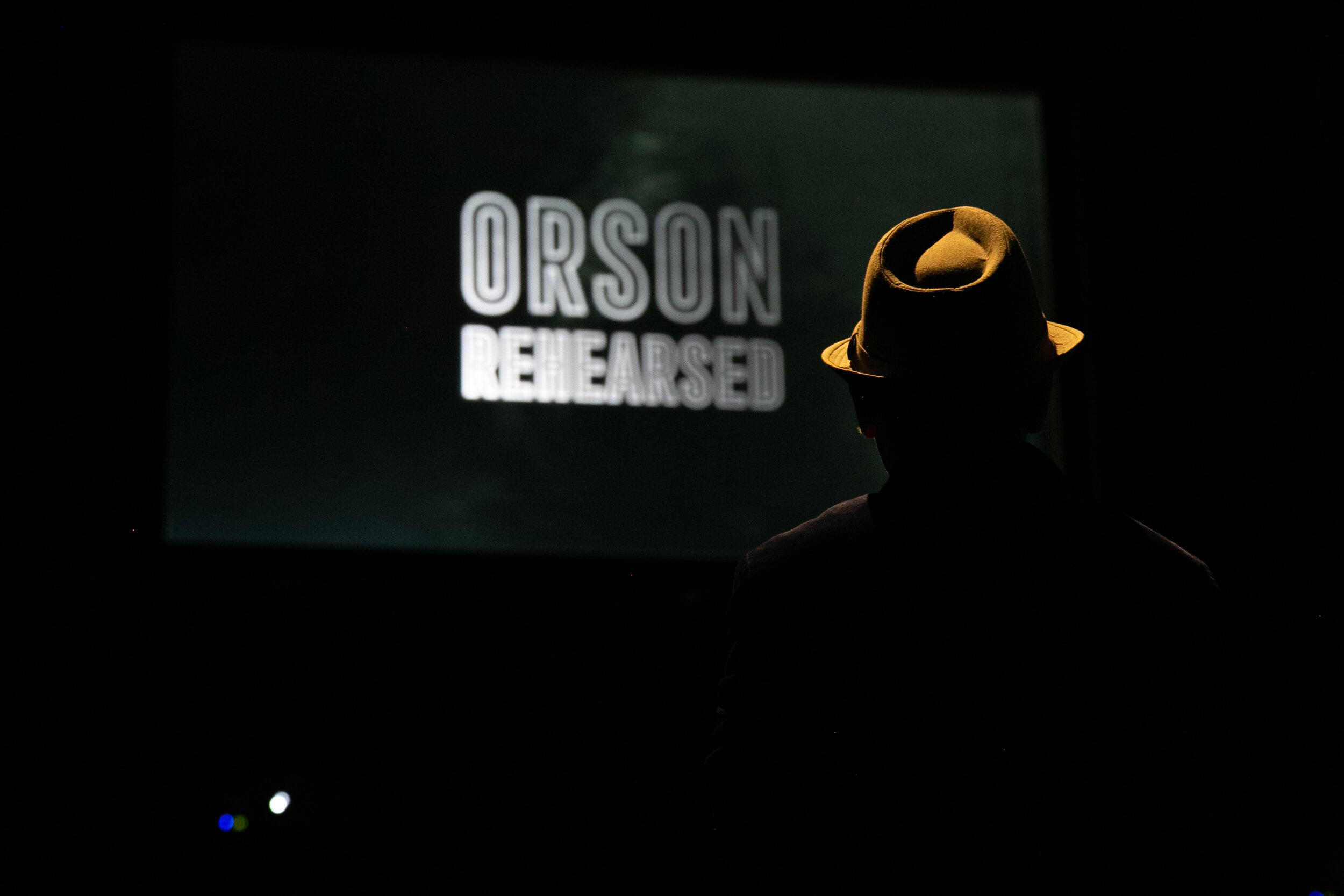
“But I’ve never called cues before,” my composition student says, headset on, already learning on the job, perched between the professional lighting designer and production manager at the worktable in the cavernous old Studebaker Theater in Chicago’s Loop sometime in September 2018 as I direct the staging and filming of my operafilm Orson Rehearsed around her. “You’re doing a great job,” I say because she has risen to the challenge and is doing a great job. They all are — all the Chicago College of the Performing Arts performers, all of my composition students, working side by side with my New Mercury Collective team — learning by doing, empowered, faces intent. “Here are the tools,” I say to each in turn, “make something.” I look at the stage, still happily washing dishes and looking out the window and teaching the basics — dramaturgy, using Cubase, taking and giving production notes, balancing a live orchestra with pre-recorded sound, theatrical and operatic protocol and tradition — as the house lights dim and together, we reenact the parable of the Cave.

Ends

Whether it was for an audience of one, as it was when I was lucky enough to receive a lesson, or millions, as it was when he presented his Young Peoples Concerts on television, Leonard Bernstein couldn’t help but teach. His generosity of spirit as a teacher (despite Oscar Levant’s ungenerous but still funny characterization of him as a “great popularizer of commonly accepted truths as insights”) was a great force for good not just in others’, but in his own life. When he taught me he was direct with me, and collegial, and affectionately brutal in his criticisms. If I felt that, in his joyous love of music, he sometimes over shared, I acknowledge with gratitude that it was in working with him that I learned that I, too, couldn’t help but teach. He it was who admonished me to “howl like a dog if you must, because you can.” I would add that one pays a karmic debt and truly joins history’s musical continuum by  “passing forward” to the most deserving the oral history, the intensely personal “family stories” that are the undocumented but priceless artistic heritage of the generations of human beings who’ve answered the call to serve, and have given their lives over to, music. I believe that with every fiber.

I am sixty-two years old, listening to the sound floating through the late summer 2023 evening Virginia air. It seems comprised of — in equal parts — Dublin pub, abattoir, campus protest, primal scream session, and revival meeting. Wintergreen Music Festival artistic director Erin Freeman is leading all of us as we sing — six composers, six conductors, a couple of stagehands, and the faculty (that’s Gilda and me) — through the instrumental parts of the chamber version of Stravinsky’s Pulcinella Suite. For the students who’ve never sung, or played in an orchestra, it’s a revelation; for the rest of us, well … we feel like teenagers again. Nothing bad (and every joyful thing) can come of this empathy building and group bonding experience — everyone is well-aware of how we sound and we’re all loving it, leaning into the dogs howling at the moon nature of it. Afterwards, when Gilda (who finished her doctorate and, with grace and mindfulness, enjoys a flourishing career both as a composer / performer and as a tenured professional academic) and I walk our hound Peanut up the mountainside toward our lodgings, she cocks one ear at us as and looks over her shoulder in that Rita Hayworth hair-flip way she has as though to say now you two are finally on to something.

When I was a kid, my brother Kevin told me that he loved opera because when singers perform it they howl out their emotions freely, and with the unabashed natural freedom of wild animals, at the top of their lungs. How to howl is something I can teach with confidence because I understand and live it. I can teach about the process of becoming music, provided that there is an understanding that music is the vessel, not the result. Living an examined life is the goal. Communication is the challenge; music is the howl. I can teach how to howl. Composition as a howl into the night sky. I’ve learned to modulate the amplitude of my howl; I’ve learned to slightly dampen its ferocity; I’ve come to respect that times change, and that howling’s not for everyone. Nevertheless, for the wild, joyous abandon if it, this hound must howl and howl I will.

View fullsize Academy of Vocal Arts Masterclass, 2006
View fullsize Cameron Dammann, 2023
View fullsize Seasons Festival, 2009
View fullsize DH-Orsons.jpg
View fullsize Juilliard, 2018
View fullsize November, 2017
View fullsize Princeton, 2005
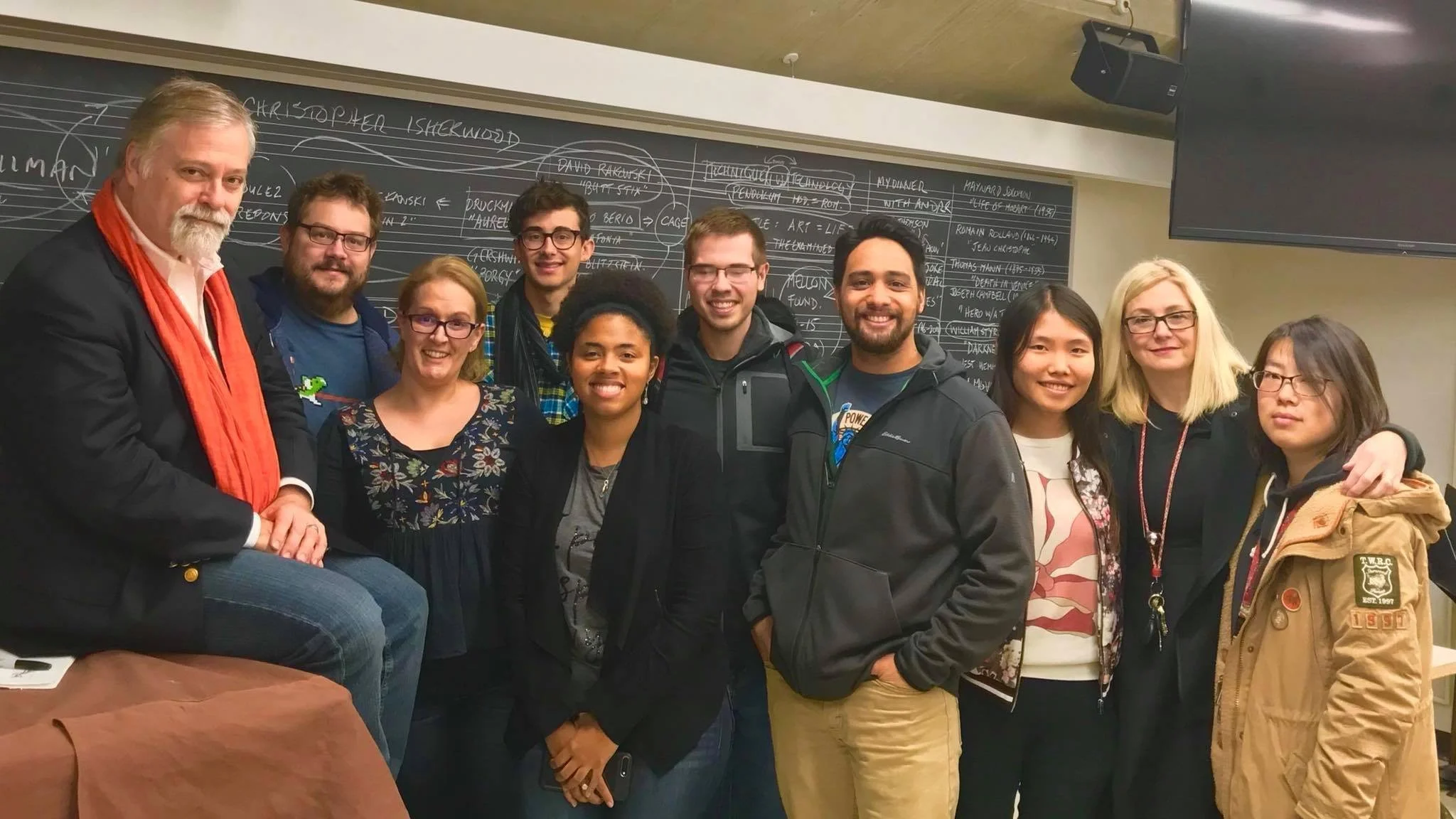
View fullsize With Former Pupils, 2019
View fullsize Wintergreen Festival, 2018
View fullsize UW-Madison, 2017
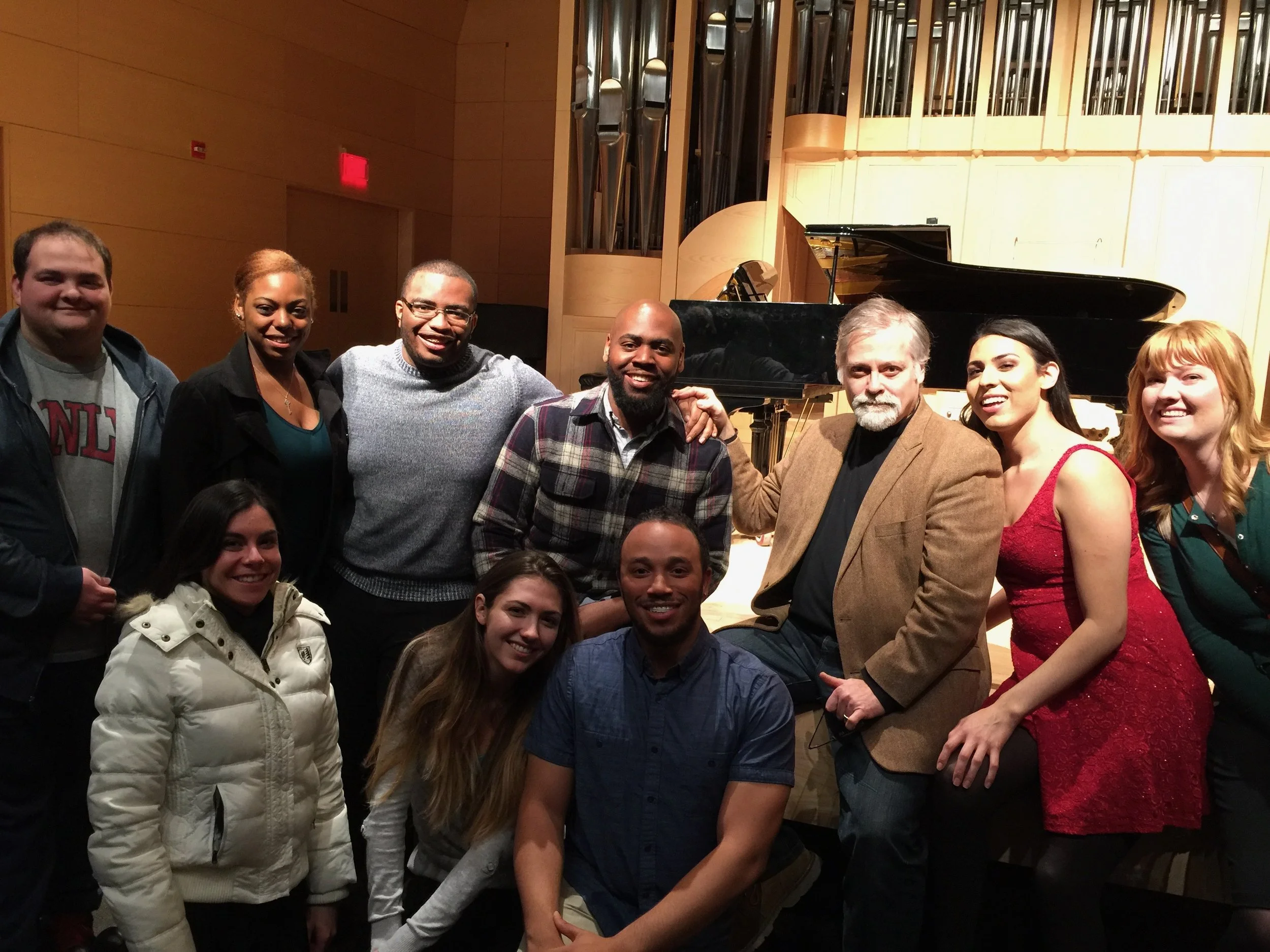
View fullsize UNLOV Masterclass, 2017
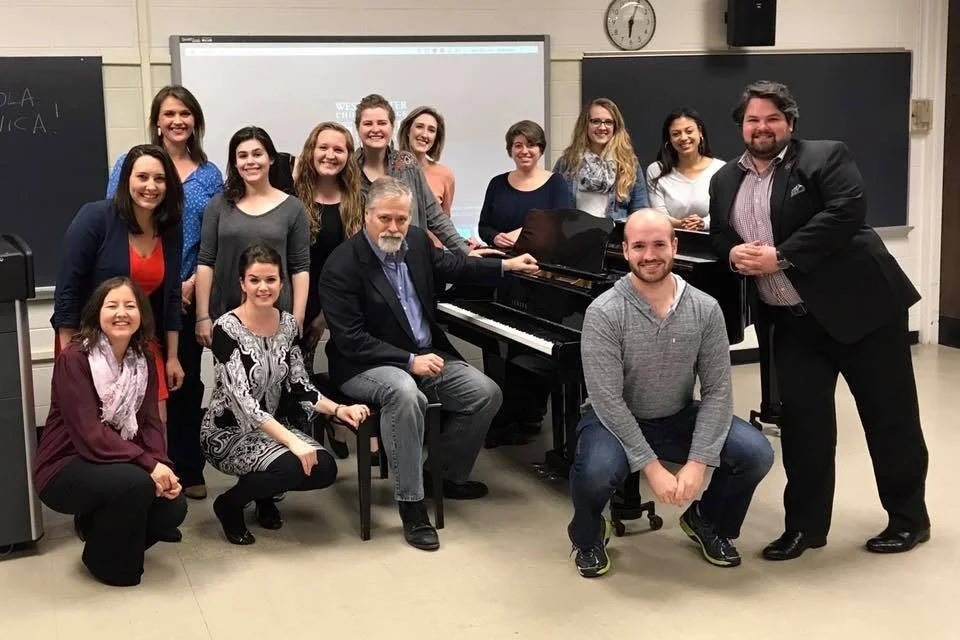
View fullsize Westminster, 2017
View fullsize Chicago, 2022
View fullsize Ball State, 2018
View fullsize Chicago College of Performing Arts Masterclass, 2018
Tags Bard College, Joan Tower, Luis Garcia Renart, Igor Stravinsky, Leon Botstein, American Symphony Orchestra, Paul Muldoon, Bandanna, David Del Tredici, City College of New York, Curtis Institute of Music, Gary Graffman, Ned Rorem, Pierre Boulez, Seasons Festival, Imani Winds, Finisterra Trio, Gary Burton, Chris Brubeck, Branford Marsalis, Marvin Stamm, Bernard Jacobson, David McDade, Donald Thulean, Brooke Creswell, Mary Anthony Cox, Ghenady Meirson, Virgil Thomson, Marc Blitzstein, Queen of Spades, Sigma-Chi Huffman Composer in Residence at Miami University, v, Princeton Atelier, Orson Rehearsed, Erin Freeman, Rita Hayworth

A still from the film starring (l. to r.) Robert Frankenberry, Omar Mulero, Robert Orth.

An Affair of the Heart -- Interview: Toronto Film Magazine

November 23, 2020

 TFM:  How did you start making films and what was the first film project you worked on?

 DH: Several years ago, I was diagnosed with a congenital, degenerative heart defect. I began looking for a story to tell in which I could explore reconciling my own mortality: what issues run through the mind of a fully expressed artist conversant with the relationship between art and life seriously facing the prospect of death? I chose Welles as my subject because he was an artistic polymath—writer, visual artist, actor, director, filmmaker—and a deeply-committed social activist who also strove to live a complete and fulfilling personal life. I have always believed as a theater person that (as architect Louis Sullivan posited) “form follows function.” 

 Consequently, it seemed obvious to me that Welles’ ebullient creative generosity and aesthetic range, intellect, and art required a many-layered dramatic treatment—one that fused images and sound on a deeper than usual level, wedded electro-acoustic and live music, live performance and film, opera and music theater, and jubilantly mashed-up musical and visual languages. I determined to build a multi-media piece that used the “bardo odyssey” of the great filmmaker Orson Welles (the film takes place as he lay dying of a heart attack) to do this.

 I knew that this deep dive was going to require more than a love of movies, an acquaintance with the writings of André Bazin, and access to some video equipment. The editing process is so important to any life, but it is central to a writer, composer, or filmmaker. I had scored some films, so I was conversant with that end of things; but my subject in Orson demanded that I not just imagine but feelhow it feels to edit film month after month. I had directed my operas professionally, conducted them, written their libretti, knew the ropes of live theater; but I had never directed a film, or managed a film production team. It turns out that the opera and film worlds are astonishingly similar. That’s how I came to start making films, beginning with Orson Rehearsed.

 TFM: Which musical genre and which genre of filmmaking fascinates you as an artist and why? 

 DH: I feel most comprehensively expressed as a composer of music interwoven with some sort of dramaturgical narrative. I’ve written eleven operas, yes, but I’ve written an awful lot of music for the concert hall—five symphonies, a dozen concerti, reams of chamber music and hundreds of art songs. Although I am a passionate collaborative artist, I admit to really liking the highly centralized and subjective control of the auteur model as defined by François Truffaut in his essays because it comes closest to the way that composers used to function in the opera world.

 TFM:  How does it feel to write, direct and then compose music for a personal style of indie film?

 DH: Absolutely wonderful. I have savored every second of the Process of making Orson Rehearsed: from discovery with the actors during the rehearsal and staging of the live component of the film, to learning how to live the life rhythm of a film editor; from the familiar process of scoring to film, to the unfamiliar process of shooting film myself to music already scored and seamlessly switching alternating between the two. My goal was not to document a live performance, make a music video, or an Umbrellas of Cherbourg, but to create a pathway toward a new genre which is not a hybrid but something more personal, more resistant to categorization—a film about opera, an opera about film.

 TFM:  What is the most challenging aspect of being an independent filmmaker in the film industry?

 DH: I don’t have an answer for that yet. My process as an artist is driven forward by continual reinvention and discovery, and I am just now learning the challenges of being an independent filmmaker. 

 TFM: How difficult is it to fund indie films?

 DH: To the extent that the world of an opera composer is similar to that of an independent filmmaker, I am familiar with the process of bringing producers and presenters to the table, hearing their vision, collaborating, making art with the artists and resources in the room instead of the ones in my head, and letting projects either unfold or evaporate, depending on things I can’t control. Funding is always a problem, of course. On the other hand, technology has made it cheaper to make films; so long as you have access to the tools and the skills to wear a bunch of different hats, you can arrive at the end with something that looks and sounds pretty good.

 In the case of Orson Rehearsed, the Chicago College of the Performing Arts served as a production partner in exchange for their students shadowing me as composer, director, and independent artist, as well as being cast in productions that combined both seasoned professionals and emerging artists. They shared costs with my New Mercury Collective, which is basically my sandbox, or, as Welles would say, train set, in which I build little sandcastles and operatic locomotives. I have more creative control than I do when I work with an opera company, but less money. 

“These films would, in effect, show us what was going on in the minds of the avatars in Welles’ mind—films within an opera that would become a film.” Daron’s editing notes detailing the synchronization of images in the three simultaneously-projected…

“These films would, in effect, show us what was going on in the minds of the avatars in Welles’ mind—films within an opera that would become a film.” Daron’s editing notes detailing the synchronization of images in the three simultaneously-projected films-within-the-opera-within-the film for the “Everybody’s Shakespeare” sequence. At this stage, these took the place of storyboards.

TFM:  Tell us about the process of the production for Orson Rehearsed? 

 DH: First, I threw spaghetti at the wall for six months in Logic Pro. I created about twenty 3-6 minute long “think pieces” about specific events and elements in Welles’ life that he might think about while dying. These dramatic beats combined manipulated snatches of recordings of my own acoustic works stretching back to the 80s, sound effects, brief snatches of Welles interviews, loops, and newly-composed vocal lines—most performed by my wife, vocalist/composer Gilda Lyons, and some by me—and mockups of what would become acoustic instrumental lines.

 I chose to divide the character of Welles into three avatars: one young, one middle-aged, one dying. This allowed for ensembles and multiple points of view. They sang a libretto that combined newly-written material by me with words drawn from public domain sources and repurposed—Shakespeare, Welles himself, Emma Lazarus, and others. Gradually, these spaghetti-throwing sessions generated a core of about a dozen musical ideas that held the entire piece together.

 Simultaneously, I filmed dozens of high-def video scenelets that would serve as visual equivalents to the musical motives being tossed up during the work in Logic—a man’s hands typing on a manual keyboard in New Haven; a woman’s hands gliding over piano keys in New York City; a child blowing out candles on a birthday cake, or tracing the letters carved into tombstones in a graveyard; hail falling in Paris; waves breaking and the sun setting in Nicaragua; an elevated train passing by overhead in Chicago; the desert outside of Albuquerque, and on and on. These images ended up unifying the films projected onstage during the live production component of production, and also served as raw material to be edited into the final film.

 During the next six months, since the film was taking place in someone’s mind and would unspool in real time in the theater, I gradually arranged the essays into a sequence, dropping some, adding others, in order to create a psychological and emotional narrative that would take the place of physical action. I edited together all the footage into three sixty-minute films that would accompany the three Orsons in live performance. These films would, in effect, show us what was going on in the minds of the avatars in Welles’ mind—films within an opera that would become a film. I edited into this mix some licensed stock footage of a red silk scarf, film leader, the Statue of Liberty at sunset, some protestors, and a poignant skein of footage culled from a 40s newsreel of a boy walking away from the camera on a country road. This boy ultimately became a rather important “ghost character.”

 Once I had synchronized the electro-acoustic soundtrack to these films, I composed the acoustic chamber orchestra component that would be performed live by the Fifth House Ensemble at the Studebaker Theater in Chicago in conjunction with the electro-acoustic score, conducted by Roger Zahab. A trusted and admired colleague who generously (and bravely) agreed to my request that we eschew the standard “film to image” gear that is used for screenings of Hollywood films when orchestras show them, Roger (who had access only to a click track) marvelously coordinated live singers, an orchestra, and pre-recorded sounds in a theater entirely by ear. I asked him to do this because I wanted the risk, the excitement, and the flexibility of live execution that I have grown to feel as a conductor myself is the secret ingredient to great opera performance.

 Next, I stage directed the show with the immensely gifted and creative cast. Their performances were captured visually over two shows and a dress rehearsal by three stationary cameras and one roving closeup camera—sort of one step up from the usual archival video. The soundtrack audio was recorded in the house. I wanted the soundtrack to sound captured live in order to advance the dialectic of “live” versus “canned” and the combination of the two. Post-production, and live concert mixing can make everything sound so homogenous that nothing sounds “real” anymore.

 I left Chicago with about ten hours of audio and video and let it sit for nearly a year before diving back in. First, I ever-so-gently massaged the soundtrack and had it mastered. Then, I cut the performance film to the soundtrack. Next, I intercut the pre-shot films and the live performance footage (which I washed out into black and white to differentiate it from the pre-shot films) before adding a third layer of semi-opaque “ghost” images screened in red and blue that carried forward elements of both. I received important feedback from colleagues at this stage about what was and was not “landing”—Rabab Haj Yahya, H. Paul Moon, John Corigliano, and Todd Vunderink, among others. This last stage of the process slowly brought the film’s messages into clearer relief and allowed me to discover what the rhythm of the recurring images and music were trying to express. 

 TFM: What inspires you to work as an artist in society and what kind of impact would you like to have on your audience as a filmmaker and composer? 

 DH: Artists of conscience can speak truth to power and make a difference (for the better) by reminding people of their humanity and interconnectedness, the responsibility we have to one another. I try to do that. I am proud to serve on the faculty of the Chicago College of the Performing Arts of Roosevelt University because the institution’s values match my own. That generous, staunch support helps me to amplify my citizenship and hone my craft while sharing it with students.

 TFM: What is your next artistic project? 

 DH: I am directing a staged production of my opera New York Stories for Florida Grand Opera in the spring, and then directing a filmed version of my opera Shining Brow in Frank Lloyd Wright’s Westcott House with the Springfield Symphony and Think TV (the Dayton PBS affiliate).

 TFM: What do you think about the distribution of indie films and what do you recommend to emerging artists? 

 DH: I don’t know enough about distribution to make any recommendations. At present I am submitting Orson Rehearsed to festivals and learning about distributors. It is an art film for which there is a minuscule market; I never expected it to be commercially viable or “popular.” Still, it is garnering laurels (for which I am grateful and honored), and it might get some legs, however humble. After it has been shown at festivals, who knows?

TFM: Why do you make films? 

 DH: Really, it circles back to process for me. I’m just feeling my way forward as an artist and as a human, learning, going deeper into truths, and working to connect, and to make the bit of difference I can, as I am able. I’m very lucky to have landed in a place where I can discover and reinvent while collaborating with extraordinary artists.  

 This interview originally appeared in Toronto Film Magazine on 23 November 2020 when Orson Rehearsed was awarded the “Best Composer” laurel at the Montreal Independent Film Festival. You can read it there by clicking here.

Screen Shot 2020-11-23 at 7.16.14 PM.png
Tags Orson Welles, Orson Rehearsed, André Bazin, François Truffaut, Umbrellas of Cherbourg, Chicago College of Performing Arts, Logic Pro, Gilda Lyons, William Shakespeare, Emma Lazarus, Fifth House Ensemble, Studebaker Theater, Roger Zahab, Rabab Haj Yahya, H. Paul Moon, John Corigliano, Todd Vunderink, Roosevelt University, New York Stories, Shining Brow, Frank Lloyd Wright, Curtis Institute of Musioc, Citizen Kane, Nicolai Rimsky-Korsakov, Richard Strauss, Arnold Schöneberg, Chicago College of the Performing Arts, Robert Orth, Robert Frankenberry, Omar Mulero, Ken Cazan, A Woman in Morocco, Jean Rosenthal, Victoria Bain, Atlas Arts Media, Zahab, Bard College, Princeton, Rudy Marcozzi, Linda Berna, Kyong Mee Choi

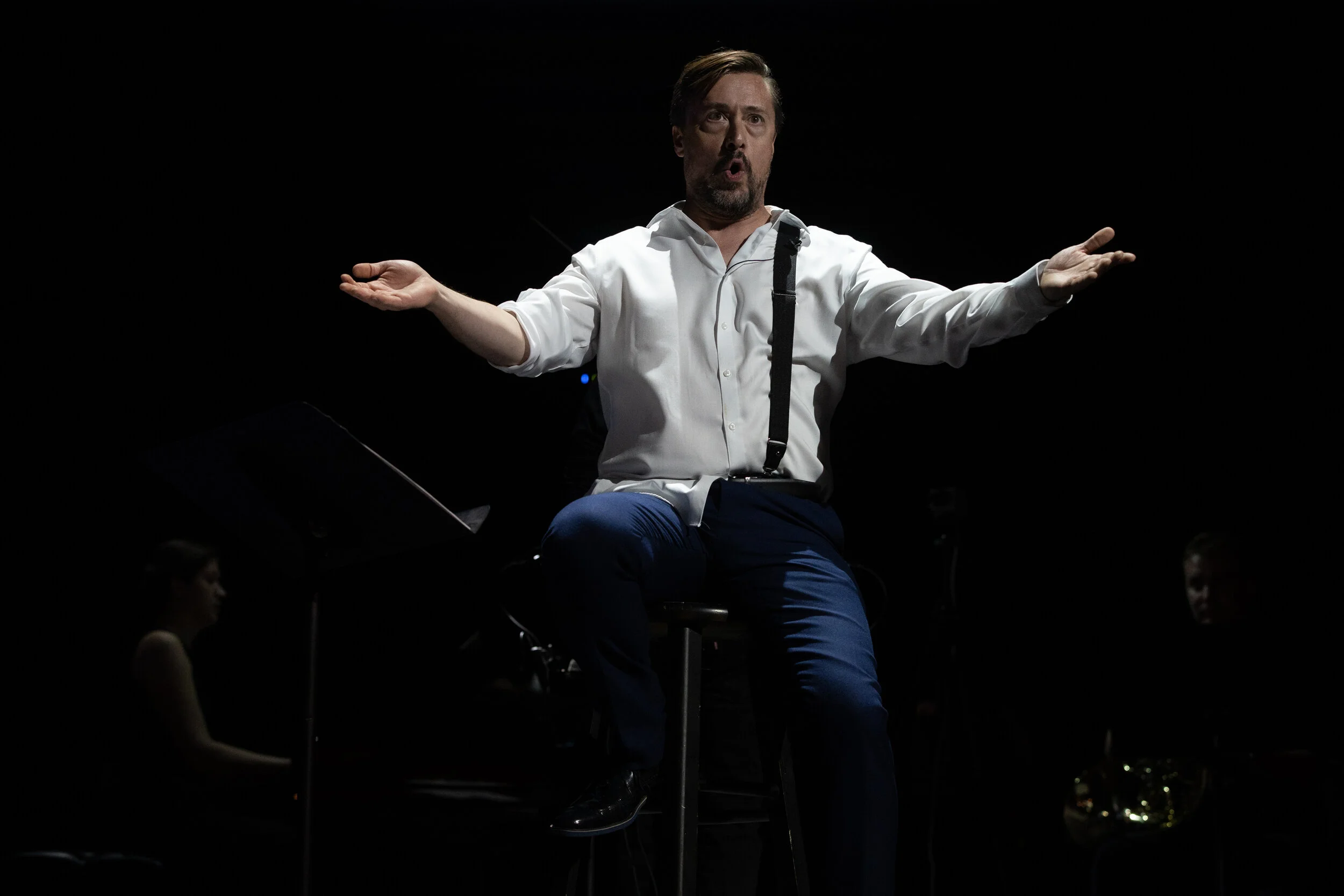
(l. to r.) Omar Mulero, Robert Frankenberry, and Robert Orth as Orson Welles. (Elliot Mandel photo)

Orson in the Bardo -- Interview: Wellesnet.com

November 7, 2020

Mike Teal of Wellesnet: Despite the fact that the pandemic has taken a heavy toll on the entertainment industry, Daron Hagen’s filmed opera, Orson Rehearsed, has been playing at movie festivals around the world and has won laurels in the Los Angeles Film Awards, Chicago Indie Film Festival, Cinefest India, and the After Hour Festival in Brazil, among others.

The film is based on a stage performance of the work, held in Chicago two years ago, which itself had incorporated filmed material into the show (much as Welles had done several times throughout his theater career).

Now the tables are turned and the new film has incorporated a lot material from that stage performance.

Hagen is a highly respected composer who has written twelve operas, and whose orchestral works have been performed by major orchestras around the world.

MT: The word “bardo” is used to describe Welles’s state at the moment he lies dying. Is this a Buddhist interpretation of Welles’s life and death?

DH: Orson Rehearsed takes place during Welles’ transition between life and death. He is, in effect, both the scorpion atop the frog’s back and the frog in mid-river. What we call it is a matter of convenience. In truth, I have been fascinated by this transitional zone for decades—inspired, probably, by the fact that my mother died of cancer in my arms when I was a young man. I have been treating this subject for decades. For example, in 1998, I recast Shakespeare’s Othello as a large two act opera on a libretto by Irish poet Paul Muldoon called Bandanna, set it on the Texas-Mexico border (yes, it dealt with the issue of immigration, among other things) on the Day of the Dead in 1968, and treated the Rio Grande as a River Styx. The debt to and homage to Welles and his Touch of Evil was overt—the corrupt labor organizer in Bandanna was named Kane. He, along with all of the characters in that story, straddled the liminal zone between life and death, love and hate, innocence and corruption, good and evil, and so forth.

Now Welles serves as both Orpheus and Eurydice in Orson Rehearsed. During the film, he crosses from life into whatever it is that comes after. In other words, no, the film is not a Buddhism-inspired speculation about what Welles might have been thinking, but rather a secular humanist yarn that conveys the narrative not through external stage action but through internal action as his thoughts proceed through a sequence of emotional, psychological, and philosophical states. What Welles thinks we audience members see on three movie screens; we also see his thoughts given physical form in the staged actions of three figments of his imagination—opera-singing avatars who interact with one another. And in the final film we see a melding of the three films, a live performance, and another semi-opaque set of ghostly avatars who interact with both the films and the avatars.

MT: With the instrumentalists onstage with the singers, it struck me that it might be more accurate to consider this a kind of oratorio or cantata instead of an opera. How would you describe it?

DH: From the start, Orson Rehearsed was intended to be sui generis. As such, one can interpret it any way one pleases — it’s an opera or a cantata, a musical or a play with words, a set of critical essays or a song cycle, an art film or a music video. There is but a single step between Max Steiner and Richard Strauss, who believed — as I do — that a great work of art should entertain the neophyte, intrigue the well-informed, and enthrall the expert. That sleight of hand, from what I’ve read, delighted Welles as an artist and man. As a technical and artistic goal, it certainly delights me. So, if Orson Rehearsed must be called anything, I’d choose “prestidigitation,” as it captures both the high, medium, and low of it all.

MT: The word “Edit” is repeated by the singers frequently, almost like a mantra. What is the significance of that?

DH: The recurring line is a cri de cœur. As a man with a congenital, degenerative heart defect, I consciously monitor my heart more than most folks probably do. In Orson Rehearsed, Welles is dying of a heart attack. The recurring, juddering cries of “Edit. Edit. Edit,” are not just the sound of his own heart coming through to him through his imagination, but they are the essence of an artist’s life—as Meister Eckhart said, “Only the hand that erases can write the true thing.” Welles spent a lot of time editing scripts, film; we know also that he was repeatedly devastated when other people recut his films—when people edited him. That is why I edited the film myself: I wanted to feel (granted, using Premiere Pro software, not a moviola) what Welles did. Orson Rehearsed is my twelfth major operatic work, so I’m no stranger to the tender mercies of the editing bay.

MT: There are more than a few references to political matters, with Welles at one point saying that the only good acting is political. I was also struck by your quoting of Roy Cohn, the infamous right-wing lawyer who helped Donald Trump rise to power in the 1970s. Do you see any kind of parallel between Welles’s death in 1985 and the rise of the kind of far-right politics currently described as Trumpism?

DH: Welles wrote speeches for FDR, took a year off to campaign for him, and is widely revered as a man who stood up for what he believed in. All of the biographies I’ve read of Welles—including Simon Callow’s sprawling, epic treatment—show him to have been a man of fine character. It is too on the nose to posit that the diabetic Welles died of a broken heart, but how could he have missed—as someone who had lived through HUAC and McCarthyism—the effects of Reaganism and the already rising tide of the fascism we’re facing today? Who of us in our darkest moments has not been beset by devils? I chose both fixer Cohn and his tweeting protégé—reverse anachronisms yanked out of chronological time—to serve as Welles’ devils.

MT: I remember the video screens during the live performance all showing a sunset at the end. The ending on the video is different, with everyone gradually leaving the stage, as in Welles’s Moby Dick Rehearsed. Was there a change, or am I not remembering correctly?

DH: The screens do show a sunset throughout the last scene of the staged iteration as the orchestra gradually drifts off; but then they give way to black and white film leader and the word “Fin” as the Youngest Welles places his beloved Hamburg hat on the pianist’s head and exits. The film is true to this. As you point out, the reference is to Welles’ Moby Dick Rehearsed.

MT: When will this video version be available to the public?

DH: This is my first film, so it was a surprise to me that, after one is done, the entire thing gets mastered the way audio recordings do. So it is in Digital Cinema Package format and meant for theatrical projection. At present I am submitting it to festivals and learning about distributors. It is an art film for which there is a minuscule market; I never expected it to be commercially viable or “popular.” Still, it is garnering laurels (for which I am grateful and honored), and it might get some legs, however humble. After it has been shown at festivals, I imagine it will be broadcast. After that, who knows?

This interview originally appeared on the Wellesnet.com website on 4 November and may be accessed here.

Tags Mike Teal, pandemic, Orson Rehearsed, Los Angeles Film Awards, Chicago Indie Film Festival, Cinefest India, After Hour Film Festival, Wellesnet, Paul Muldoon, Bandanna, Touch of Evil, Othello, Day of the Dead, Kane, Orpheus and Eurydice, Max Steiner, Richard Strauss, Meister Eckhart, Donald Trump, Roy Cohn, FDR, HUAC, Joseph McCarthy, Ronald Reagan, Cohn
A still from the film. (Photos by Elliot Mandel)

A still from the film. (Photos by Elliot Mandel)

"Orson Rehearsed" Interview: Chicago Movie Magazine

October 12, 2020

Daron Hagen is an American composer, filmmaker, director, and author. He made his debut as a director mounting his own works at the Kentucky Opera in Louisville; he has also directed his works at the Skylight Music Theater in Milwaukee, the Chicago Opera Theater, and others. He is currently directing a film version of his opera Shining Brow for Ohio Public Television.

It was truly our pleasure to interview Daron Hagen for Chicago Movie Magazine.

Screen Shot 2020-11-25 at 10.56.14 AM.png

1. What draws you to filmmaking, cinematic language and composing music for film?

I started watching films critically in my late teens at the Oriental Landmark Theater in Milwaukee at exactly the same time I started digging into music composition and its attendant commentary. The Oriental was a glorious, ramshackle calendar house that showed all sorts of films—from Fellini to Scorsese, Welles to Wenders, Chaplin to Kieślowski, Ford to Ford Coppola, Kurosawa to Lucas. Around the same time, I began reading film criticism and theory—beginning with Truffaut’s incendiary screeds. I am drawn to film because, setting aside the crucial component of live performance, it does everything that opera does and in much the same way.

Operatic scores and filmic documents convey narrative and control dramaturgy through manipulating time and fundamentally altering our perception of its passing. Film’s visual and sonic rhetoric creates the reality in which the narrative unfolds, exactly as opera sets forth an assemblage of gestures, timbers, moods, and sticks to them. As a composer cutting film, I feel the way that I do when I am composing and orchestrating music: one’s choices are guided always by the desire to clarify and illuminate the dramatic and emotional nuclear reactor firing the scene; rhythm is paramount, transitions are where the emotions shift. 

Opera composers have traditionally been treated, like auteur filmmakers, as the genre’s visionaries. The opera house is a vast mechanism filled with profoundly gifted technicians, directors, and craftspersons, all of whom are happy to spray Febreze on mediocre operatic product if they must, just as the artisans in a film production company do. 

In the US at least the opera world seems to have shifted away from the traditional idea of the composer leading a team of collaborators gathering together to illuminate and enhance the composer’s intent. In addition to the much-needed heavy-lifting being done by opera producers in terms of fostering a collaborative environment that reflects current ideas of racial and gender equity, there has been a systematic reevaluation of the composer’s role in the collaborative process: just twenty years ago, treating opera composers like commercial music theater composers still seemed to be at least a short-term path towards dismantling the 19th century “great man” model. For many of my colleagues, the opera composer’s role now is that of a member of a creative team led by the director or the producer.

As a lifelong learner and personal reinventor, I decided to move laterally into directing my own operas about ten years ago because I wanted to explore the similarities between stage and cinematic languages and directing. Although absolutely delighted as a composer to provide music for a film perfectly pitched to serve the director’s and music editor’s vision if required, I realized that I could only explore the territory between the two disciplines if I not only created the score, but also wrote, directed, and edited the film to the score, adjusting each to the other to form a more perfect dialogue between them. In order to maintain the frisson of live opera’s visceral appeal (and palpable risk), I needed to create a production process that allowed for there to be a live production as part of the progression towards the screen.

I formed The New Mercury Collective, a loose association of actors, singers, writers, and designers with whom I had made crossover projects over the previous thirty years utilizing both Music Theater, Opera, and Filmic staging techniques. This would be my sandbox, and the place where I would create Orson Rehearsed, which I knew from the very start would end up as a film and an open-ended music-theater piece that would constantly change shape depending on the circumstances.

2. Do you believe in film schools or does making a film teach you more than film school?

I did not go to film school, so I don’t know. Since I learned how to write operas by accompanying them, singing in them, writing them, conducting them, and directing them, it seemed sensible to me to learn filmmaking the same way—by taking on the genre’s constituent tasks and learning by doing. I did go to Juilliard and to Curtis to study music, so I have some pretty strong ideas about what I learned at those places, and what I didn’t. For example, I am astonished that student composers are not simply required to attend the rehearsals of their local orchestras. Critical listening (to actual performers in situ performing one’s own and others’ music) teaches more about composing than does any class because you can hear what works and what doesn’t—and when it doesn’t what the performers have to do to make it work. Perhaps I am projecting, but I imagine that nascent filmmakers encounter pretty much the same terrain in film school.

3. What makes cinema stand out more than the arts for you?

I could never relinquish live theater—making it with others and watching it has given me the most fulfilling personal and aesthetic experiences in my life. During my lifetime, technology has made it easier, faster, and cheaper to write film operas than staged operas. 

4. Did you choose a certain directing style for making this film based on the script? 

I have cool adoration for the subversiveness of Truffaut’s Doinel films and an appetite for the ethical earnestness of Rod Serling’s morality screenplays. My mother was a visual artist and took pains to explain Welles’ techniques to me when together we watched Kane when I was a kid. But my roots are in opera, so I warm to Fellini’s aesthetic of intensity: I like to create environments that are so fake that they create their own reality. Film is great at this sort of subterfuge—even better than live theater, but not better than a live magic show.

It was pretty early in my career as a composer of large-scale works for orchestras and opera companies when I really came to terms with the concept of strictly terracing simultaneously presented ideas. Composer Nicolai Rimsky Korsakov in his Principles of Orchestration lays out elegantly the idea that complex compositions should strictly hierarchize foreground, middle-ground, and background events for the listener through orchestration. Arnold Schoenberg’s string quartets are masterly in their painterly use of relief, chiaroscuro, and “deep action.” The violas in Richard Strauss’ Der Rosenkavalier tell us clearly what the Marschallin is really feeling: either we hear them or we intuit them. Either way, we win. These precepts are no different from Welles’ framing of the father in the foreground, mother and banker in the middle ground, and Charlie and his sled in the background.

For Orson Rehearsed I shot about thirty hours of full-color video to create three 60-minute films that portrayed the internal thoughts of three onstage singers who portrayed Orson Welles inside his own mind. Into this I mixed about ten minutes of licensed and public domain archival footage. The films constituted the background images (all tied to musical ideas in the score, of course). The foreground images in the film are all in black and white and consist of the reality played by the avatars themselves as they sing. Between the two (like the violas in Strauss) flows a layer of ghostlike, semi-opaque single-color images drawn from the upper and lower layers of rhetoric that superimpose themselves like fleeting thoughts and then disperse. The Process was: shoot the background films, stage the foreground action, then, formulate the middle layer while editing together the top and bottom layers.

Omar Mulero

Omar Mulero

Robert Orth

Robert Orth

Robert Frankenberry

Robert Frankenberry

5. How did you choose the cast and the crew of your film?

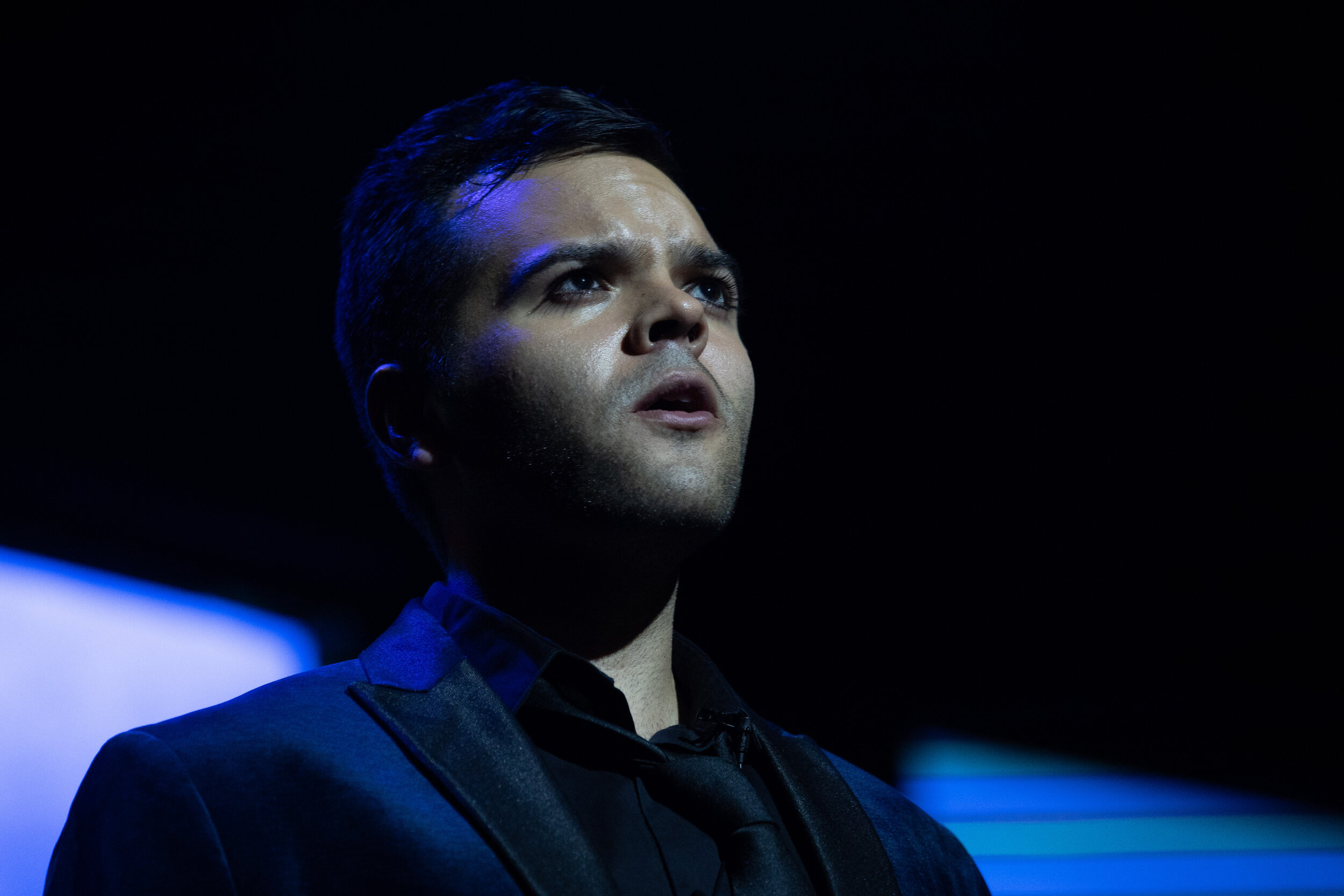
I had already created my Collective and intended to draw from them the team needed for this project. But I needed not one but three Orson Welles avatars: a youthful, middle-aged, and dying Orson. As a faculty member of the Chicago College of Performing Arts, I was able to cast the young Orson with Omar Mulero, a gifted tenor and graduate student there, then just beginning his career. 

For the middle-aged Orson, I knew beforehand that I would write for Robert Frankenberry, a prodigious musical and theatrical polymath (conductor, tenor, stage director, composer, pianist) who I had cast as Louis Sullivan in the Buffalo Philharmonic’s recording of my Frank Lloyd Wright opera Shining Brow and who had gone on to conduct the orchestra in a revival of the opera in a site-specific staging at Wright’s Fallingwater a few years later. 

I’d known for nearly a decade that I was going to write the role of the dying Welles for the legendary baritone Robert Orth. Bob was a fiercely capable, emotionally brave intellect and performer who could suavely straddle the American Music Theater and Opera traditions. The “go to” baritone for an entire generation of well-known American opera composers, Bob and I had first crossed paths when the terrific director Ken Cazan had cast him in a revival of Shining Brow with the Chicago Opera Theater in the 90s. As it happened, Bob was receiving chemotherapy during the staging and filming of Orson Rehearsed. His performance was nothing less than heroic, and he passed away a few months after production. 

Having these three men go through the discovery and staging process together, and serving as their composer and director, was really, really moving—the most fulfilling experience of my career in the theater. The give-and-take between them—Bob’s wisdom and experience, Frankenberry’s brave questing, Omar’s open, honesty—soaking it all up, glowing and growing in the process—amazing. It’s why I committed to the theater as a teenager and why I’ve remained so.

While staging my opera A Woman in Morocco for Kentucky Opera I had the good fortune to collaborate with lighting designer Victoria Bain, with whom I explored a lot of the Jean Rosenthal-inspired effects I wanted for that production. For Orson, she graciously jumped in to the Kieślowski-esque Red-White-Blue aesthetic I had in mind for Orson Rehearsed  (I first fell in love with this when composing the opera Bandana back in the late 90s—the vocal score is chock-o-block with lighting cues that most theatrical lighting designers ignore) and she nimbly avoided most of the pitfalls inherent in lighting a stage show that was going to be folded into a movie but still had to look good in the theater. There was an able young team in Chicago called Atlas Arts Media that were then just getting on their feet that was able to adroitly handle both the camera emplacements I needed for coverage and the live mix of sound for the soundtrack and CD-release of the score. 

Conductor Roger Zahab and Hagen during production at the Studebaker Theater in Chicago. (Elliott Mandel photo)

Conductor Roger Zahab and Hagen during production at the Studebaker Theater in Chicago. (Elliott Mandel photo)

6. How did you fund your film and what were some of the challenges of making this film?

The Chicago College of the Performing Arts served as a production partner in exchange for their students shadowing me as composer, director, and independent artist, as well as being cast in productions that combined both seasoned professionals and emerging artists. They shared costs with my New Mercury Collective. It is basically a sandbox, or, as Welles would say, a train set, in which I build my little sandcastles and operatic locomotives. I have more creative control than I do when I work with an opera company, but less money. On the other hand, technology has made it cheaper to make films; so long as you have the skills to wear a bunch of different hats, you can arrive at the end with something that looks and sounds pretty good.

The major challenge of production was the real-time coordination of my elaborately-crafted electro-acoustic tracks, the live onstage ensemble of eleven instrumentalists (the Chicago-based Fifth House Ensemble), the three live singers in performance with the three sixty-minute films, and the three onstage sixty-minute films on a low budget. The credit goes to composer / violinist / conductor Roger Zahab, who held it all together from the podium. The team at Chicago’s Atlas Arts Media mixed the show in real time while also giving me basic camera coverage so that I could embark upon the next leg of production with hard drives full of soundtrack ready to be mixed, and shots ready to be edited together.

7. Do you consider yourself an indie filmmaker and what would most be the most difficult thing about being an independent artist?

I have been an independent artist all my professional life, so moving sideways into the creation of indie film has been a deeply pleasurable learning experience; one that feels like donning a familiar and much-beloved old sweater. Though I’ve served on the faculties of Bard College, Princeton, and Curtis, among others, they were always adjunct positions—however long-term, that helped to pay the bills so that I could make more art. I’ve been lucky, but I’ve always been a very hard worker, and I’ve been supported by a lot of really generous people, been given a lot of opportunities to learn my craft and to grow up in my chosen fields. The indie film world of makers, presenters, and festivals is on first take a more mutually supportive scene than the concert music world.

8. What is the distribution plan for your film?

Since I am learning as I go along, I am simply entering the film into festivals and finding out who actually watches it carefully enough to find value in it. If it lands with enough people it will get legs, just as operas and concert pieces do. I realize that “legs” in this case means a distributor. If it doesn’t, then, well, nobody got hurt: in the process of making it I lived my best life, and I made a piece of art about which I care passionately.

9. What is your cinematic goal in life and what would you like to achieve as a filmmaker?

I’ve got several projects already in pre-production that carry forward the methods (combining music and image, film and live theater) I’ve been steadily digging into over the past 20 years. I’m slated to direct a filmed version of my opera Shining Brow at the Frank Lloyd Wright-designed Westcott House with the Springfield Symphony and Think TV (the Dayton PBS affiliate) next year. I’m also filming my next film/opera 9/10, set in an Italian restaurant in Little Italy the night before the Twin Towers fell, in Chicago, in spring 2022 in another CCPA-New Mercury Collective co-production. I’m taking things as they come and scaling things in order to match vision and budget sensibly. My ultimate goal is to gain complete fluency in the idiom and to work at the highest levels with collaborators from whom I can learn the most.

10. What kind of impact would your film have in the world and who is your audience?

Chris Lyons Illustration

Chris Lyons Illustration

I am thinking of this film the way that a poet thinks of a poem and a serious opera composer builds an opera: it is dense, highly allusive in its methods, and it benefits from repeated viewings; Orson Rehearsed delves with subversive lightness into some pretty dark and scary places. I am not expecting it to be “popular” in any sense of the word; it is an “art film,” that will land with people who bring an open mind and heart to it.

11. Please tell us more about the Chicago College of Performing Arts and your involvement with the institution. 

Rudy Marcozzi, rock-solid Dean of the Chicago College of Performing Arts, and Linda Berna, Associate Dean and Director of the Music Conservatory, understand that my values as a citizen and as an artist are in synch with Roosevelt University’s as an institution. The school maintains Opera and Music Theater programs side-by-side. I am grateful to have been encouraged by the faculties of both divisions to work freely with their professionally bound singers on my compositions, which consciously combine the technical and aesthetic methods of both disciplines in our uniquely American way. With their guidance, I cast CCPA’s young artists in projects that also feature mid-career professionals that I draw from my Collective, from whom (as Omar did in Orson) they learn through collaborating and observing during production. In addition, I invite the composition students—who study under the strong, mindful leadership of composer / visual artist Dr. Kyong Mee Choi—to serve as members of my production teams, to assist me as director, and so forth, to be immersed as composers in the production of opera and film in a way that they cannot elsewhere. I can’t tell you how supportive the faculty at CCPA has been of this atelier / sandbox / train set nestled within the various conservatories that make up the school.

Official Trailer.

This interview originally appeared in the October 2020 issue of Chicago Movie Magazine and may be accessed there online here.

Tags Kentucky Opera, Skylight Music Theater, Chicago Opera Theater, Oriental Landmark Theater, Federico Fellini, Martin Scorsese, Wim Wenders, Charlie Chaplin, Kieślowski, John Ford, Francis Ford Coppola, Kurosawa, George Lucas, Francois Truffaut, The New Mercury Collective, Orson Rehearsed
Featured
On Nicaragua
Dec 7, 2025
On Nicaragua
Dec 7, 2025
Dec 7, 2025
Screenshot 2025-11-17 at 5.43.35 PM.png
Nov 17, 2025
On Work
Nov 17, 2025
Nov 17, 2025
On Composing
Nov 8, 2025
On Composing
Nov 8, 2025
Nov 8, 2025
On Vocal Scores
Nov 2, 2025
On Vocal Scores
Nov 2, 2025
Nov 2, 2025
On Orchestrating Brahms
Oct 2, 2025
On Orchestrating Brahms
Oct 2, 2025
Oct 2, 2025
On Performing
Sep 3, 2025
On Performing
Sep 3, 2025
Sep 3, 2025
DH-RLW-23July2012-GM.jpg
Jul 27, 2025
On Teaching
Jul 27, 2025
Jul 27, 2025
On Music Copying
May 4, 2025
On Music Copying
May 4, 2025
May 4, 2025
On Teachers
Apr 24, 2025
On Teachers
Apr 24, 2025
Apr 24, 2025
On Venice
Mar 28, 2025
On Venice
Mar 28, 2025
Mar 28, 2025
IMG_9973%2B2.jpg
Jan 28, 2025
On Being Ready
Jan 28, 2025
Jan 28, 2025
On Singing Beautifully
Apr 9, 2024
On Singing Beautifully
Apr 9, 2024
Apr 9, 2024

Copyright © 1999-2025 Burning Sled Media