
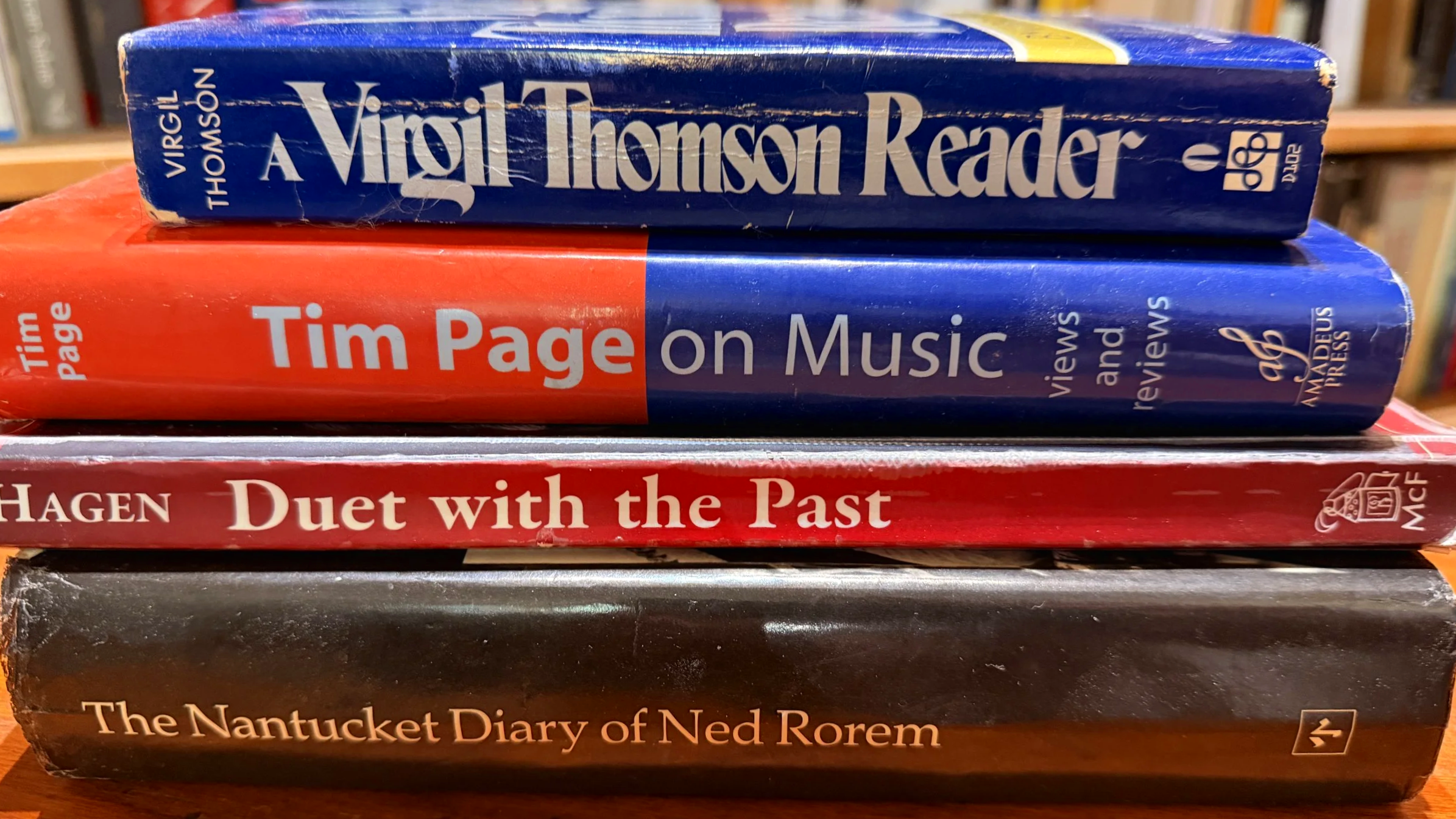
Writing about writing about music.
The red dining room table in Ned Rorem’s apartment was covered with piles of manila folders, each one with the title of the piece whose paperwork, correspondence, contract, and, most importantly, program notes, scrawled on it in loopy black and white marker. It was 29 May 2018. I had brought my sons to town for a visit. My younger one immediately accepted a blank piece of typing paper from Mary and fed it into Ned’s portable Royal and began tapping away. His big brother and I wondered at the height of the piles. “They’re going to the Library of Congress,” I explained. “Ned’s getting his papers ready to send off.” “Why?” “So that people can read them after he is gone,” I answered. “Why would they want to do that?” he asked.
Crafting prose is one of a composer’s trickiest jobs. On a lark, and happy to be paid, I ghost-wrote some program notes for a famous colleague for a few months back in the late 80s and, while I learned a lot about how that composer thought, I couldn’t help feeling like a cross between a copywriter at an ad agency writing about luxury products and a Method actor in an unhealthy role—so I quit. Ironically, from 1988-90 I enjoyed immensely crafting concert listings for 7 Days, a short-lived but really good magazine-newspaper hybrid published in the Village. I was sad when a publishing recession forced them to shut down. While I couldn’t get over the fact that ghostwriting felt dishonest, the magazine gig was an invitation to take on the irreverent but clever tone of the magazine. That was good, honest fun.
Virgil Thomson quipped to me once that they are usually “high-, middle-, and low-gossipy things.” I can’t remember the exact words he used, but it was something about “high” being who commissioned it, “middle” being how much you were paid, and “low” being who you were romancing when you wrote it. He wrote somewhere about “liquid program notes,” or what I heard him once refer to as “musical travelogues” which could scoop the piece and, above all, last too long. There was even a snarky sally that circulated at Juilliard back in the 80s about Columbia doctoral candidates whose spoken remarks typically lasted exactly twice as long as their pieces.
Ned Rorem often gave his pieces programmatic subtitles while insisting in his notes that they were meant to be literary, not literal. While Virgil’s (outwardly-facing, professional) program notes benefit from the friction between his patrician European sophistication (strikingly evident even in his earliest writings) and the American newspaperman’s reportage, Ned’s notes (seemingly confessional while being in fact meticulously calibrated for maximum public effect) benefit from the friction between his Quaker desire for plainspokenness and his Francophile playfulness. Both, of course, stated their opinions as facts.
Winner of the Pulitzer Prize for Criticism Tim Page and I are connected by way of Virgil (by whom he was mentored and whose musical writings he famously edited, describing him as “probably the best classical music critic ever,” and a primary writing influence) and for whom I worked as an arranger for a while, as Ned had done forty years earlier. We are also connected by Juilliard, where I was incredibly fortunate to take one of his first critical writing seminars, along with Bruce Brubaker, and Gwendolyn Freed. Only six years my senior, he was already a critical superstar when we met. His radio show on WNYC, New, Old, and Unexpected, was considered required listening by all the composers I knew, and I was a compulsive listener. Tim describes music without telling people what to hear.
If I admired Virgil’s writing from afar and had strong opinions — both pro and con — about Ned’s prose, my admiration for Tim’s writing was without caveat. Virgil’s public persona was the Unpretentious Sage; Ned’s was the Suave Internationalist. Tim’s compassionate directness, eclectic tastes, and intellectual acuity made him at once a world class intellectual and a person you could sit down next to at a concert and not be afraid that your stomach would gurgle at the wrong moment — as mine would whenever a piece by Elliot Carter was performed.
Interestingly, in the second half of his career, Tim has written a beautiful (miraculously slender) memoir and even managed to foster a revival of the great Dawn Powell’s works. His memoir, Parallel Play explores his life growing up with undiagnosed Asperger’s syndrome in a way that makes it useful to readers. Virgil’s autobiography is, by my reading, quite traditional; less revealing about him than his critical writing. How gloriously competitive and dead wrong he is in his review of Porgy and Bess, for example — I’d have liked to hear him rail along in his wrongness for a while. It’s good to be passionately wrong; a good rant helps to keep one sane. Ned may have written “brazenly provocative” diaries that presented themselves as confessional, but to read them as such is to miss the point: they were pure artifice, life transformed into art. If I wrote my memoir by braiding together memory, associations, and narratives with a curative eye toward, as Cesar A. Cruz’s wrote, “comforting the disturbed and disturbing the comfortable,” Tim’s writing, at its best, is restorative in its excellent, quiet pursuit of veracity.
Berlioz aside, I think what I like the most about Tim’s writing is that he writes about music like a composer without the snark.
I haven’t asked around, but I’ll bet that other composers in their fourth decade of public life have either wished they could have, or actually have, rewritten program notes for pieces written. Tim described to me once how, when he and Vanessa Weeks Page were editing Virgil’s letters, they had to keep fending off his attempts to edit his younger self. It’s hard to blame him. What were Ned’s diaries but program notes to his life — posterity trumping honesty? What was my memoir but a struggle not to fall into the same trap?
Take the program note I wrote for a nine-minute orchestra piece called Heliotrope which has grown enough legs that it still gets performed every once in a while. Commissioned by ASCAP, Lukas Foss and the Brooklyn Philharmonic premiered it at Cooper Union. In 1989, I was just out of Juilliard and had begun teaching at Bard.
The first program note is earnest, slightly academic, and has a self-justifying tone. This is followed by a deep-dive into musical materials to signal the composer’s command of skills. It closes with an aspirational summation stipulating how I’d like the piece to land. Experience hadn’t yet taught me, though I had long intuited, that one of the pitfalls of the postmodern use of stylistic allusion is that snobs reflexively consider it “musically derivative” — which they consider a putdown, having bought into some authority figure’s decree that “original” means unfamiliar and is therefore somehow “better.” The next twenty years would see me moving further and further away from what I deemed the “corporate, Transatlantic voice” — just pretty enough, just ugly enough, just complicated enough, just abstract enough.
Robert Schuneman, who was the guiding light and owner of E.C. Schirmer, the Boston music publishing house that controlled Heliotrope, asked me to write a new program note when they brought out a new edition of the study score in 2009. I was a more confident writer, and I was working full time on my memoir, so it was easy to focus on drama, narrative, and lineage.
No more talk about musical mechanics. Gone is the gush about combining jazz and concert music — now I am framing them as musical characters, and the piece as a dream scenario — which was true — I had had the dream; I just hadn’t known how to place it in a note. Amelia and Shining Brow and a half dozen other operas were already behind me and I had begun to think of everything I wrote as operatic DNA. There’s a not-so-subtle inference that the theater composer I had become was already there, nascent, in 1989. True, but Virgil would applaud my revisionism. What a visionary!
In 2019, giving a masterclass to the composers on Heliotrope, which the festival orchestra is performing at the Seasons Music Festival in Yakima, Washington, I open the manila folder I’d brought with me from New York with HELIOTROPE scrawled on it and scan a page of notes to myself that I made from memory the day before when the incredulous conductor, unable to explain to the drummer what my markings meant and not bothering to conceal that he didn’t think that I knew, turned around and instructed me in front of the orchestra to explain them to the player.
The interaction was a perfect lesson in the art of sophisticated stealth. It showed the composers how to weave "low" styles into "high" art and how to handle the snobbery of conductors who dismissed the piece as a mere "pops" tune. Heliotrope’s obviousness is actually a clever ruse. Much like Mark Twain, who used simple folk language to hide deep social commentary, the piece’s simplicity is foxy and subversive. It uses elite complexity not to show off, but to charm.
During the break I had talked the embarrassed percussionist through what I meant by “70s Television Rock Style,” followed four bars later by “McCoy Tyner-style,” and then, at measure 44, “40s Broadway-style,” and then at measure 205, “50s Nelson-Riddle-style,” followed by “Gene Krupa-style” at measure 225. “But I don’t know these things,” he said. “Go online and listen to each of them and you’ll hear how distinctive they are. It’s your repertoire,” I explained. “No, it isn’t,” he replied. “I’m an orchestral percussionist. They should hire someone who knows how to do this.”
A few months ago, I had a day to throw at that pile of scores and manuscripts that lives on my desk behind the computer monitor. I pulled up my pencil score for an orchestration of Heliotrope Bouquet that I had done for JoAnn Falletta and the Denver Chamber Orchestra that Bob Schuneman had asked to publish shortly before he died and that the company had now forgotten it owned. As a respectful gesture, I reminded the current owner of the company that they owned it and I was about to engrave it after all these years and did he still want it because I was happy to take it back and give it to Peermusic if he didn’t. He was pleased to keep it. So engrave it I did, and in so doing, was taken on one of those Sextonian “Music Remembers” journeys that only musical Madeleines may: I remembered Philly in the 80s, and Denver, and a hundred other things as I engraved. I listened to the thing again for the first time in years and was moved to write a third —and I think final — program note for Heliotrope. The 2025 program note reads like this:
This Heliotrope, or, better yet, this bouquet of heliotropes, is commissioned by ASCAP, the membership association of songwriters, composers, and music publishers that operates as a performing rights organization to celebrate the 75thAnniversary of its founding and affectionately tossed to the audience like a wedding bouquet signifying love, hope, and individuality by one of its grateful composer members. It uses as its starting point a little original theme I always hum over the trio when I play Scott Joplin and Louis Chauvin’s Heliotrope Bouquet at the piano and runs with it.
Reflective and philosophical, this final look at Heliotrope aims to prove nothing. Now that the memoir is several years behind me and the Bardo Trilogy has been rendered to film, I am interested in the work's longevity, not its mechanics. I have shifted my focus from how the piece was made to why; how it lands with an audience is now infinitely more vital than explaining my rationale for simply being who I am. If there is a hint of fatigue here, it is because the vigor with which I once reacted to the snobs has given way to a search for correlatives. Listening now, I can hear my eager young mind thinking out loud; I still like the ideas, and I am finally on the other side of paying the price for having gone my own way. In these notes, I connect the music to the physical act of its creation — playing it at the piano — and the "ghost" of a tune that was evoked as I played. While Ned would find such an anecdote a distraction, he would at least appreciate that I was throwing the public a bone. I remain relentless in my subversion of class distinctions, insisting that the "low-art" of ragtime and the "high-art" of the symphony belong in the same room.
I know now that music doesn’t “mean” anything. Its abstraction is its greatest appeal. It is worth noting that Ned sat just behind me at the premiere and really, really disliked Heliotrope. I was delighted. Ned, the Proustian socialite, opted for high-brow aesthetics as befitted a Midwestern arriviste of his generation. Born a few decades later, I view composers as members of a guild rather than a social elite. I use narrative to reach the “middle-brow” audiences who might feel alienated by Ned’s taste-driven world. Both our choices were conscious; both were valid; they simply exist in direct opposition.
In the early 80s, I adopted Ned’s habit of filing everything — save for personal letters — in folders dedicated to the associated piece. “When did you know you’d be sending your papers to the library?” I once asked him. “I sort of always knew,” he said, unsentimental. I asked Virgil the same thing a few weeks later. “I always knew, kid,” he laughed. “Always.”
So, here I am in my office, closing a manila folder with HELIOTROPE written across it in big, loopy letters. I smell the old paper, the dust of a dozen different apartments, and place it into one of the boxes destined for the University of Wisconsin Mills Music Library this September. I will write no new program note for this piece; I have read others’ words about the piece that I like better. In the end, none of the words matter; but the music still does. That said, I foresee never laying eyes on these words, these notes, again.
Gently, now.