
• SHORT
    • LONG
    • worklist by genre
    • worklist by year
    • blog
    • Exploring Operafilm
    • Duet With the Past
  • news
  • operafilms
  • operas
    • discography
    • archive
    • press portraits
    • Colleagues
    • lagniappe
    • galleries
    • Papers / Archive
    • Fleisher Collection
    • Bibliography
    • interviews / lectures
    • Reviews
  • contact
Menu

Daron Hagen

  • bio
    • SHORT
    • LONG
  • music
    • worklist by genre
    • worklist by year
  • words
    • blog
    • Exploring Operafilm
    • Duet With the Past
  • news
  • operafilms
  • operas
  • recordings
    • discography
    • archive
  • gallery
    • press portraits
    • Colleagues
    • lagniappe
    • galleries
  • research
    • Papers / Archive
    • Fleisher Collection
    • Bibliography
    • interviews / lectures
    • Reviews
  • contact

blog

On Notes

April 27, 2026

Writing about writing about music.

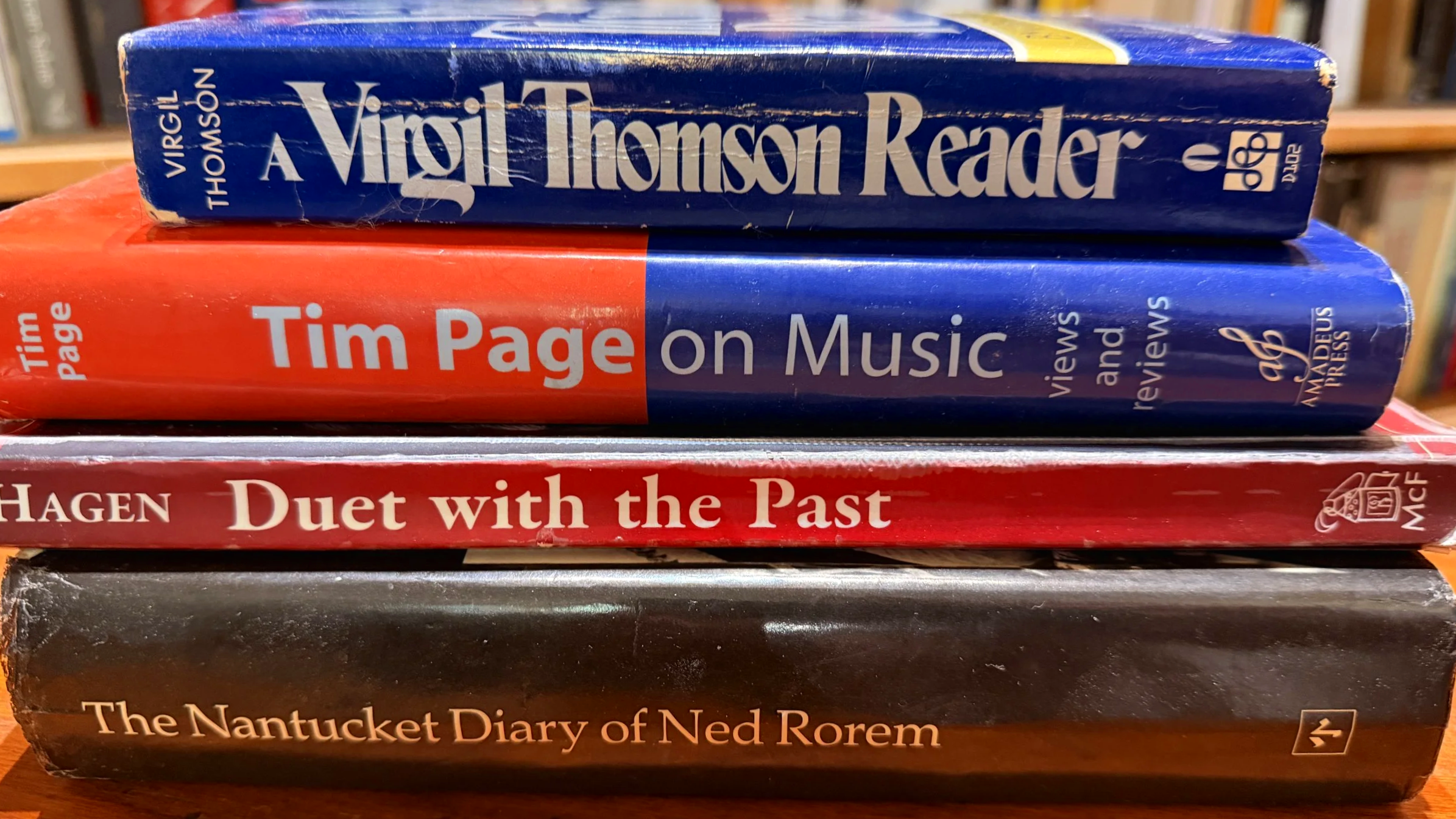
The red dining room table in Ned Rorem’s apartment was covered with piles of manila folders, each one with the title of the piece whose paperwork, correspondence, contract, and, most importantly, program notes, scrawled on it in loopy black and white marker. It was 29 May 2018. I had brought my sons to town for a visit. My younger one immediately accepted a blank piece of typing paper from Mary and fed it into Ned’s portable Royal and began tapping away. His big brother and I wondered at the height of the piles. “They’re going to the Library of Congress,” I explained. “Ned’s getting his papers ready to send off.” “Why?” “So that people can read them after he is gone,” I answered. “Why would they want to do that?” he asked.

Crafting prose is one of a composer’s trickiest jobs. On a lark, and happy to be paid, I ghost-wrote some program notes for a famous colleague for a few months back in the late 80s and, while I learned a lot about how that composer thought, I couldn’t help feeling like a cross between a copywriter at an ad agency writing about luxury products and a Method actor in an unhealthy role—so I quit. Ironically, from 1988-90 I enjoyed immensely crafting concert listings for 7 Days, a short-lived but really good magazine-newspaper hybrid published in the Village. I was sad when a publishing recession forced them to shut down. While I couldn’t get over the fact that ghostwriting felt dishonest, the magazine gig was an invitation to take on the irreverent but clever tone of the magazine. That was good, honest fun.

Virgil Thomson  quipped to me once that they are usually “high-, middle-, and low-gossipy things.” I can’t remember the exact words he used, but it was something about “high” being who commissioned it, “middle” being how much you were paid, and “low” being who you were romancing when you wrote it. He wrote somewhere about “liquid program notes,” or what I heard him once refer to as “musical travelogues” which could scoop the piece and, above all, last too long. There was even a snarky sally that circulated at Juilliard back in the 80s about Columbia doctoral candidates whose spoken remarks typically lasted exactly twice as long as their pieces.

Ned Rorem often gave his pieces programmatic subtitles while insisting in his notes that they were meant to be literary, not literal. While Virgil’s (outwardly-facing, professional) program notes benefit from the friction between his patrician European sophistication (strikingly evident even in his earliest writings) and the American newspaperman’s reportage, Ned’s notes (seemingly confessional while being in fact meticulously calibrated for maximum public effect) benefit from the friction between his Quaker desire for plainspokenness and his Francophile playfulness. Both, of course, stated their opinions as facts.

Winner of the Pulitzer Prize for Criticism Tim Page and I are connected by way of Virgil (by whom he was mentored and whose musical writings he famously edited, describing him as “probably the best classical music critic ever,” and a primary writing influence) and for whom I worked as an arranger for a while, as Ned had done forty years earlier. We are also connected by Juilliard, where I was incredibly fortunate to take one of his first critical writing seminars, along with Bruce Brubaker, and Gwendolyn Freed. Only six years my senior, he was already a critical superstar when we met. His radio show on WNYC, New, Old, and Unexpected, was considered required listening by all the composers I knew, and I was a compulsive listener. Tim describes music without telling people what to hear.

If I admired Virgil’s writing from afar and had strong opinions — both pro and con — about Ned’s prose, my admiration for Tim’s writing was without caveat. Virgil’s public persona was the Unpretentious Sage; Ned’s was the Suave Internationalist. Tim’s compassionate directness, eclectic tastes, and intellectual acuity made him at once a world class intellectual and a person you could sit down next to at a concert and not be afraid that your stomach would gurgle at the wrong moment — as mine would whenever a piece by Elliot Carter was performed.

Interestingly, in the second half of his career, Tim has written a beautiful (miraculously slender) memoir and even managed to foster a revival of the great Dawn Powell’s works. His memoir, Parallel Play explores his life growing up with undiagnosed Asperger’s syndrome in a way that makes it useful to readers. Virgil’s autobiography is, by my reading, quite traditional; less revealing about him than his critical writing. How gloriously competitive and dead wrong he is in his review of Porgy and Bess, for example — I’d have liked to hear him rail along in his wrongness for a while. It’s good to be passionately wrong; a good rant helps to keep one sane. Ned may have written “brazenly provocative” diaries that presented themselves as confessional, but to read them as such is to miss the point: they were pure artifice, life transformed into art. If I wrote my memoir by braiding together memory, associations, and narratives with a curative eye toward, as Cesar A. Cruz’s wrote, “comforting the disturbed and disturbing the comfortable,” Tim’s writing, at its best, is restorative in its excellent, quiet pursuit of veracity.

Berlioz aside, I think what I like the most about Tim’s writing is that he writes about music like a composer without the snark.

I haven’t asked around, but I’ll bet that other composers in their fourth decade of public life have either wished they could have, or actually have, rewritten program notes for pieces written. Tim described to me once how, when he and Vanessa Weeks Page were editing Virgil’s letters, they had to keep fending off his attempts to edit his younger self. It’s hard to blame him. What were Ned’s diaries but program notes to his life — posterity trumping honesty? What was my memoir but a struggle not to fall into the same trap?

Take the program note I wrote for a nine-minute orchestra piece called Heliotrope which has grown enough legs that it still gets performed every once in a while. Commissioned by ASCAP, Lukas Foss and the Brooklyn Philharmonic premiered it at Cooper Union. In 1989, I was just out of Juilliard and had begun teaching at Bard.

The first program note is earnest, slightly academic, and has a self-justifying tone. This is followed by a deep-dive into musical materials to signal the composer’s command of skills. It closes with an aspirational summation stipulating how I’d like the piece to land. Experience hadn’t yet taught me, though I had long intuited, that one of the pitfalls of the postmodern use of stylistic allusion is that snobs reflexively consider it “musically derivative” — which they consider a putdown, having bought into some authority figure’s decree that “original” means unfamiliar and is therefore somehow “better.” The next twenty years would see me moving further and further away from what I deemed the “corporate, Transatlantic voice” — just pretty enough, just ugly enough, just complicated enough, just abstract enough.

Robert Schuneman, who was the guiding light and owner of E.C. Schirmer, the Boston music publishing house that controlled Heliotrope, asked me to write a new program note when they brought out a new edition of the study score in 2009. I was a more confident writer, and I was working full time on my memoir, so it was easy to focus on drama, narrative, and lineage.

No more talk about musical mechanics. Gone is the gush about combining jazz and concert music — now I am framing them as musical characters, and the piece as a dream scenario — which was true — I had had the dream; I just hadn’t known how to place it in a note. Amelia and Shining Brow and a half dozen other operas were already behind me and I had begun to think of everything I wrote as operatic DNA. There’s a not-so-subtle inference that the theater composer I had become was already there, nascent, in 1989. True, but Virgil would applaud my revisionism. What a visionary!

In 2019, giving a masterclass to the composers on Heliotrope, which the festival orchestra is performing at the Seasons Music Festival in Yakima, Washington, I open the manila folder I’d brought with me from New York with HELIOTROPE scrawled on it and scan a page of notes to myself that I made from memory the day before when the incredulous conductor, unable to explain to the drummer what my markings meant and not bothering to conceal that he didn’t think that I knew, turned around and instructed me in front of the orchestra to explain them to the player. I intended to use the interaction as a teaching moment with the composers — an opportunity to discuss how to integrate “low” styles in so-called “high” contexts and how to elegantly cope with the condescension of  snobbish conductors who felt that the piece would be better served on a “pops” concert.

The interaction was a perfect lesson in the art of sophisticated stealth. It showed the composers how to weave "low" styles into "high" art and how to handle the snobbery of conductors who dismissed the piece as a mere "pops" tune. Heliotrope’s obviousness is actually a clever ruse. Much like Mark Twain, who used simple folk language to hide deep social commentary, the piece’s simplicity is foxy and subversive. It uses elite complexity not to show off, but to charm.

During the break I had talked the embarrassed percussionist through what I meant by “70s Television Rock Style,” followed four bars later by “McCoy Tyner-style,” and then, at measure 44, “40s Broadway-style,” and then at measure 205, “50s Nelson-Riddle-style,” followed by “Gene Krupa-style” at measure 225. “But I don’t know these things,” he said. “Go online and listen to each of them and you’ll hear how distinctive they are. It’s your repertoire,” I explained. “No, it isn’t,” he replied. “I’m an orchestral percussionist. They should hire someone who knows how to do this.”

A few months ago, I had a day to throw at that pile of scores and manuscripts that lives on my desk behind the computer monitor. I pulled up my pencil score for an orchestration of Heliotrope Bouquet that I had done for JoAnn Falletta and the Denver Chamber Orchestra that Bob Schuneman had asked to publish shortly before he died and that the company had now forgotten it owned. As a respectful gesture, I reminded the current owner of the company that they owned it and I was about to engrave it after all these years and did he still want it because I was happy to take it back and give it to Peermusic if he didn’t. He was pleased to keep it. So engrave it I did, and in so doing, was taken on one of those Sextonian “Music Remembers” journeys that only musical Madeleines may: I remembered Philly in the 80s, and Denver, and a hundred other things as I engraved. I listened to the thing again for the first time in years and was moved to write a third —and I think final — program note for Heliotrope. The 2025 program note reads like this:

This Heliotrope, or, better yet, this bouquet of heliotropes, is commissioned by ASCAP, the membership association of songwriters, composers, and music publishers that operates as a performing rights organization to celebrate the 75thAnniversary of its founding and affectionately tossed to the audience like a wedding bouquet signifying love, hope, and individuality by one of its grateful composer members. It uses as its starting point a little original theme I always hum over the trio when I play Scott Joplin and Louis Chauvin’s Heliotrope Bouquet at the piano and runs with it.

Reflective and philosophical, this final look at Heliotrope aims to prove nothing. Now that the memoir is several years behind me and the Bardo Trilogy has been rendered to film, I am interested in the work's longevity, not its mechanics. I have shifted my focus from how the piece was made to why; how it lands with an audience is now infinitely more vital than explaining my rationale for simply being who I am. If there is a hint of fatigue here, it is because the vigor with which I once reacted to the snobs has given way to a search for correlatives. Listening now, I can hear my eager young mind thinking out loud; I still like the ideas, and I am finally on the other side of paying the price for having gone my own way. In these notes, I connect the music to the physical act of its creation — playing it at the piano — and the "ghost" of a tune that was evoked as I played. While Ned would find such an anecdote a distraction, he would at least appreciate that I was throwing the public a bone. I remain relentless in my subversion of class distinctions, insisting that the "low-art" of ragtime and the "high-art" of the symphony belong in the same room.

I know now that music doesn’t “mean” anything. Its abstraction is its greatest appeal. It is worth noting that Ned sat just behind me at the premiere and really, really disliked Heliotrope. I was delighted. Ned, the Proustian socialite, opted for high-brow aesthetics as befitted a Midwestern arriviste of his generation. Born a few decades later, I view composers as members of a guild rather than a social elite. I use narrative to reach the “middle-brow” audiences who might feel alienated by Ned’s taste-driven world. Both our choices were conscious; both were valid; they simply exist in direct opposition.

In the early 80s, I adopted Ned’s habit of filing everything — save for personal letters — in folders dedicated to the associated piece. “When did you know you’d be sending your papers to the library?” I once asked him. “I sort of always knew,” he said, unsentimental. I asked Virgil the same thing a few weeks later. “I always knew, kid,” he laughed. “Always.”

So, here I am in my office, closing a manila folder with HELIOTROPE written across it in big, loopy letters. I smell the old paper, the dust of a dozen different apartments, and place it into one of the boxes destined for the University of Wisconsin Mills Music Library this September. I will write no new program note for this piece; I have read others’ words about the piece that I like better. In the end, none of the words matter; but the music still does. That said, I foresee never laying eyes on these words, these notes, again.

Gently, now.

Tags Ned Rorem, Library of Congress, Virgil Thomson, Quakerism, Dan Brubaker, Gwendolyn Haverstock, Dawen Powell, Cesar A. Cruz, Porgy and Bess, Vanessa Weeks Page, Heliotrope, Robert Schuneman, ECS Publishing, Shining Brow, Amelia, McCoy Tyner, Nelson Riddle, Gene Krupa, Denver Chamber Orchestra, Peermusic Classical, ASCAP, The Bardo Trilogy

On Montage

February 12, 2026

Director Giuseppe Tornatore’s Salvatore weeps alone as he gratefully receives the unexpected gift of a lifetime of edited-out kisses unreeling at the end of Cinema Paradiso (1988); Noah Baumbach’s Jay, accompanied by his agent, vacillates between cool, professional self-critical appraisal and straight-ahead narcissism, seeming almost to struggle to succumb to tears as a lifetime of his performances unreels in Jay Kelly (2025). Both directors’ montages are brave, highly poetic visual quodlibets that appear to be aiming for the elevated emotional reverie of the sustained and examined single emotional state at which opera is particularly good.

From my Amelia (2010) work notes I can see that I was already reaching toward operafilm from the direction of music the way that Baumbach and Tornatore were reaching toward it from the direction of cinema. I conceived of the a capella cadenza featuring the entire company at the end of the opera as the doctor held her newborn aloft in the delivery room with Tornatore’s masterful montage in mind. In the sketches,  even marked the passage “Unspooling like a montage of kisses.” My vocal ensemble brought together the eponymous heroine’s souls — family both quick and not, imaginary mythological characters, and the professional medicos just doing their jobs — to sing “Anything is possible.” The sequence has always been staged as a tableaux in the opera house, like most operatic scenes of its type. If we had had dancers in Seattle I would have composed the same music and called upon the choreographer to execute Amelia’s stylized memories — reaching toward operafilm. Honor is due Ennio Morricone’s eloquent underscoring of the Paradiso montage, and Curtis’ use of Brian Wilson’s immortal God Only Knows to underpin the closing Heathrow montage of Love, Actually. How keenly I’d like to complete the transition I began at the end of Amelia from opera to operafilm composer by going back and transforming that big ensemble into what it so clearly (in retrospect) wanted to be — not by changing a note of the music, but by integrating the images and live movement that I held even then in my head as I wrote it.

Composed in the late 80s and early 90s during a period when a number of “great person” – sometimes called “CNN operas” – were being written, including Nixon in China (1987), Harvey Milk (1995), Rasputin (1988), and Marilyn (1993), the human cost of unbridled self-actuation was addressed by “me generation” Boomers. Paul Muldoon and I elected, when treating Frank Lloyd Wright’s life in our first collaboration, Shining Brow (1993), to take Wright to the point in his life immediately after the deaths of Mamah Cheney and her children — the point at which he is about to make the choice between his own self actuation and others’ as described by Hermann Hsse: “Ich meine, man könne eine ziemlich scharfe Grenze zwischen Jugend und Reife ziehen. Die Jugend endet mit dem Egoismus, die Reife beginnt mit dem Leben für andere.” (“I mean that one can draw a fairly sharp line between youth and maturity. Youth ends with egotism does; maturity begins with living for others.”) We ask whether leaving an artistic legacy is enough.

Jay Kelly watches as his life’s performances flash before him in what Bazin described as “veritable luminous impression[s] in light” not in Byronic solitary contemplation like Salvatore but accompanied by his manager, with whom he has an exploitative, transactional relationship. Is Ron Jay’s Svengali or is it the other way around? Clips chosen (presumably by filmmaker Baumbach) from George Clooney’s wide-ranging in-real-life catalogue transform the Real-Life actor’s role into the film’s raisonneur, robbing the character he’s playing of agency. It’s a curiously unkind message that the scene is sending, particularly when both characters appear to weep. Ron’s tears are for himself: they mourn the failure to save a loved one from their own selfishness and the knowledge that he and Jay are consequently (and necessarily) quits. Jay’s tears are self-pitying, too: he (evidently) realizes that he’s alone and lonely because he sacrificed being a humane person for the sake of self-actuation. He, like our character of Wright, has all the trappings of adulthood – a partner, children, a career – but he has yet to commit to something larger than himself. “Can I go again? I’d like another one,” he bleats, radiating existential regret. But, whereas architect Wright – like composer Robbie in my operafilm I Hear America Singing (2025) – was a creator and the creator of his own reality, Jay is a re-creator, the executant (or, as Muldoon described Wright’s apprentices, “the pencil in [Wright’s] hand”) of other artists’ visions.

Director Tornatore fashions a dithyramb in the spirit of ancient Greek theater to cinema’s representation of romantic and carnal love. The power of the “kiss montage” sequence in Paradiso is only partly in the order and choice of the strips of celluloid cut from the films by the censorious priest, Father Adelfio. The montage cuts away again and again to track Salvatore’s emotions as we watch him in medium closeup from a nearby seat watching the film unspool. There is an emotionally accessible, plangent love being passed from the blind projectionist (ha!) Alfredo to Salvatore through the years which Salvatore seems to be accepting as an example of the lost past that his own films have tried to replicate, but that now he has come to realize is agape — corporeal, human, messy, tear-streaked, and happy-sad. He’s brave (and mature) enough to allow himself to be vulnerable, taken for a sentimental fool, knowing that, in the final result, it is the real kisses, not the ones on celluloid, that matter — even though his greatest love may well have been film.

The bookending montages of embraces at the beginning, and the literal splitting up into thousands of embraces at the end, of Richard Curtis’ Love Actually (2003), celebrate in their Brené Brown way the same urge to connect, but they aren’t staged like Tornatore’s, or abstractions of their own experience, like Baumbach’s. The ending “Heathrow montage” mixes (as love mixes fantasy and reality) the characters in the story with footage of real passengers at London Heathrow Airport whose unrehearsed and unscripted reunions frame the artifice of the parallel narratives that make up the screenplay. I emulated this approach by surrounding / framing my characters in 9/10: Love Before the Fall (2023) with “real” diners given only a single instruction — to not look at the cameras. My operafilm Orson Rehearsed (2021), of course, is a multi-layered collection of montages operating at different speeds and levels, sometimes from left to right in time, and sometimes simultaneously in what I think of as “Vertical Kuleshov.” (The “Kuleshov” Effect — named after Lev Kuleshov — is a film editing principle where the audience derives more meaning from the interaction of two sequential shots than from a single shot in isolation.) Combining the “Kuleshov Effect” with “Fosse Time” at least begins to suggest the complexity of the way people understand experience.

In fact, the concept of “Vertical Kuleshov” defines the heart of my pursuit in “operafilm.” By extending the classic Kuleshov effect into a vertical, audiovisual dimension, I weave layered images and precisely correlated musical ideas into a unified expressive whole. Yet, the true resonance of this work lives in the alchemy of the spectator’s gaze; it is the audience who performs the final, essential act of creation, fusing these independent streams into a single, shimmering emotional reality. Just as melodic lines in counterpoint retain their autonomy while blossoming into a richer harmony, these interwoven threads of sight and sound function as a living audiovisual counterpoint. Vertical Kuleshov is more than a metaphor — it is the formal grammar of a work that is fully authored from score to screen yet only finds its ultimate completion in the mind of the viewer.

Through “Vertical Kuleshov,” Orson Rehearsed blends Welles’ real biography and his fictional roles as his life unspools as a “memory palace” of beats. Through traditional montage, Jay Kelly replays key scenes of the eponymous actor’s life as he makes his way to the tribute event at which he then completes his inner journey by replaying key scenes in his filmography. Cinema Paradiso is about the restoration of memories, while Orson is an exercise in the censorship of self, a creator’s fixation on refashioning experience to the very end. While in Paradiso and Kelly Alfredo and Ron sacrifice themselves for their proteges, we are invited to witness Welles’ destruction of Self (like Robbie’s and American Music’s in I Hear America Singing). Robbie views his life as a perpetual cosmic audition, with his narrative leaping mid-sentence from apartment to theater to park bench. This fluid movement mirrors Baumbach’s Kelly, where the protagonist sits in an audience watching his own life—a fulcrum between art and artifice. It evokes the way the film clips in Paradiso bridge Salvatore’s past and future, or how Love, Actually uses its sprawling locations to suggest that Shakespeare’s stage is, truly, “everywhere."

Tags Giuseppe Tornatore, Cinema Paradiso, Noah Baumbach, Jay Kelly, Amelia, CNN Operas, Nixon in China, Harvey Milk (opera), Rasputin (opera), Marilyn (opera), Kuleshov, montage, Frank Lloyd Wright, Paul Muldoon, Mamah Cheney, Herman Hesse, Byronic, raisonneur, I Hear America Singing, Love, Love Actually, Kuleshov Effect, 9/10: Love Before the Fall, Orson Rehearsed, George Clooney

On Vocal Scores

November 2, 2025

On a shelf in a hallway connecting the chorus and band rooms at Pilgrim Park Junior High School in Brookfield, Wisconsin in spring 1976 dwelt 30 copies of the vocal score of Georges Bizet’s Carmen. Wallace Tomchek, our charismatic, terrifying, wildly gifted, somewhat mad chorus teacher, told me that he intended to stage it one spring, “if ever I have the voices.” An opera? I asked, dazzled. “Possibly the best,” he answered briskly, pulling a score off the shelf and tossing it to me the way that, three years later, literature teacher Diane Doerfler would toss to me a copy of John Cheever’s short stories with a mischievous grin, singing, “Here, read these; he mainly gets it right.” I don’t think that the biology of mustering enough teenage choral students to mount Carmen ever worked out for Wally, but I already intuited that I would be an artist, probably a musician or writer, when he told me to keep the score only a year or two before my brother Kevin gave me the vocal score of Benjamin Britten’s Billy Budd for Christmas, thereby cementing my love affair with opera. I treasure both vocal scores to this day.

That year, Wally required that our parents all purchase for us copies of the beautiful 1970 gold-covered Williamson edition of Rogers and Hammerstein’s The Sound of Music. Wally had (rightly) determined that I was at best supporting actor material and had cast me as Max, a role so integral to the show that they cut his songs when the movie was made. “Piano Reduction by Trude Rittman,” I read on the title page.

Over time, I came to know (in my heart and in my hands both) and love the smoothly schmoozy feel of playing Frank Loesser vocal scores; the cooly precise, Ravel-like fussiness of Stephen Sondheim’s; the gnarly, saturated chromatics of Richard Strauss’ own piano reductions, with all the heavy lifting in the thumbs and index fingers of both hands; Kurt Weill’s flinty, Hindemith-y piano reductions to his own (European) scores, followed by the more Gershwin-y feel of his (American) scores; Jack Beeson’s scholarly, sensible reductions of his own shows — especially Lizzy Borden; the richly pianistic vocal scores of Marc Blitzstein for his own shows, which feel as though one should be singing them at the piano whilst playing. Things begin to run off the rails with George Gershwin’s own piano reduction of Porgy and Bess, which requires a real pianist — ironically, the hardest music to play is the transitional stuff, which gets all Gaspard de la nuit and requires real chops — to pull off.

Then there are the vocal scores executed not by the composers themselves but by associates: the practical, uninspired, not particularly singer-friendly Erwin Stein reductions of Benjamin Britten’s Peter Grimes and Billy Budd, which I love, but which do not feel good to play; the noble piano reduction by composer John McGinn of John Adams’ Nixon in China — a real achievement — both playable and fun; Noel Coward’s marvelous, splay-fingered vocal scores executed by Elsie April, which always made me want to have a martini at hand; the co-blended vocal score of West Side Story, which is harder to play than it needs to be, and requires the pianistic athleticism of a keyboard jock to get through.

One of the most inspiring things about the lyric theater — by which I mean live theater or film in which people start singing now and then or all the time — is its compulsively collaborative nature. “Composer” can mean the person who wrote the tune, supported by an arranger who either adds chords or serves as an amanuensis to a composer playing by ear, as well as a “dance music arranger” who takes the tune and develops it for a dance sequence. Robert Russell Bennett used to write the overtures to the shows that he orchestrated for Rogers, and for Cole Porter (despite having the chops, having studied orchestration with Vincent D’Indy), for example. Lin-Manuel Miranda’s In the Heights score was powered by Bill Sherman and Alex Lacamoire, who transcribed, arranged and orchestrated the show.

Musical departments gather and congeal based on time constraints and trust: John Williams and Conrad Pope, because of the speed at which musical materials must be generated for film; Leonard Bernstein and Irwin Kostal / Sid Ramin, who were given detailed “short scores” for execution as a 27 piece pit arrangement for West Side Story, freeing up Bernstein’s time so that he could be “in theater” and able to make changes quickly to a rapidly evolving, choreography-heavy show. Or Sondheim and Jonathan Tunick, whose signature sound is as recognizable as was Robert Russell Bennet’s and as important to the success of the shows on which he works. Which brings us back around to the queen of them all: German composer Trude Rittman, whose Sound of Music reduction was just the tip of the iceberg of her involvement in some of the greatest scores in the American Musical Theater.

In fact, the core piano vocal score documents — disciplined, vocally-supportive, easy-to-play while following a conductor’s stick or coaching a singer — of the American MT repertoire are nearly all Trude Rittman’s superb handiwork: Rogers’ great scores (Carousel, South Pacific, Sound of Music, The King and I); Frederick Loewe’s (more ornate, harder to play) Camelot, My Fair Lady, and numerous orchestrations, dance arrangements. What a treat it was to run into her handwriting, and to learn the handwriting styles of all the great orchestrators when I used to hand copy music at Chelsea Music back in the day.

The number of composer executive chefs in the kitchen, the number of sous-chefs, line cooks, and pastry chefs is dizzying and — if one has a taste for playing in a pit or singing on a stage — pretty cool. (The role of composer is entirely different in commercial MT than it is in opera. For example, when Burt Bacharach got the flu and ran behind in delivering songs for Promises, Promises the producer threatened to take on another composer to finish the score.) With all the different crews crafting performance documents in the living theater, there are bound to be myriad variations on what constitutes the best sort of piano reduction for a show. Usually, they come to us like love letters left after the end of a love affair, sitting in a box at a place like Chelsea Music in Manhattan, founded by Don Walker and Mathilde Pinchus, with the name of the show stamped on the side and a big “piano conductor” score bound archivally, leaning hard either to the left or to the right, there to stay until Broadway’s lights (or the office lights) are extinguished for good —  or until the creative teams’ heirs transfer the papers to some university’s archives. Otherwise, they sit, awaiting the next revival.

Piano conductor scores consist of a playable piano part and other lines that contain meaningful countermelodies and “fills” that can be assigned to whomever has been hired for the production at hand. They’re sometimes conducted from (Boosey and Hawkes only brought West Side Story’s conductor score out a few years ago, for example), but, usually, the show’s producers have spent just enough on the music to get the cast album in the can and then — man, I’ve seen shows where the “p/c” and the orchestra parts were just left on the stands at the recording session and then … lost, because the show’s impact was so ephemeral and nobody thought it would ever be revived. Anyone who has played a semi-professional community playhouse production of anything has played out of these books (which have gotten pretty slick — particularly when an outfit like Disney owns the copyright), and which often have the name of the player and the city where the “bus and truck” tour last ended. It is such great insider theater lore.

In the musical theater, pianists accept as a matter of honor that their vocal book is itself a malleable, living, evolving thing, and that errors and inconsistencies will crop up during production(s) over the years as changes for various situations are made and unmade. Cuts are made and sewn up, transitions massaged, songs added and dropped.

American opera composers sometimes emerge from the musical theater tradition and are abashed when pulled up short by opera repetiteurs and rehearsal pianists, who typically expect their scores to have been “frozen” and edited. Opera pianists can’t really be blamed for feeling taken advantage of, since they’re being pulled out of their professional comfort zone if they have never ever coached or played a musical. Their default stance is often (though not always) that the composer didn’t have enough common sense or experience to simplify their short score, either by simply supporting the singers the way Rittman’s scores did or leaving them to their own devices and simply presenting the orchestra parts, as Stein’s did. They can hardly be blamed for feeling that, not only do they have to watch the stick, coach the singers, but also piece together an idiomatic part to play.

There’s a lot to sort out here. Full disclosure: It should be obvious by now that I grew up playing shows and operas from all sorts of scores and truly enjoy coming to terms with the different ways that they come to us. I began my opera career fourteen operas ago by crafting my first piano reduction based on the Britten / Stein model with a dash of Rittman. I’ve come at each score with a fresh ear, hoping to capture the psychology of that opera, but — for better and for worse — I have never “coddled” singers by doubling them in the orchestra unnecessarily and I don’t do it in my vocal scores. Because I have always loved browsing the stacks and learning repertoire from the page, I’ve loved crafting the vocal scores myself to my theatrical works.

I do not use arrangers or orchestrators. It’s just not my way. I have always composed into full (or, if rushed, a detailed short) score, even when the commissioning agreement calls for a piano reduction first to facilitate workshops. Perhaps, one day I will leave making the piano reduction of one of my operas to someone else, because it is a lot of work, or maybe just to see how it feels. It will probably be done better than I could do it. Maybe when I write an opera without words.

In any event, here are a couple of anecdotes that illustrate the level of mutual forbearance, respect and trust required of opera composers and opera coach / repetiteurs to get the work done.

I remember the conductor of an early revival of my opera Shining Brow who added thirds and (often) unresolved 7ths and 9ths to the piano reduction I had made when coaching. He explained that it helped the singers to find their pitches (I had followed the Britten / Stein model). At the first orchestral read-through, the singers had trouble finding their pitches because they had relied on the extra notes he’d been feeding them.

Another time, during a revival of Amelia, for which the original commissioning contract had stipulated that there would be two pianists for rehearsals, the pianist took me aside and said, “With all due respect, you could have given me a piano reduction instead of a short score to coach from.” The next revival, the pianist, playing out of the newly simplified score, admonished me to put in instrumental cue names so that he could tell the singers “what to listen for” when coaching. (In musical theater scores, such cues are common, and I often put them in, but, for that generation of the vocal score I had removed them.)

Coaching the original cast of Vera of Las Vegas from the keyboard (as I had my previous shows) in Las Vegas, I had delighted in getting every articulation right, every musical style just so, every mannerism notated. Twenty years later, during a European tour, I laughed with the band over beers when they said, “Jesus, you were specific. We know what you want. Trust us. Take them all out.” Too late, the score had been “frozen” years previous.

Some operas, like Orson Rehearsed, are modular, and incorporate lots of un-notateable electronica. Imagine my brilliant conductor’s consternation when the otherwise beautiful vocal score he was using to coach his singers didn’t capture exactly what the electronics were doing. “Once I figured that out, I was fine, but before that, it was touch and go.”

The vocal score of The Antient Concert was, first and foremost, a document of the string quartet arrangement with which the work was first premiered. Jocelyn Dueck, the coach and repetiteur for the original workshop at the Princeton Atelier, was comfortable “dropping” phrases when she needed to so that she could support the singers. The result was that she played an opera score like a musical theater score. She really “got” what I gave her, and I was grateful. When the score was published, I wanted to make sure that the fact that it was not a piano reduction was made clear, so I placed on the title page “Vocal Score by the Composer,” which some clever librarian somewhere catalogued as “Vocal score by [sic] the composer.” Everyone’s so smart.

Recently, I returned to the 2013 piano reduction of A Woman in Morocco to transform it into a Rittman-style score that could be used by traditional opera coaches. In my original development score I found notes given to me by Kathleen Kelly during a developmental workshop of the piece years ago in Texas. An extraordinary pianist, coach, and conductor, she had done such an excellent job preparing the singers before I got to town that, when she asked me about some of the French that I had set in the score, I trusted her enough to ask her to “fix” my French prosody as she saw fit and to teach me afterwards what she had done. I remain grateful.

The musical director (conducting and playing out of a “piano / conductor” score) of a revival of Vera of Las Vegas revealed to me that he had had no problem cueing the drummer in one city, but that the current drummer had sworn that the part was unreadable because several of the instruments were on different lines than he was used to. (He was fired and another person engaged.) “He came to look at his part in the piano / conductor score, laughed, and said, ‘this isn’t an opera, it’s a cabaret. I shouldn’t have to play exactly what’s written!’”

One time, during staging rehearsals of another show, I was asked to step in to accompany a staging rehearsal in which the conductor was consistently behind the beat. I took it as long as I could before (I was younger then) started accompanying the singers and ignoring the stick. The scene, which had been slow and aggravating, sprang into motion like a racehorse. I was thrilled. Finally, I had to admit to myself that I was doing the production a disservice because the conductor had just started following me; as soon as I resumed my place on the sidelines, the old tempi returned.

What have I learned? That every vocal score should be accepted on its own merits because it is the result of the development process by which it was wrought. There is no correct way to execute a vocal score, though a “piano reduction” should be idiomatic and only go to three staves when there’s no other recourse. If a pianist is looking at a “piano conductor” score, then they should know going in that they’ll be required to make a lot of decisions about what to play and what not to. There’s no blame to go around.

Our mission from the piano bench is to prepare the singers, protect them, and support them as best we can. We can’t afford to get lost in the weeds. Our job is stressful and for the most part thankless, but we’re working out of living documents created by people in the thick of creating. Mistakes in vocal scores rarely occur out of ignorance; usually they occur because of lack of experience or time. As a retired Teamster copyist, I’d be the first fella to simply blame the copyist — everyone does. As Lukas Foss used to tell me, “Daron, the ink is wet until you die.” Play on.

Tags George Bizet, Carme, Carmen, Wallace Tomchek, Diane Doerfler, John Cheever, Kevin Hagen, Benjamin Britten, Billy Budd, Richard Rogers, Oscar Hammerstein, The Sound of Music, Trude Rittman, Frank Loesser, Maurice Ravel, Stephen Sondheum, Richard Strauss, Kurt Weill, Paul Hindemith, George Gershwin, Jack Beeson, Lizzy Borden, Marc Blitzstein, Porgy and Bess, Gaspard de la nuit, Erwin Stein, Peter Grimes, John McGinn, John Adams, Nixon in China, Noel Coward, Elsie April, West Side Story, Robert Russell Bennett, Cole Porter, Vincent d'Indy, Lin-Manuel Miranda, In the Heights, Bill Sherman, Alex Lacamoire, John Williams, Stuart Pope, Irwin Kostal, Sid Ramin, Jonathan Tunick, Carousel, South Pacific, The King and I, Frederick Loewe, Camelot, My Fair Lady, Chelsea Music, Don Walker, Mathilda Pincus, David Diamond, The Noblest Game, Christopher Keene, Bernard Rands, Vincent (opera), Sacco and Vanzetti (opera), Ned Rorem, Shining Brow, Amelia, Vera of Las Vegas, Orson Rehearsed, Jocelyn Dueck, A Woman in Morocco, Kathleen Kelly, Burt Bacharach, Promises, Promises Primises
Featured
IMG_0766.png
Apr 27, 2026
On Notes
Apr 27, 2026
Apr 27, 2026
best_music_face.png
Feb 12, 2026
On Montage
Feb 12, 2026
Feb 12, 2026
On Composing
Jan 30, 2026
On Composing
Jan 30, 2026
Jan 30, 2026
On Nicaragua
Dec 7, 2025
On Nicaragua
Dec 7, 2025
Dec 7, 2025
Screenshot 2025-11-17 at 5.43.35 PM.png
Nov 17, 2025
On Working
Nov 17, 2025
Nov 17, 2025
On Vocal Scores
Nov 2, 2025
On Vocal Scores
Nov 2, 2025
Nov 2, 2025
On Orchestrating Brahms
Oct 2, 2025
On Orchestrating Brahms
Oct 2, 2025
Oct 2, 2025
On Performing
Sep 3, 2025
On Performing
Sep 3, 2025
Sep 3, 2025
On Music Copying
May 4, 2025
On Music Copying
May 4, 2025
May 4, 2025
On Teachers
Apr 24, 2025
On Teachers
Apr 24, 2025
Apr 24, 2025
On Venice
Mar 28, 2025
On Venice
Mar 28, 2025
Mar 28, 2025
On Singing Beautifully
Apr 9, 2024
On Singing Beautifully
Apr 9, 2024
Apr 9, 2024
On David Del Tredici (1937-2023)
Mar 18, 2024
On David Del Tredici (1937-2023)
Mar 18, 2024
Mar 18, 2024
IMG_9973%2B2.jpg
Jan 28, 2024
On Being Ready
Jan 28, 2024
Jan 28, 2024
On Composing "Shining Brow"
Dec 6, 2023
On Composing "Shining Brow"
Dec 6, 2023
Dec 6, 2023
On Louis Krasner
Nov 2, 2023
On Louis Krasner
Nov 2, 2023
Nov 2, 2023
On Onegin, the Perfect Libretto
Jun 25, 2023
On Onegin, the Perfect Libretto
Jun 25, 2023
Jun 25, 2023
On Ned Rorem's Our Town
Jul 12, 2022
On Ned Rorem's Our Town
Jul 12, 2022
Jul 12, 2022
On Burt Bacharach (1928-2023)
Apr 15, 2022
On Burt Bacharach (1928-2023)
Apr 15, 2022
Apr 15, 2022
On Fatherhood
Dec 12, 2021
On Fatherhood
Dec 12, 2021
Dec 12, 2021
Orson Rehearsed: Naxos Explore Classical Music Interview
Jun 26, 2021
Orson Rehearsed: Naxos Explore Classical Music Interview
Jun 26, 2021
Jun 26, 2021
Orson Rehearsed Interview: New York Arts and Cinema
May 7, 2021
Orson Rehearsed Interview: New York Arts and Cinema
May 7, 2021
May 7, 2021
Screen%2BShot%2B2021-01-10%2Bat%2B7.48.35%2BPM.jpg
Dec 7, 2020
Orchestrating a Psychological Landscape -- Interview: Fullshot Cine Mag
Dec 7, 2020
Dec 7, 2020
Screen+Shot+2020-05-06+at+3.06.37+PM.jpg
Nov 23, 2020
An Affair of the Heart -- Interview: Toronto Film Magazine
Nov 23, 2020
Nov 23, 2020
Orson in the Bardo -- Interview: Wellesnet.com
Nov 7, 2020
Orson in the Bardo -- Interview: Wellesnet.com
Nov 7, 2020
Nov 7, 2020
"Orson Rehearsed" Interview: Chicago Movie Magazine
Oct 12, 2020
"Orson Rehearsed" Interview: Chicago Movie Magazine
Oct 12, 2020
Oct 12, 2020
mel.jpg
Nov 3, 2017
On Mel Rosenthal (1940-2017)
Nov 3, 2017
Nov 3, 2017
On Yaddo
Aug 10, 2017
On Yaddo
Aug 10, 2017
Aug 10, 2017
On Setting Text
Jul 13, 2017
On Setting Text
Jul 13, 2017
Jul 13, 2017
On How Composers Keep Score
Apr 4, 2017
On How Composers Keep Score
Apr 4, 2017
Apr 4, 2017

Copyright © 1999-2026 Burning Sled Media
[site search]