
I.
New York City, Summer 2010
Being outgrown by my own life. I held my arms looped around my son like a lasso as we perched in the bay window of our Hamilton Heights music room, five floors above the Broadway traffic. Outside, the sycamores were mid-exfoliation. They are my favorite trees because they wear the strain of growth so openly. Unlike other species, a sycamore’s bark lacks elasticity; it cannot stretch to accommodate the expanding wood beneath. Instead, the rigid exterior must crack and slough off in brittle flakes to make room for the new life pushing out from the center.
“Taxi cab!” he exulted, pointing. “School bus! City bus! Limousine! Ah!” His joy reached its peak: “BIG truck!” Below us, two old men played dominoes in the sliver of park tucked between the lanes of Broadway. A drug dealer patrolled from 143rd Street to 145th and back, a rigid loop of handshakes and commerce. Spanish—the neighborhood's true mother tongue—drifted up to us, alongside the E-flat major jingle of a Mister Softee truck, that unbidden anthem of the New York collective memory. A block west, mothers pushed strollers toward the promenade of Riverbank State Park, where the Hudson opened up to the Palisades and the George Washington Bridge.
Most days, after an hour of play listening to Brian Eno’s Music for Airports, and a shared breakfast, we walked hand in hand to the park. There, the sycamores filtered the light into something sacred, a reprieve from the rigid loop of the streets. We sprawled in what Whitman called “the interminable grass,” looking up into the sheltering canopy as I whispered, “You know, honey—if there are trees in heaven, they must be sycamores.” His golden ringlets bounced as he nodded in solemn, certain agreement. In the quiet of the park, the brittler parts of who I used to be receded.
Even the music always running through my head—the flowing, yet rigid law of my own career—fell silent, replaced by the ghost of Benjamin Britten’s music for Captain Vere. Was it Peter Pears’ plangent voice from the distant past or William Burden’s ringing tenor? It didn’t matter. In that moment, I rewrote Vere’s tragedy. He had sacrificed the son he loved to the demands of the Law, a choice that left him lost on an “infinite sea” of regret. But here, under the sycamores, that professional gravity was sloughing off me. I was choosing the love over the career. “But I’ve sighted a sail in the storm,” Vere sang on in my head, “the far-shining sail, and I’m content. I’ve seen where she’s bound for.”
My son twisted his small, strong fist from mine and pounced on something shiny in the grass. I don’t know if I felt contentment, but I felt the centeredness of knowing that for now we were one—and that when we one day became two, it would be enough. Gravely, he presented his treasure for my admiration. I examined it closely, praising my little Far-shining Sail’s discovery exactly as my mother had once praised mine.
II.
Rio Mar, Nicaragua, February 2015
The Pacific was anything but. It was that time of the day in the tropics when the competing gravitational pulls of the setting sun and the rising moon are at their most fierce. The idea that the seventh wave is always the largest is a myth of course; but there is to the surf a stubbornly predictable, horrible rhythm of violence and surcease. The sheer tonnage of seawater thrown against the Nicaraguan coast can crush you like a rag doll if you’re caught at sunset between the water and the lava cliffs.
It was February 2015, and Enrique Bolaños, the affable right-winger whom I had met at a party in 2007 was out. In the interim, Daniel Ortega had returned. He had thrown up statues of Bolivar and Chávez here and there, built homes for those Managüenses who had been living in Las Ruinas, accepted a treatment facility from the Germans to decontaminate Lake Nicaragua, began coming to terms with La Cheureca, and begun paying people to pick up the garbage around the highways. Closer to our little house, talk had finally given way to definite plans for the restoration of the Casares oceanfront, devastated by the 1992 tsunami. The road from Diriamba to Casares had been paved; the Chinese had fixed the one that ran south. There was even talk of running a municipal water pipe south to the Hotel Lupita, just to the north.
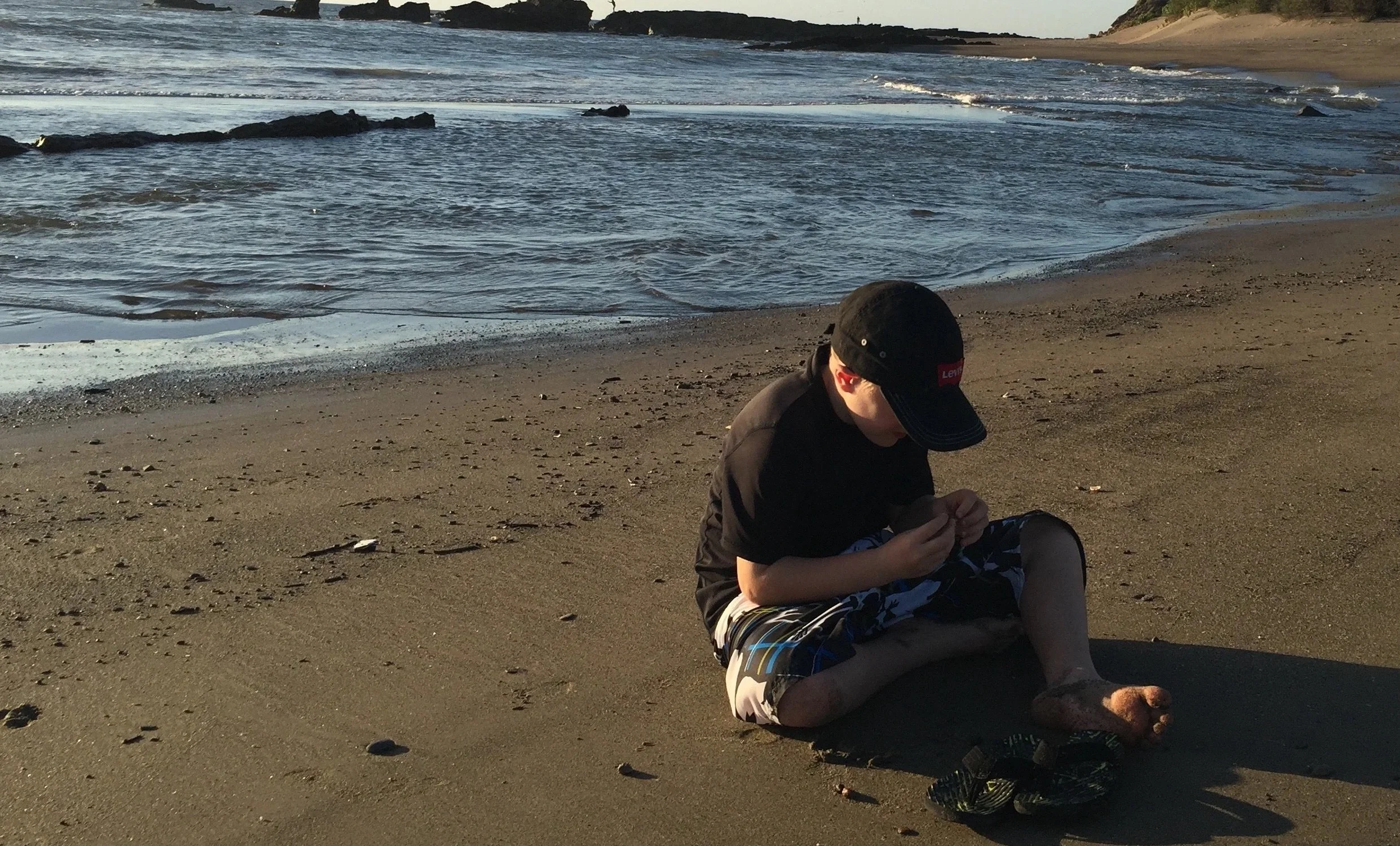
One evening, as my son and I walked northwards along the beach, his small, strong hand—as seven-year-old boys’ hands must—began writhing wildly to get free. He was desperate to run into the Pacific, to throw himself into the incoming surf, and tired of his father telling him to be careful. Rendered breathless by the intensity of his own emotions, he cried, “Let me go, Papa. Let me go!” I gripped his hand all the harder as the seventh wave begin to rise to the west, Leviathan-colored, majestic, and awful. “Ow, Papa,” he said, pulling away.
I lost my footing, fell, lost my grip, and he dashed into the water in pursuit of his flip-flop. He dove for his shoe just as the undertow was strongest and slingshotted seaward like an arrow, arms extended, head down, somersaulting like driftwood. My heart exploded. There was nobody around to call out to, no time to damn myself for being over 50 and out of shape. I pushed up from the sand and stumbled into the surf just as the next roller, horse head high, broke over him. God, take me and not him was my only thought. I was about six feet from him when the wave hit me head on and brought me to my knees. My arms were extended before me like a priest’s arms to a congregation, half a broken Host in each hand. Water still up to my neck. I heard the roar of the wave breaking on the beach behind me.
Suddenly, my son appeared before me, tossed skyward like flotsam by the wave, clutching his lost flip flop, a look of wild triumph on his proud, beautiful, magnificent face. The ocean threw him into my arms and I grabbed him, hard, and held him for dear life as my heart burst a second time. How could any Father ever look on as his son drowned, I thought. Right? There was a knot in my throat, and a hot iron behind my forehead. Death has slapped me on the back and bought me a Toña, I thought, aware that I was going into shock. “Run up the beach,” I told my son. “Get inland.” With a passing, quizzical look, he did as he was told.
A father’s dignity comes, Lord, from the fact that one of us will (and has a right to) completely forget that they were saved today, but the other will not, I thought. A moment later, I caught up to him and, together we continued up the beach. I could scarcely breathe. He had no idea how close we had both come to drowning. I watched him from the corner of my eye as—happy—he pointed his strong chin into the wind. After a while, whistling, he slipped his hand back into mine, and together we returned to the little house. “Want to watch Pelicans roost?” I asked, knowing that he would say yes.
III.
Las Cortinas, Nicaragua, April 2018
Countless metric tons of seawater hurtled into and over las Cortinas, or curtains—named for the cascade the Pacific makes when it thunders over them and the slab-like shape of the volcanic rock formations themselves—thrusting out of the Nicaraguan shoreline south of Casares with the weight and sound of a doomed jet. It was the hour between dog and wolf, when the light parts the veil between day and night in a part of the world comprised of attracting opposites: priceless natural beauty and heartrending poverty; profound generosity and the expedience of necessity; life, and the other.
I looked to the sun, a somniferous blob of mercurochrome, far out to sea. My sons—still my hearts outside of my body, aged six and ten—built a sandcastle in the surf a few feet from me with their friend, conscious of the place’s beauty, but still untouched by its menace. I reassured myself of their safety by observing that their mother and grandmother were close by.
A swimmer who looked to be about twenty-two, slender, swarthy, and breathtakingly reckless, thrashed in a shallow, rocky posita at the base of the curtain of frozen lava on which hammered the deafening tide. He stroked piston-like, joylessly, against the incoming rollers, his arms pumping mindlessly in the confined space like a diaphragm providing air to a dying brain. When his head disappeared among the razor sharp outcroppings, I thought, he’s going to die, and commenced the mental calculus—distance from me to him, him to the rocks, boys to their mother, next wave to the shore, time required to cover the distance between us, distance I could go without leaving my sons fatherless. His head reappeared, and the wave flicked him backwards. He could either get out or dive into the next wave.
Out of the corner of my eye I noted in an instant both my oblivious children’s joy and the horror on the women’s faces. I halved the distance between myself and the swimmer in case I was compelled to decide whether or not to try and save him. At that moment, with difficulty, he climbed out of the surf. So he is going to live, I thought. Shaking my head, I turned to my family. My wife’s eyebrows rose; wordlessly, she indicated with her finger that I should look back.
He had scaled an immense slab of frozen lava and now stood, back to us, arms thrown wide like waxen wings, facing the ocean, haloed by the ruby sunset, dazzling in his youth, his arrogance, his foolishness, his proximity to his own destiny? He’s invited Death in, I thought. There wasn’t even time to call out to him. In one beat, his legs were swept from beneath him and he disappeared. Sucked inland, not seaward, between the Charybdis of water and Scylla of stone, his head reappeared for an instant as it hit a shelf of rock six feet under where he had just been standing. His legs followed as the waves cascaded over and around him, pushing him into the posita another six feet down, where he disappeared again. I began towards him. His head reappeared. I determined to drag him out of the water and begin CPR. Came the next wave, which pushed him under and expelled him, raking his legs against the barnacles. I thought, if he’s unconscious, then it’s going to be easier to serve as Charon, if I can reach him before he’s carried out to sea.
As I made for him a third time, he hauled himself out of the water, and strode decisively to a log on the beach, pulled a phone from a bag, and began texting. I stopped and observed him. Stabbing at the phone, he seemed unaware of the blood streaming from the deep cuts and abrasions on his legs. If he had been concussed, then he hadn’t yet gone into shock. He didn’t seem drunk, altered, or fatally injured—there seemed even to be a slight caper in his step. (Or was that my imagination?) Was he suicidal? Had he stupidly taunted Death in some sort of sideways-macho-bullshit Hemingway stunt, or was he just a fool? What was his story?
The boys, concentrating on their sandcastle, seemed to have missed it all. I inhaled deeply, noting with a trace of guilt that I felt no compassion for the boy, and felt relief that I hadn’t really been called upon to decide whether or not to risk my life to save him. My youngest sang quietly as he patted the wet sand; the ladies were still processing their astonishment. My older boy looked up at me. “Did you see that?” I asked him, indicating the swimmer, his back to us, sloping up the beach in the starlight, talking animatedly on the cellphone. “Hmm?” He replied. “The boy who nearly met Death just now,” I answered. “No,” he said, sunnily. “I was watching my sandcastle get swept away.”
IV.
Upstate, Spring 2025
The music in my dream drowned under the swoosh of a passing car. I thought, I was in C, but heard myself whisper to the dark, “I am at sea.” Outside, a rain squall hissed against the air conditioner like water hitting grease in a hot pan. The hound trembled against my calf. When I tore the mask from my face, a harsh, mechanical eruption of air broke the silence, quickly stilled as I thumbed the machine off. In the sudden quiet, a susurrus stirred the Tulip Trees outside. Then came a total, silent stand of tide. I gently dislodged the dog and moved, as quietly as a man of my age and girth can, toward the hallway that opens onto my sons’ rooms.
As it had countless times before, time froze—the same suspended animation I felt on Delancey Place, hearing Lisa’s Shostakovich through the walls from one floor and Michaela’s Bartok from another. I stood paralyzed that night on the stairs, knowing I was leaving Philadelphia in every way. It was the same stillness as the night Roland Flint read “Resuming Green” in my MacDowell studio, his rolling baritone describing the way a streetlight lit the swaying branches outside his daughter’s room the night he decided to leave. Or the way the sky looked—so silent and crisp—as I stood stupidly in an emergency room parking lot after Father and I had ferried Mother’s remains there. Or Venice: standing by a streetlamp at the station, pulled back to my senses by the scent of brioche, a kindly face, and the gurgle of a passing vaporetto’s wake—a muffled engine snoring like a contented, sleeping bear.
What crashes on the beach is driven mostly by the wind, I thought, checking on my older son—now eighteen. His long limbs extended past the end of the bed, arms thrown above his head like a sleeping Baryshnikov. These incoming waves are measured in seconds—the splashing we delighted in when he was three at the park, the heavy surf in Nicaragua, and suddenly a boy a foot taller than me, stepping out of the shower on his way to a date. Like a man hit by a swell, I lost my balance for an instant, then poked my head into his fifteen-year-old brother’s room. I thought of our nights in the dark: listening to his latest composition, debating the big issues, hearing him read from a new manuscript, or him explaining Infinite Jest to me or….
As my older son sat in the front row beside his date, watching George and Emily transition from childhood friendship to young love over a soda, I stole a glance at their faces from a few seats away. I caught them at the exact moment Emily whispers, “I… I am now; I always have been.” And then, just a few minutes later, the tide shifted again as my other boy, playing Mr. Webb, stepped forward to give Emily away.
A few hours ago, we were all seated around Kevin’s heavy wooden table, clasping hands for a quick blessing. I thought of Gilda singing, “Do any human beings ever realize life while they live it—every, every minute?” to Ned as I accompanied Emily’s aria in his Our Town. I felt the tide of emotion rise behind my forehead like a boule—a hard, rising knot of water. Searching for a blessing, I could only sob and say, “This was heaven.”
We’ve begun, I think, as I turn my back to their darkened rooms and hear the steady thrum of their breathing, the ebb tide. A deep respiratory sigh measured in years, in generations. The years when Icarus flies and my generation falls—but it’s okay; the descent is full of life. My sons’ transit is out and away from me, their sails bent for the infinite sea.

Las Cortinas, Nicaragua. p/c: Daron Hagen
The first section of this piece originally appeared in the Huffington Post. Click here to read it there.