
Digest of Blurbs and Reviews:
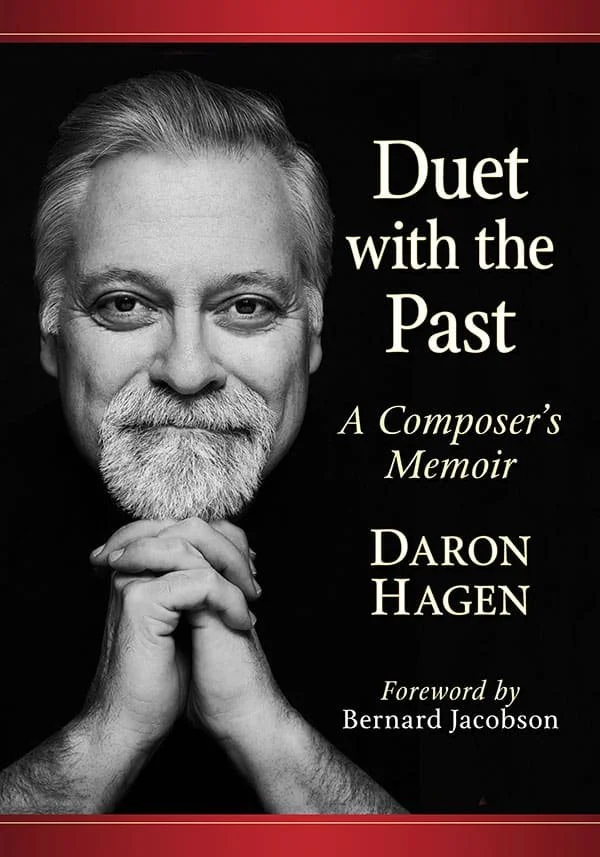
In Duet with the Past, composer Daron Hagen conducts a literary "braid" of memory, weaving the "bleakly beautiful" wreckage of a haunted Wisconsin childhood into the high-stakes tapestry of international classical music. As Pulitzer Prize-winner Tim Page observes, the memoir is an "unsparing" intellectual history that refuses to shy away from the "ache" of a family blighted by alcoholism and the "melancholy triage" of early death.
Hagen’s journey is far from a standard rise to fame; it is a "cautionary tale" of survival within a "brutally unforgiving" industry. Composer Russell Platt and conductor JoAnn Falletta highlight the "ruthless competition" and "political machinations" Hagen navigated while rubbing shoulders with legends like Leonard Bernstein and Ned Rorem. Yet, even amidst these "privileged anecdotes," the narrative remains grounded by what the late James Primosch of the University of Pennsylvania called a "brave, revealing" spirit, capturing a specific era of American musical history with "searing honesty."
The prose itself functions with the precision of a score. Syndicated radio host Ross Amico notes that Hagen writes "with all five senses," evoking everything from the scent of dusty movie house curtains to the "neurotic" elegance of David Diamond’s suits. This sensory depth transforms the book from a mere "confessional" into what Colin Clark of Fanfare Magazine describes as a "riveting" and "revelatory" work of art.
Ultimately, the narrative arc bends toward a hard-won redemption. By "pleating and plaiting" his self-destructive tendencies and tragic losses, Hagen—as Robert Schulslaper of Fanfare Magazine notes—transforms himself into a "humane and mostly happy man." It is a testament to the idea that even when one "bottoms out," the "warp and weft" of a life can still be woven into a masterpiece.
ABOUT THE BOOK
Composer, conductor and operatic polymath Daron Hagen has written five symphonies, a dozen concertos, 13 operas, reams of chamber music and more than 350 art songs. His intimate, unsparing memoir chronicles his life, from his haunted childhood in Wisconsin to the upper echelons of the music world in New York and Europe. Hagen’s vivid anecdotes about his many collaborators, friends and mentors—including Leonard Bernstein, Lukas Foss, Gian Carlo Menotti, Paul Muldoon, Ned Rorem, Virgil Thomson and Gore Vidal—counterpoint a cautionary tale of the sacrifices necessary to succeed in the brutally unforgiving business of classical music.
Praise
“Duet with the Past is an unsparing and bleakly beautiful memoir from composer, conductor and operatic polymath Daron Hagen that takes him from his haunted childhood in Wisconsin to the upper echelons of musical life in New York and Europe. It is rich intellectual history, filled with privileged anecdotes about legends and near-legends, but especially valuable for the narrative candor of the author, who has seen much and taken care to remember it all for us, no matter how it may ache.” — Tim Page, Pulitzer Prize-winning music critic, editor, biographer, memoirist, University of Southern California
“It is a rare privilege to experience a glimpse into the inner world of a great artist, and Daron Hagen has opened the door to his life in a memoir of searing honesty and unguarded intimacy. Daron leads us through a journey that begins in a brilliant, talented but dysfunctional family, into the treacherous depths of the ruthless competition and political machinations of the classical music scene, to a search for a happiness that often seems unattainable. Filled with anecdotes of countless musical luminaries, Duet with the Past is irresistible in its revealing candor and charm- an unforgettable journey into the private world of one of our country’s greatest composers.” — JoAnn Falletta, conductor Buffalo Philharmonic
“At times tragic or melancholic, the memoir unsparingly confronts the downward spiral of a family blighted by alcoholism and early, preventable death and the unhappy denouement of an impulsively entered-into marriage. But it also celebrates his worshipful love for his talented mother, second wife Gilda (a composer and singer), and sons Atticus and Seamus, that helped him overcome his self-destructive, depressive tendencies as he gradually transformed himself into a ‘humane and mostly happy man.’ … Late in the book, Hagen reflects that ‘a biographer pursues his subject’s truth by marching facts down the page after it like little soldiers, while an artist interlaces life’s storylines and dreams, pleating and plaiting memory and associations until one’s truth emerges as a braid.’ Arresting though the story is as it ‘marches’ more or less chronologically through the years, it’s the artistically woven warp and weft of his life’s tapestry that lingers. — Robert Schulslaper, Fanfare Magazine
“[Hagen] takes a balanced inventory of his days and in the process he delivers a cogent depiction of an era of music.” — Times Union
“Fascinating… Feels like an earlier part of American musical history… The book is a brave, revealing, and touching enterprise.” — James Primosch, composer, Dr. Robert Weiss Professor of Music, the University of Pennsylvania
“In an age suffused with memoir, it is rare indeed to read a book that is both ruthlessly honest and beautifully written. Duet with the Past is not only the chronicle of a brilliant young man who survived a family that, for decades, was haunted by death; it is also a cautionary tale that shows, with painful accuracy, the sacrifices needed to maintain a classical-music career in a brutally unforgiving business. Every young American composer should read it.” — Russell Platt, composer and ASCAP Deems Taylor Award-winning music critic, Vanderbilt University.
“If Daron Hagen weren’t a composer, he would be one hell of a writer. He IS one hell of a writer. I already knew that, but I finally got around to reading his memoir, Duet with the Past, last month, and I have to say, it is one of the best-written books, fiction or nonfiction, I’ve read in a while. … He's not afraid to share his missteps, but if nothing else his life story demonstrates that even when you bottom-out, if you just hang in there, things might work out all right in the end. Talent and hard work are important, but luck, or chance, if you will, will always be a deciding factor. … Hagen can be nostalgic and hardnosed, pensive and reckless, ugly and beautiful, vainglorious and modest. But who among us has not been? He writes with all five senses. Proust had his madeleine; Hagen had… well, everything apparently. We’ve all had the experience of certain scents conjuring memories, but Hagen, it seems, never forgot a smell, whether it be that of a dusty curtain in an old movie house or that distinctive blend of aromas that characterize any city. You can tell he’s always been a faithful journaler, which is only one more thing to admire. … Not that the subject matter is always delightful. Hagen can be brutally honest, and it’s not always pretty. But in his writing, as in his music, he is dedicated to serving truth. He does so with enviable recall, a powerful command of observation, often great sensitivity, and a poetic disposition.” — Classic Ross Amico, Syndicated Radio Host and Producer, WMUH, WXLV, and WWFM
“Autobiography, memoir, confessional: Hagen’s book is all of these things. It offers a candid telling of his personal story, at times heart-breaking, at times positively inspirational. It tells of a composer’s quest for truth, of a composer’s struggles in a highly competitive world; it offers illumination into a whole clutch of composers, but most revealingly the close ties Hagen has enjoyed with Ned Rorem, Lukas Foss, Leonard Bernstein, and David Diamond. … Hagen’s descriptions of others are vivid and come with an inbuilt ring of truth. They can be poetic, too. Of Diamond, he writes that, ‘he was a superb artisan whose Neo-classic compositions grafted intense lyricism with a neurotic and deeply felt hyper-contrapuntal style … like Witold Lutosławski, David wore excellently tailored suits … ‘ and so it goes on. His description of clearing out his deceased father’s belongings as ‘the melancholy triage of Executorship’ seems to exude a particular poignance. … Perhaps the greatest compliment I can give is that the book is riveting from first to last; and I write his as no regular reader of autobiographies. In short, it is a fabulous, revealing, and sometimes revelatory read, a window into a sometimes-tortured soul with what feels like a happy ending (Hagen was born in 1961, so one hopes for much more happiness to come).” – Colin Clark, Fanfare Magazine

Format: softcover (7 x 10)
Pages: 279
Bibliographic Info: 27 photos, discography, index
Copyright Date: 2019
pISBN: 978-1-4766-7737-8
eISBN: 978-1-4766-3587-3
Imprint: McFarland