
• SHORT
    • MEDIUM
    • LONG
    • CV
    • worklist by genre
    • worklist by year
    • words
    • Duet With the Past (print)
    • Duet with the Past (audio book)
    • Exploring Operafilm
  • operafilms
  • operas
    • discography
    • archive
    • Colleagues
    • Portraits
    • Lagniappe
    • Bibliography
    • interviews / lectures
    • Reviews
  • news
  • contact
Menu

Daron Hagen

  • bio
    • SHORT
    • MEDIUM
    • LONG
    • CV
  • music
    • worklist by genre
    • worklist by year
  • words
    • words
    • Duet With the Past (print)
    • Duet with the Past (audio book)
    • Exploring Operafilm
  • operafilms
  • operas
  • recordings
    • discography
    • archive
  • pix
    • Colleagues
    • Portraits
    • Lagniappe
  • research
    • Bibliography
    • interviews / lectures
    • Reviews
  • news
  • contact

words

On Vocal Scores

November 2, 2025

On a shelf in a hallway connecting the chorus and band rooms at Pilgrim Park Junior High School in Brookfield, Wisconsin in spring 1976 dwelt 30 copies of the vocal score of Georges Bizet’s Carmen. Wallace Tomchek, our charismatic, terrifying, wildly gifted, somewhat mad chorus teacher, told me that he intended to stage it one spring, “if ever I have the voices.” An opera? I asked, dazzled. “Possibly the best,” he answered briskly, pulling a score off the shelf and tossing it to me the way that, three years later, literature teacher Diane Doerfler would toss to me a copy of John Cheever’s short stories with a mischievous grin, singing, “Here, read these; he mainly gets it right.” I don’t think that the biology of mustering enough teenage choral students to mount Carmen ever worked out for Wally, but I already intuited that I would be an artist, probably a musician or writer, when he told me to keep the score only a year or two before my brother Kevin gave me the vocal score of Benjamin Britten’s Billy Budd for Christmas, thereby cementing my love affair with opera. I treasure both vocal scores to this day.

That year, Wally required that our parents all purchase for us copies of the beautiful 1970 gold-covered Williamson edition of Rogers and Hammerstein’s The Sound of Music. Wally had (rightly) determined that I was at best supporting actor material and had cast me as Max, a role so integral to the show that they cut his songs when the movie was made. “Piano Reduction by Trude Rittman,” I read on the title page.

Over time, I came to know (in my heart and in my hands both) and love the smoothly schmoozy feel of playing Frank Loesser vocal scores; the cooly precise, Ravel-like fussiness of Stephen Sondheim’s; the gnarly, saturated chromatics of Richard Strauss’ own piano reductions, with all the heavy lifting in the thumbs and index fingers of both hands; Kurt Weill’s flinty, Hindemith-y piano reductions to his own (European) scores, followed by the more Gershwin-y feel of his (American) scores; Jack Beeson’s scholarly, sensible reductions of his own shows — especially Lizzy Borden; the richly pianistic vocal scores of Marc Blitzstein for his own shows, which feel as though one should be singing them at the piano whilst playing. Things begin to run off the rails with George Gershwin’s own piano reduction of Porgy and Bess, which requires a real pianist — ironically, the hardest music to play is the transitional stuff, which gets all Gaspard de la nuit and requires real chops — to pull off.

Then there are the vocal scores executed not by the composers themselves but by associates: the practical, uninspired, not particularly singer-friendly Erwin Stein reductions of Benjamin Britten’s Peter Grimes and Billy Budd, which I love, but which do not feel good to play; the noble piano reduction by composer John McGinn of John Adams’ Nixon in China — a real achievement — both playable and fun; Noel Coward’s marvelous, splay-fingered vocal scores executed by Elsie April, which always made me want to have a martini at hand; the co-blended vocal score of West Side Story, which is harder to play than it needs to be, and requires the pianistic athleticism of a keyboard jock to get through.

One of the most inspiring things about the lyric theater — by which I mean live theater or film in which people start singing now and then or all the time — is its compulsively collaborative nature. “Composer” can mean the person who wrote the tune, supported by an arranger who either adds chords or serves as an amanuensis to a composer playing by ear, as well as a “dance music arranger” who takes the tune and develops it for a dance sequence. Robert Russell Bennett used to write the overtures to the shows that he orchestrated for Rogers, and for Cole Porter (despite having the chops, having studied orchestration with Vincent D’Indy), for example. Lin-Manuel Miranda’s In the Heights score was powered by Bill Sherman and Alex Lacamoire, who transcribed, arranged and orchestrated the show.

Musical departments gather and congeal based on time constraints and trust: John Williams and Conrad Pope, because of the speed at which musical materials must be generated for film; Leonard Bernstein and Irwin Kostal / Sid Ramin, who were given detailed “short scores” for execution as a 27 piece pit arrangement for West Side Story, freeing up Bernstein’s time so that he could be “in theater” and able to make changes quickly to a rapidly evolving, choreography-heavy show. Or Sondheim and Jonathan Tunick, whose signature sound is as recognizable as was Robert Russell Bennet’s and as important to the success of the shows on which he works. Which brings us back around to the queen of them all: German composer Trude Rittman, whose Sound of Music reduction was just the tip of the iceberg of her involvement in some of the greatest scores in the American Musical Theater.

In fact, the core piano vocal score documents — disciplined, vocally-supportive, easy-to-play while following a conductor’s stick or coaching a singer — of the American MT repertoire are nearly all Trude Rittman’s superb handiwork: Rogers’ great scores (Carousel, South Pacific, Sound of Music, The King and I); Frederick Loewe’s (more ornate, harder to play) Camelot, My Fair Lady, and numerous orchestrations, dance arrangements. What a treat it was to run into her handwriting, and to learn the handwriting styles of all the great orchestrators when I used to hand copy music at Chelsea Music back in the day.

The number of composer executive chefs in the kitchen, the number of sous-chefs, line cooks, and pastry chefs is dizzying and — if one has a taste for playing in a pit or singing on a stage — pretty cool. (The role of composer is entirely different in commercial MT than it is in opera. For example, when Burt Bacharach got the flu and ran behind in delivering songs for Promises, Promises the producer threatened to take on another composer to finish the score.) With all the different crews crafting performance documents in the living theater, there are bound to be myriad variations on what constitutes the best sort of piano reduction for a show. Usually, they come to us like love letters left after the end of a love affair, sitting in a box at a place like Chelsea Music in Manhattan, founded by Don Walker and Mathilde Pinchus, with the name of the show stamped on the side and a big “piano conductor” score bound archivally, leaning hard either to the left or to the right, there to stay until Broadway’s lights (or the office lights) are extinguished for good —  or until the creative teams’ heirs transfer the papers to some university’s archives. Otherwise, they sit, awaiting the next revival.

Piano conductor scores consist of a playable piano part and other lines that contain meaningful countermelodies and “fills” that can be assigned to whomever has been hired for the production at hand. They’re sometimes conducted from (Boosey and Hawkes only brought West Side Story’s conductor score out a few years ago, for example), but, usually, the show’s producers have spent just enough on the music to get the cast album in the can and then — man, I’ve seen shows where the “p/c” and the orchestra parts were just left on the stands at the recording session and then … lost, because the show’s impact was so ephemeral and nobody thought it would ever be revived. Anyone who has played a semi-professional community playhouse production of anything has played out of these books (which have gotten pretty slick — particularly when an outfit like Disney owns the copyright), and which often have the name of the player and the city where the “bus and truck” tour last ended. It is such great insider theater lore.

In the musical theater, pianists accept as a matter of honor that their vocal book is itself a malleable, living, evolving thing, and that errors and inconsistencies will crop up during production(s) over the years as changes for various situations are made and unmade. Cuts are made and sewn up, transitions massaged, songs added and dropped.

American opera composers sometimes emerge from the musical theater tradition and are abashed when pulled up short by opera repetiteurs and rehearsal pianists, who typically expect their scores to have been “frozen” and edited. Opera pianists can’t really be blamed for feeling taken advantage of, since they’re being pulled out of their professional comfort zone if they have never ever coached or played a musical. Their default stance is often (though not always) that the composer didn’t have enough common sense or experience to simplify their short score, either by simply supporting the singers the way Rittman’s scores did or leaving them to their own devices and simply presenting the orchestra parts, as Stein’s did. They can hardly be blamed for feeling that, not only do they have to watch the stick, coach the singers, but also piece together an idiomatic part to play.

There’s a lot to sort out here. Full disclosure: It should be obvious by now that I grew up playing shows and operas from all sorts of scores and truly enjoy coming to terms with the different ways that they come to us. I began my opera career fourteen operas ago by crafting my first piano reduction based on the Britten / Stein model with a dash of Rittman. I’ve come at each score with a fresh ear, hoping to capture the psychology of that opera, but — for better and for worse — I have never “coddled” singers by doubling them in the orchestra unnecessarily and I don’t do it in my vocal scores. Because I have always loved browsing the stacks and learning repertoire from the page, I’ve loved crafting the vocal scores myself to my theatrical works.

I do not use arrangers or orchestrators. It’s just not my way. I have always composed into full (or, if rushed, a detailed short) score, even when the commissioning agreement calls for a piano reduction first to facilitate workshops. Perhaps, one day I will leave making the piano reduction of one of my operas to someone else, because it is a lot of work, or maybe just to see how it feels. It will probably be done better than I could do it. Maybe when I write an opera without words.

In any event, here are a couple of anecdotes that illustrate the level of mutual forbearance, respect and trust required of opera composers and opera coach / repetiteurs to get the work done.

I remember the conductor of an early revival of my opera Shining Brow who added thirds and (often) unresolved 7ths and 9ths to the piano reduction I had made when coaching. He explained that it helped the singers to find their pitches (I had followed the Britten / Stein model). At the first orchestral read-through, the singers had trouble finding their pitches because they had relied on the extra notes he’d been feeding them.

Another time, during a revival of Amelia, for which the original commissioning contract had stipulated that there would be two pianists for rehearsals, the pianist took me aside and said, “With all due respect, you could have given me a piano reduction instead of a short score to coach from.” The next revival, the pianist, playing out of the newly simplified score, admonished me to put in instrumental cue names so that he could tell the singers “what to listen for” when coaching. (In musical theater scores, such cues are common, and I often put them in, but, for that generation of the vocal score I had removed them.)

Coaching the original cast of Vera of Las Vegas from the keyboard (as I had my previous shows) in Las Vegas, I had delighted in getting every articulation right, every musical style just so, every mannerism notated. Twenty years later, during a European tour, I laughed with the band over beers when they said, “Jesus, you were specific. We know what you want. Trust us. Take them all out.” Too late, the score had been “frozen” years previous.

Some operas, like Orson Rehearsed, are modular, and incorporate lots of un-notateable electronica. Imagine my brilliant conductor’s consternation when the otherwise beautiful vocal score he was using to coach his singers didn’t capture exactly what the electronics were doing. “Once I figured that out, I was fine, but before that, it was touch and go.”

The vocal score of The Antient Concert was, first and foremost, a document of the string quartet arrangement with which the work was first premiered. Jocelyn Dueck, the coach and repetiteur for the original workshop at the Princeton Atelier, was comfortable “dropping” phrases when she needed to so that she could support the singers. The result was that she played an opera score like a musical theater score. She really “got” what I gave her, and I was grateful. When the score was published, I wanted to make sure that the fact that it was not a piano reduction was made clear, so I placed on the title page “Vocal Score by the Composer,” which some clever librarian somewhere catalogued as “Vocal score by [sic] the composer.” Everyone’s so smart.

Recently, I returned to the 2013 piano reduction of A Woman in Morocco to transform it into a Rittman-style score that could be used by traditional opera coaches. In my original development score I found notes given to me by Kathleen Kelly during a developmental workshop of the piece years ago in Texas. An extraordinary pianist, coach, and conductor, she had done such an excellent job preparing the singers before I got to town that, when she asked me about some of the French that I had set in the score, I trusted her enough to ask her to “fix” my French prosody as she saw fit and to teach me afterwards what she had done. I remain grateful.

The musical director (conducting and playing out of a “piano / conductor” score) of a revival of Vera of Las Vegas revealed to me that he had had no problem cueing the drummer in one city, but that the current drummer had sworn that the part was unreadable because several of the instruments were on different lines than he was used to. (He was fired and another person engaged.) “He came to look at his part in the piano / conductor score, laughed, and said, ‘this isn’t an opera, it’s a cabaret. I shouldn’t have to play exactly what’s written!’”

One time, during staging rehearsals of another show, I was asked to step in to accompany a staging rehearsal in which the conductor was consistently behind the beat. I took it as long as I could before (I was younger then) started accompanying the singers and ignoring the stick. The scene, which had been slow and aggravating, sprang into motion like a racehorse. I was thrilled. Finally, I had to admit to myself that I was doing the production a disservice because the conductor had just started following me; as soon as I resumed my place on the sidelines, the old tempi returned.

What have I learned? That every vocal score should be accepted on its own merits because it is the result of the development process by which it was wrought. There is no correct way to execute a vocal score, though a “piano reduction” should be idiomatic and only go to three staves when there’s no other recourse. If a pianist is looking at a “piano conductor” score, then they should know going in that they’ll be required to make a lot of decisions about what to play and what not to. There’s no blame to go around.

Our mission from the piano bench is to prepare the singers, protect them, and support them as best we can. We can’t afford to get lost in the weeds. Our job is stressful and for the most part thankless, but we’re working out of living documents created by people in the thick of creating. Mistakes in vocal scores rarely occur out of ignorance; usually they occur because of lack of experience or time. As a retired Teamster copyist, I’d be the first fella to simply blame the copyist — everyone does. As Lukas Foss used to tell me, “Daron, the ink is wet until you die.” Play on.
Tags George Bizet, Carme, Carmen, Wallace Tomchek, Diane Doerfler, John Cheever, Kevin Hagen, Benjamin Britten, Billy Budd, Richard Rogers, Oscar Hammerstein, The Sound of Music, Trude Rittman, Frank Loesser, Maurice Ravel, Stephen Sondheum, Richard Strauss, Kurt Weill, Paul Hindemith, George Gershwin, Jack Beeson, Lizzy Borden, Marc Blitzstein, Porgy and Bess, Gaspard de la nuit, Erwin Stein, Peter Grimes, John McGinn, John Adams, Nixon in China, Noel Coward, Elsie April, West Side Story, Robert Russell Bennett, Cole Porter, Vincent d'Indy, Lin-Manuel Miranda, In the Heights, Bill Sherman, Alex Lacamoire, John Williams, Stuart Pope, Irwin Kostal, Sid Ramin, Jonathan Tunick, Carousel, South Pacific, The King and I, Frederick Loewe, Camelot, My Fair Lady, Chelsea Music, Don Walker, Mathilda Pincus, David Diamond, The Noblest Game, Christopher Keene, Bernard Rands, Vincent (opera), Sacco and Vanzetti (opera), Ned Rorem, Shining Brow, Amelia, Vera of Las Vegas, Orson Rehearsed, Jocelyn Dueck, A Woman in Morocco, Kathleen Kelly, Burt Bacharach, Promises, Promises Primises

Ned Rorem and Daron Hagen at Rorem’s apartment in fall 2018. (Photo: Mary Marshall)

On Ned Rorem's Our Town

July 12, 2022

When Thornton Wilder’s 1938 meta-theatrical triptych of portraits of American Life Our Town (which, no matter when it is staged, always takes place in 1938) was produced at the McCarter Theater in Princeton, twenty years had passed since the American Dream had been convulsed by the “War to End all War.” That which burns away any Rockwell-esque nostalgia and powers the drama of the play is the “Damoclesian sword” that was the rise of fascism and the impending outbreak of World War II—only months away. The audience was invited to grieve for the characters from the moment that they met the omniscient, fourth-wall-piercing character of the Stage Manager. It was in the air: Marc Blitzstein’s The Cradle Will Rock, (with Blitzstein and Orson Welles on stage essentially splitting the role that Wilder would transform into the Stage Manager for his Our Town) had electrified the American theater during summer 1937. Louise Talma (the only composer besides Hindemith to convince Wilder to pen a libretto, in German, no less—for her earnest, turgid Alcestiad—in the ’50s) told me at Yaddo during the ’90s that “Thornton certainly knew Marc’s opera. The Depression was winding down. We saw Hitler coming to power. People were mourning Good Old Days that never were.”[1]

Arguably, Wilder’s “continual dryness of tone”—as he described it in the introductory note to the 1938 “acting edition” of the play—found its ideal composer in Aaron Copland’s seminal 1940 musical score (dedicated to Leonard Bernstein) for the original film.[2] Copland, according to Vivian Perlis, stated, “For the film version, they were counting on the music to translate the transcendental aspects of the story. I tried for clean and clear sounds and in general used straightforward harmonies and rhythms that would project the serenity and sense of security of the story.” Rudolf Bing, then general manager of the Metropolitan Opera, approached Copland in 1951 with the idea of expanding his score into a full-length operatic version. Wilder, according to Perlis, quashed the idea, responding, “my texts ‘swear at’ music; they’re after totally different effects.”[3] What was required, as Wilder wrote in his introduction to the play was, “the New England understatement of sentiment, of surprise, of tragedy. A shyness about emotion ... a sharpening and distinctness of the voice.”

Fast forward. Wilder said no to many composers during his lifetime, though he did permit Jerry Herman and Michael Stewart to turn The Matchmaker into Hello Dolly and, in 1965, did grant rights to Leonard Bernstein, Betty Comden, and Adolph Green to adapt The Skin of Our Teeth into a musical. Musical theater collaborations are fickle—everything’s got to fall into place or the producers bolt and the soufflé falls. Everything didn’t, and the project collapsed. When Lenny returned to Wilder, seeking operatic rights, Wilder shut him down. We are the poorer for his decision.[4]

I studied with composer Ned Rorem during the early ’80s while a student at the Curtis Institute, and served as his copyist for half a decade after that. I knew his music from the inside out, and I knew particularly well his short operas. Art song composer nonpareil, he and Kenward Elmslie had adapted August Strindberg’s Miss Julie in 1965 with mixed success, and many thought him not suited to the demands of large-scale lyric theater. But Ned persevered, and garnered universal praise from opera stalwarts when, in 1994, he returned to Miss Julie, trimming it into a “taut and persuasive” 90-minute one act, according to James Oestreich in the Times.[5]

J.D. (Sandy) McClatchy, the svelte poet, erudite editor, and versatile librettist for Little Nemo in Slumberland (Daron Hagen), Miss Lonelyhearts (Lowell Liebermann), 1984 (Lorin Maazel), Dolores Claiborne (Tobias Picker), and A Question of Taste (William Schuman) among others, and I met when translator William Weaver commissioned me to compose some songs in memory of James Merrill—Sandy was Merrill’s executor. I admired his libretti and told him so. He said that Tappan Wilder had agreed to loosen the bonds on the Our Town rights, and that he, Sandy, was looking for the right composer. How, he asked me, would I proceed if I took on the job? I don’t recall now what I said, but I do recall ending the conversation by saying, “You know, the man you’re looking for is really Ned Rorem. Ned’s Quakerism provides the proper emotional repose; his age the appropriate cultural reference points. Most importantly, he’s entirely secure in his own voice, and will be comfortable letting Wilder’s play take the lead.”

I doubt that Sandy chose Ned because of what I said, but I knew then (and now) that I was right.Our Town the opera was premiered by Indiana University Opera Theater with student singers and orchestra on February 25, 2006. Its professional debut was at the Lake George Opera on July 1, 2006. Intended from the start to be a chamber opera, the orchestration is small, and the scoring is light and transparent throughout—consistent with a work best suited to young voices. The formal structure follows Wilder’s play closely. Minor deviations from the original play seem to have been made (the fleshing out of the role of Simon Stimson, the creation of choral numbers, for example) to provide opportunities for musicalization. Rorem moves in and out of speech and utilizes more elevated recitative (parlando) than in his previous theatrical works.

Playing through Ned’s first manuscript vocal score with Gilda Lyons shortly after he finished his first draft, we pounced upon the opportunity of giving the concert première of the (now classic) aria for Emily. (Notably, the opera’s only freestanding set piece.) In it, the ironic union of opposites that make the opera Our Town the immediate American classic that it is were on full display—economy of construction, absolute, unwavering resistance to unnecessary emotionalism, frankly open textures, wisps of Poulenc at his driest, and the sort of stunning Protestant hymns that only an atheistic alcoholic Quaker whose life partner was a church organist can pen. Everywhere in the music there is a sort of cool, self-contained regretfulness—the regret so central to the play’s initial impetus, a regret so intense as to border on dread—that perfectly underpins and undercuts the sentimentality of the portraits.

Rorem uses three compositional strategies to hold the opera together structurally, track the story’s narrative, and to keep his musical rhetoric coherent.

First, he manifests Wilder’s “emotional shyness” with abrupt stylistic cross-cutting (in mid- thought, sometimes in mid-musical phrase) between Americana (Thomsonian faux-Protestant hymns, plush sustained cinematic strings, Copland-esque woodwind solos, Ivesian collages), transatlantic modernism (the tartly-scored “sting” chords, jagged, off-kilter ostinatos in close- canon, denatured melodic fragments in place of memorable tunes), and Gallic lyricism (rapturous string obbligatos, sudden snatches of emotionally-vibrant melody, Debussy-esque orchestration).

Screen Shot 2019-02-12 at 11.21.30 PM.png

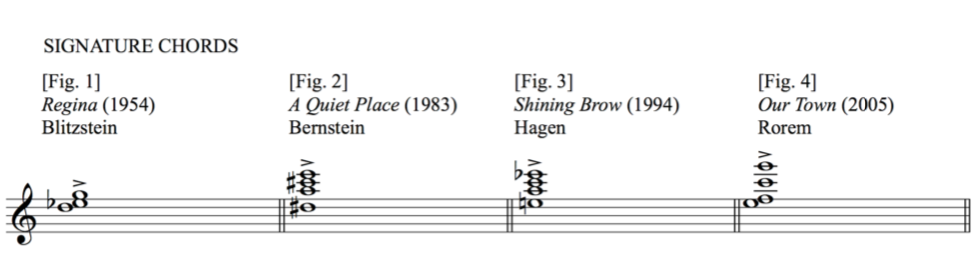
The first sixty seconds of the opera deftly arrays all three techniques. The pungent bell-tone chord that strikes 5AM declares that Our Town is part of a continuum of American operas that frankly destabilize traditional harmony by thrusting, like a billy to the ribs, an unresolved fourth into the triad. Blitzstein’s poisoned capitalists, Bernstein’s tragic suburbanites, my tormented architect, and Rorem’s dread-filled citizens of Grover’s Corners all inhabit the same American operatic landscape. Ned immediately crosscuts to another of his favorite tropes—the faux Protestant chorus underpinned harmonically by parallel unresolved sevenths in the bass—before overlaying a sudden, Gallic, sensually-arresting obbligato in the high strings. When the action begins, the parlando (passages of elevated speech that do not quite rise to song) section that follows is typical of the handling of dialogue throughout the opera: The characters unpretentiously skitter halfway between speech and recitative over a plush, comforting pad of sustained, Copland-esque strings.

Screen Shot 2019-02-12 at 11.23.16 PM.png

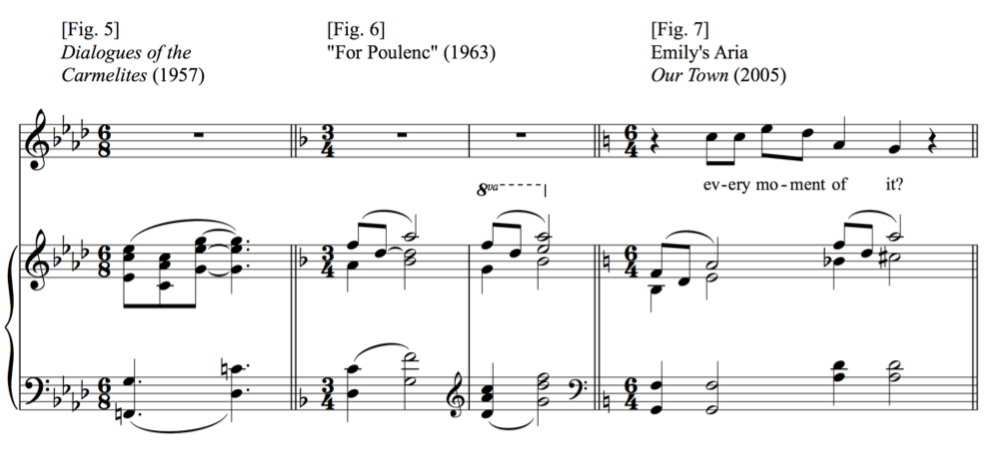
Second, throughout the opera, beginning in the background during the first moments as a woodwind obbligato like a nettlesome foreigner, is a “deedle-dum” figure that unmistakably evokes the falling motif associated with the doomed nuns in Poulenc’s Dialogues of the Carmelites[Fig. 5]. Rorem’s personal association with the motif inspired him to quote it in his own song, “For Poulenc” [Fig. 6], and, over the years, a dozen instrumental works, large and small. In the score of Our Town, it completes its transit (in Ned’s life as a composer and in his catalogue) in his characterization of Emily [Fig. 7].

The motif evolves inexorably over the course of the opera, generating tension the way that someone playing with their hair during a serious conversation is at first slightly distracting and, over time, enervating. It begins to take on a life of its own as the second act unfolds, the curling of melodies in the background behind the characters’ parlando turning in on themselves in an Ouroborus-like way, transforming the fragments into slowly unraveling ostinati that are both claustrophobic and comforting—like the family life Rorem’s music limns. Characters begin taking on the background ostinati and incorporating them into their parlando in odd melismatic passages that heighten words in a baroque fashion. As the second act closes and the young couple marry, the dread given us by the first acerbic chord of the opera returns, literally underscoring the fragility of their happiness. A violin solo gives another fleeting taste of sensual pleasure before Rorem snuffs it as, again, “too much” to close with an anything but comforting, dread-filled, Ives-ian mash-up of the “Mendelssohn Wedding March.”

Pedal points in the strings, quizzical quasi-chorales in the winds and brass, the “deedle-dum” curling wind obbligati, all return in the third act; the opera continues to unfold, but all the vocal lines are heightened above parlando (they’re taken closer to “song” and effusive tunefulness by making their tunes less abstract and more traditionally singable and giving the phrases more melismas) in a way that they weren’t in the first two acts. This “gradual emotional warming” manifests Ned’s third, and most subtle, strategy for giving the opera emotional depth, the character of Emily emotional verifiability, and the piece a satisfying emotional trajectory.

This is how he did it. Gradually, Rorem invests the chorus with more and more emotional warmth so that they—in death, but not in life—create the sort of musico-emotional landscape into which Emily can step. The apotheosis of the opera is, of course, Emily’s aria, wherein Rorem combines at proximity all the musical gestures laid out in the first two acts. In this, the “eleven o’clock” spot, he gives Emily the only unabashedly rapturous music in the opera, and on the most regretful sentiment: “Do any human beings ever realize life while they live it—every, every minute?” The composer’s self-control in finally allowing us to “feel” is masterful; the effect is devastating. His obvious identification with Emily, Poulenc, and the nuns is an astonishing personal revelation for a composer so famously public in his prose and yet so resolutely private in fact. Emily concludes, as Ned (a writer who eschews exclamation points and composer who famously hates repeating words, breaks his own rules) sums up a world-view, “That’s all human beings are. Blind!”

Screen Shot 2019-02-12 at 11.24.21 PM.png

But why did Our Town need to be made into an opera? Just 80 years have elapsed since the 1937 premiere of Wilder’s play, yet a 1938 audience’s dread is like that felt in many quarters in 2017. Spring 2017 may find Americans in greater need of the sort of narrative that Our Town provides than they have been since the ’30s. The “Damoclesian sword” of rising fascism has returned with a vengeance; we’re told that we’re not experiencing a Depression, yet unemployment isn’t being measured in a way that considers how many people have simply stopped looking for work, or the fact that retired people are working at Walmart to supplement their pensions. The Peterborough, New Hampshire, that Wilder used as a model for Grover’s Corners had faded to the margins by the time I began visiting the MacDowell Colony during the early ’80s. Nobody in Wilder’s play could afford to live in the Peterborough of today.

Ned has told me that Satie’s Socrate may be “the greatest of all operas.” Certainly, he exploits in his score for Our Town the same kind of baroque cantata textures and affects as Satie did in his 1920 masterpiece and that Wilder (according to Mabel Dodge)[6] most preferred. But the Rorem and McClatchy Our Town also contains—in the propulsive, off-kilter ostinati percolating uneasily beneath the Nantucket matter-of-factness of its musical surfaces and its stubborn unwillingness to wear its heart on its sleeve—an astonishing undercurrent of unanticipated, and highly effective dramaturgical fury.


This article originally appeared as the liner notes to New World Records 80790-2 [2 CDS] world premiere recording of Ned Rorem and J.D. McClatchy’s opera Our Town, based on the play by Thornton Wilder.

Footnotes

  1. Louise Talma in conversation with the author at Yaddo, summer 1995.

  2. Thornton Wilder’s “Some Suggestions for the Director” from the 1938 “acting edition” of the script.

  3. Vivian Perlis quotes Aaron Copland in a letter to the New York Times, January 31, 1998.

  4. Tappan Wilder, program notes for “Thornton Wilder and Music,” a program by the American Symphony Orchestra, December 19, 2014.

  5. James Oestreich, New York Times review of the Manhattan School of Music production of the revised Miss Julie, spring 1994.

  6. Mabel Dodge is quoted by Tappan Wilder in his American Symphony Orchestra program note.

Tags Ned Rorem, Thornton Wilder, Louise Talma, Paul Hindemith, Norman Rockwell, Marc Blitzstein, Aaron Copland, Rudolf Bing, Vivien Perlis, Jerry Herman, Michael Stewart, Betty Comden, Adolph Green, Curtis Institute of Music, August Strindberg, Miss Julie, Kenward Elmslee, Kenward Elmsie, James Oestereich, J.D. McClatchy, Lowell Liebermann, Lorin Maazel, Tobias Picker, William Schuman, James Merrill, Gilda Lyons, Virgil Thomson, Francis Poulenc, Mabel Disge, EWric Satie, Eric Satie, Orson Welles, Damoclese
Featured
On Nicaragua
Dec 7, 2025
On Nicaragua
Dec 7, 2025
Dec 7, 2025
Screenshot 2025-11-17 at 5.43.35 PM.png
Nov 17, 2025
On Work
Nov 17, 2025
Nov 17, 2025
On Composing
Nov 8, 2025
On Composing
Nov 8, 2025
Nov 8, 2025
On Vocal Scores
Nov 2, 2025
On Vocal Scores
Nov 2, 2025
Nov 2, 2025
On Orchestrating Brahms
Oct 2, 2025
On Orchestrating Brahms
Oct 2, 2025
Oct 2, 2025
On Performing
Sep 3, 2025
On Performing
Sep 3, 2025
Sep 3, 2025
DH-RLW-23July2012-GM.jpg
Jul 27, 2025
On Teaching
Jul 27, 2025
Jul 27, 2025
On Music Copying
May 4, 2025
On Music Copying
May 4, 2025
May 4, 2025
On Teachers
Apr 24, 2025
On Teachers
Apr 24, 2025
Apr 24, 2025
On Venice
Mar 28, 2025
On Venice
Mar 28, 2025
Mar 28, 2025
IMG_9973%2B2.jpg
Jan 28, 2025
On Being Ready
Jan 28, 2025
Jan 28, 2025
On Singing Beautifully
Apr 9, 2024
On Singing Beautifully
Apr 9, 2024
Apr 9, 2024

Copyright © 1999-2025 Burning Sled Media