
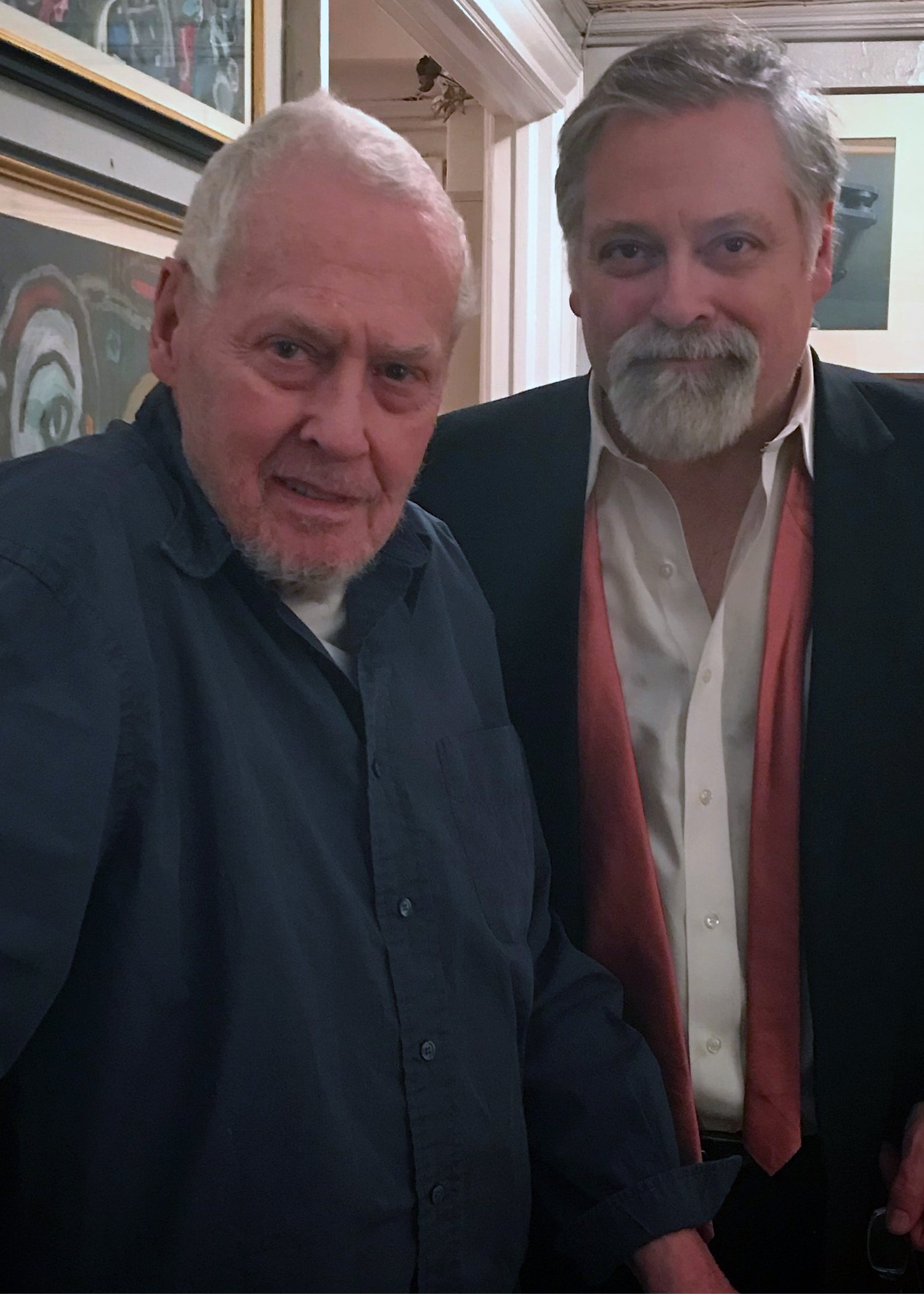
29 January 2018 p/c: Mary Marshall
From the Minors to the Majors (1981-1991)
Although Ned Rorem remains famous for having an opinion — sculpted into an aphorism — on almost everything, he never said or wrote a word that I know of about baseball. The closest I think he ever got was his setting of his frequent collaborator Paul Goodman’s poem “Boy With a Baseball Glove” in his massive Evidence of Things Not Seen, and that poem’s really about the “effortless poise of youth,” not baseball, which was distinctly outside of his aesthetic universe. Fiercely un-athletic Ned, who I recall demonstrating his physical dexterity only once, but then on the Dick Cavett Show, by walking on his hands, a display I viewed on a four-inch-wide portable television while an undergraduate at UW-Madison in summer 1980.
It isn’t that Ned didn’t have anything to say about baseball. He didn’t write about baseball because baseball didn’t say anything about him. Just as this article about Ned Rorem will be more about me than Ned, everything Ned wrote was really about himself. But enough about me.
Giving a phone interview just before my lesson three years later, he delivered a biting zinger to the New York Times about avant-garde composers going neo-tonal. He scoffed that they were like people applauded for giving up smoking while those who never took it up were ignored. Yet, standing in the dugout as his pupil, my job was not just to learn how to pitch, but to observe as the Master's own pitch sequence evolved. The early, diatonic, Francophilic lyricism of the songs of his that I loved as a teenager had been enlivened by tone rows and chromatic saturation. Like a veteran pitcher expanding his repertoire to stay in the Show, Rorem's music had evolved as he assumed his place as an elder statesman at Curtis. By inviting me to study with him at Curtis, he had pulled me up from the minors, showing me not just how to survive in the Show, but how to command the mound.
At a place like the Curtis Institute — where every student has been provided with a full scholarship since 1928 — the pursuit of absolute perfection demands a psychological currency, not a financial one. No more sandlot busking; you were handed a locker in the ultimate clubhouse. But that membership required trading the exquisitely mediocre pleasures of the minor leagues for the crushing pressure of being groomed as a thoroughbred. You were prepared for the social and professional elite, then assigned your role in the Show. But the stakes were brutal: you graduated only when your teacher said you were ready. You could be dismissed at any time, sent down to regional orchestras, semi-professional opera companies, or worse — a teaching job.
Ned taught for two years at SUNY Buffalo and two more at the University of Utah, famously declaring that after that amount of time, “a teacher begins to believe what he says.” I was one of his first three students at Curtis, where he ultimately broke his own rule and taught for over two decades. He was quite open about his mixed feelings regarding pedagogy, outlining them in his 1993 Opera News piece, “Learning With Daron.” His brutality as a teacher was no doubt informed by how he, a product of both Curtis and Juilliard, had been treated by his own mentors: Gian Carlo Menotti, who was a massive influence, and Rosario Scalero, whom he found stifling. While he never talked about studying with Bernard Wagenaar at Juilliard, he worked as a copyist for Virgil Thomson in exchange for lessons and occasionally referred to David Diamond as “more than a friend — a mentor.”
“Do any of you write?” he asked my classmates Norman, Robert, and me one afternoon. I hazarded sharing a review of a concert I had written as a freelancer for a local Philly paper. He read it back to us, pausing after each sentence to comment upon it, dissect it, and dismiss it. That was a tough day. I didn’t share my writing with him again until spring 1984, when, having had some success with a manuscript that my friend and writing mentor Emily Wallace had shared with Joel Conarroe, then Dean of the Faculty of Arts and Sciences at the University of Pennsylvania, I presented a copy to Ned. I wrote about it, thirty years later, in my memoir:
Taken aback, he flipped through it and placed it carefully on a pile of papers on his red dining room table. “I’ll read it, Daron,” he promised. I thought myself rather brave. “But I haven’t much hope for it.” I deflated. “Why?” I asked, sincere. He had evidently formulated a summing up of me for my character prior to our final meeting, and now, he delivered it, suavely wrought, an opinion stated with all the simple conviction of fact: “You tell people what you think they want to hear. Since you’re bright, you’re usually right. But sometimes you’re not.” It occurred to me then that I felt psychically the way that I had felt physically the night that I sliced off a knuckle into some corned beef. There was blood everywhere, of course; but the blade was so sharp that I never felt it. In fact, it was the single cruelest thing that Ned ever said to me —and probably the most therapeutic. A few days later I had Ned’s letter —
“I read your whole diary in almost one fell swoop and was quite impressed. Diaries are dangerous, being the most subjective of literary forms (and subjectivity is boring), but yours makes it, and is the real thing…. When we are next together we can talk more. Meanwhile, know that I was truly moved by much of it.”
Afterwards, Emily took me to lunch and shared Joel’s take. “Tell Daron that, if he’d like to kick off a great literary career and kill his music career at the same time," he had said, “I’ll be happy to pass it along to an agent in New York.” While Ned had secured his place as an “intellectual social arbiter” with the 1966 publication of The Paris Diary of Ned Rorem, times had changed. There was no way I was going to compete with Ned on his own turf. So I kept the manuscript in a drawer, working on it for another fifteen years before parts of it finally ended up in my 2019 memoir, Duet with the Past.
Home Runs (1992-2012)
After establishing myself by fulfilling a handful of commissions from big orchestras and winning some prizes, I officially stepped onto the national operatic stage in 1993 with the success of Shining Brow. I knew it was so because Ned marked the opening night with a charming telegram telling me that it was — literally a telegram, in that old Western Union teletype font, the letters uneven and herky-jerky above and below the horizon, reading: “Congratulations Daron I told you that you would arrive at 23 Love Ned.”
My career began in 1981 when the Philadelphia Orchestra premiered Prayer for Peace. It was an earnest, Transatlantic piece that any serious tonal composer could be proud of — and I was. Though pushed to keep writing that same piece, I rebelled. As my farewell to Curtis, I offered a jazzy Divertimento built on a bebop head by Les Thimmig, the teacher who had launched me as a UW-Madison undergraduate. It was a deliberate provocation. Bringing pop music into Curtis Hall was a mortal sin back then; even George Rochberg’s polystylism was shunned. Yet my piece was a deadly serious attempt to reconcile my Midwestern love for the “low” '70s L.A. Sound with the dominant, "high" academic ideology of the East Coast. In this, I followed Les, who had fought to bridge his Yale modernism with his roots as a jazz saxophonist.
Critics like Paul Griffiths at The New Yorker used Brow’s unabashed eclecticism to point out that I was failing to toe the Transatlantic line. I paid them little mind. More persuasive practicing artists, more understanding voices like Leonard Bernstein's recognized my sincerity and my use of musical allusions to build a meta-narrative. This metamodernist trajectory began publicly at my final student premiere in April 1984 at Curtis Hall. Even at that early stage, I was drawn to the ebullient stylistic freedom of Lukas Foss over Ned’s curated, late-century intellectual elegance.
During the late ‘90s and early aughts, I worked as a professional hand music copyist in Manhattan. I served as Ned’s personal amanuensis alongside a fistful of other prestigious clients. As a colleague and fellow hard worker, Ned was proud that he had worked for Virgil as a copyist exactly forty years before I had worked for Virgil as an arranger. But this shared history could lead to problems. One night at Yaddo my name came up in conversation. Ned deftly recharacterized me as merely his copyist rather than his colleague. When I heard about it, I yelled at him, and he stopped that sort of thing.
Around that time, Ned’s masterwork, Evidence of Things Not Seen, premiered, launching him into a phase of legacy and summation. While he cemented his reputation with that massive, evening-length cycle, I was carving out a guildsman’s career as a practical, working musician. I focused increasingly on lyric theater, composing operas like Vera of Las Vegas, Bandanna, and Amelia, alongside over a hundred new songs. It annoyed him when I accepted commissions from groups he had just worked with. For instance, a piece I wrote for the King’s Singers made him jealous enough to snark on it in his diaries. But writers settle scores; that is simply the price of knowing one.
Ned, Gary Graffman, and David Diamond took me to dinner across the street from Curtis. We chatted about trying me out as a faculty member to occasionally teach Ned's students. Everything worked out as it had to. Any questions about whether the Curtis Institute was the right fit for me were answered by my opera Vera. Its furious, relentlessly allusive score — coupled with the stylized, filmic subversiveness of my piece Much Ado — moved Ned to acknowledge that, while I was never going to be a manageable, Establishment-affirming team player, what I was doing took real passion, skill, and guts.
In 2003, Ned retired from Curtis after twenty-three years. At that exact time, I was skidding through a divorce while winding down what had become a ten-year stint teaching composition at Bard College. My schedule was relentless; at one point, I was teaching simultaneously at Curtis, City College, the Princeton Atelier, and Bard. Yet our relationship was no longer defined by academic schedules or institutional hierarchies. Ned once told me, “No matter how long we know one another, I’ll always think of you as my student.” But after his partner James Holmes died in 1999, Ned admitted that any debt I felt I owed him for bringing me to the East Coast was paid in full by the care I gave Jim at the end. This was a characteristically unsentimental but deeply moving acknowledgment of how far our relationship had evolved.
In my 40s and Ned’s 70s, we frequently discussed the differing paths our careers had taken. While my focus was on building community — serving as president of the Lotte Lehmann Foundation and running music festivals — Ned became the ultimate establishment figure, serving as president of the American Academy of Arts and Letters and speaking and writing as a revered public intellectual. Even though my metamodernist aesthetic, embracing polystylism and intermedial works was directly in opposition to the traditionalism and cultural elitism that Ned had defended throughout his life, he gave me credit for having found my own voice and going my own way. As arts funding decreased and the old, reliable gatekeepers lost their authority, Ned turned 80, and Gilda and I moved our family Upstate to raise our kids. Fatherhood became my central focus, and my journey into operafilm began taking me way out of Manhattan’s orbit.
Stealing Home (2012-2022)
Between 2013 and Ned’s death in 2022, our trajectories reflected a profound contrast in generational artistic response to aging. For Ned, it was a decade of intentional, quiet deceleration and the peaceful guarding of a monumental legacy. For me, it was a period of deep fulfillment as a father and husband, counterbalanced by relentless, restless artistic reinvention. As the traditional musical establishment declined — or simply took up new enthusiasms — I turned to new visual and technological mediums, actively pivoting from staged opera and embracing operafilm.
As Ned entered his nineties, he famously declared that he had said everything he needed to say and was content to let his enormous catalogue speak for itself. Nearly forty years younger than Ned, and with my sons moving into their teens, my reaction to advancing age and the realities of heart disease was precisely the opposite.
As writers we could not have been more different but, in the end, both perfectly reflect our sensibilities: Ned’s polished, detached elegance reached for sculpted aphorisms; my grounded prose braids memory and technical fluency into raw narratives. Bernard Jacobsen once likened Ned to a fox and me to a hedgehog. I sort of agree. But, if I am a hedgehog, then I am one who dreams a fox’s dreams. Surely then it must follow that the fox dreams a hedgehog’s dreams. Who knows? In the end, Ned and I did the work to meet up somewhere in the middle.
When I published my memoir, Duet with the Past, in 2019, facing heart disease squarely made my own mortality feel like a ticking clock. If Ned's response to the encroaching twilight was Quaker silence, mine was a fierce understanding: to document a complete summation of my theatrical vision, I could no longer wait around for establishment institutions to grant me at-bats.
I concluded that, to leave nothing on the field, I had to abandon it and build my own. I threw myself into developing a new subgenre of opera and film that I called “operafilm.” Acting as an independent auteur, I served not just as composer, but as storyboard artist, director, and editor. This race against time yielded my Bardo Trilogy — a highly concentrated exploration of the threshold between life and death.
Ned’s pleasure in pastry from Soutine’s (now closed), a little pocket patisserie down the street was common knowledge. He loved sweets. Arriving with a box of them guaranteed an impish smile through the crack in the door. That said, the renowned sensualist’s daily lunch of a peanut butter sandwich and a can of Ensure year in and out clearly served him; when he died in November 2022, he had lived but one year shy of an entire century.
Three years after his death, my open-heart surgery stands as a success, the Bardo Trilogy is complete, and “operafilm” has launched with my new manifesto, Exploring Operafilm, to anchor it. With my boys getting ready for college and my strength returning, I am contemplating another major artistic shift — perhaps, having stolen home, I am just going to keep running. But for now, a quodlibet for Ned:
He was pleased when guests arrived precisely at the appointed hour. He liked it when I played and sang my songs for him. He was a suave, quietly enchanting crooner who would play Harold Arlen from memory. He lit up when Barbara Grecki entered the room, and he treasured Mary Marshall and Shirley Perle. He knew everybody. He could be willful, petulant, and nasty. I knew how to make him laugh. He forgave me repeatedly for things I said to him. And I forgave him.
Those of us who knew him all cherish memories of Wallace the cat, Sonny the Bichon Frisé, and Jim serving juice mixtures made by combining whatever was left in the refrigerator. I remember the night Ned visited me in my apartment on St. Mark’s Place, rose from the couch, and brained himself on the low, angled ceiling of my garret — sitting back down, stunned, and then bursting out laughing. I remember how consistently he treated my son Atticus, even at the age of three, like an absolute equal. I remember painting the ceiling of his office blue one summer while he insisted on answering letters at his desk directly below. I remember finding a sliver of raw onion in the whipped cream atop a banana cream pie I had baked and carried up to New York for him and sitting with Norman Stumpf at the red table listening to Robert Convery taking his lesson in the living room. Or performing “Emily’s Aria” from his Our Town with Gilda — getting to be the first people to do that — and treasure his description of my mother’s face when they shared a table at the Barclay before attending my Curtis debut.
He was as kind to me as I deserved, and I was to him. I understood him when he would say, once in a while, that in the end, it was more important to be understood than it was to have been loved.