
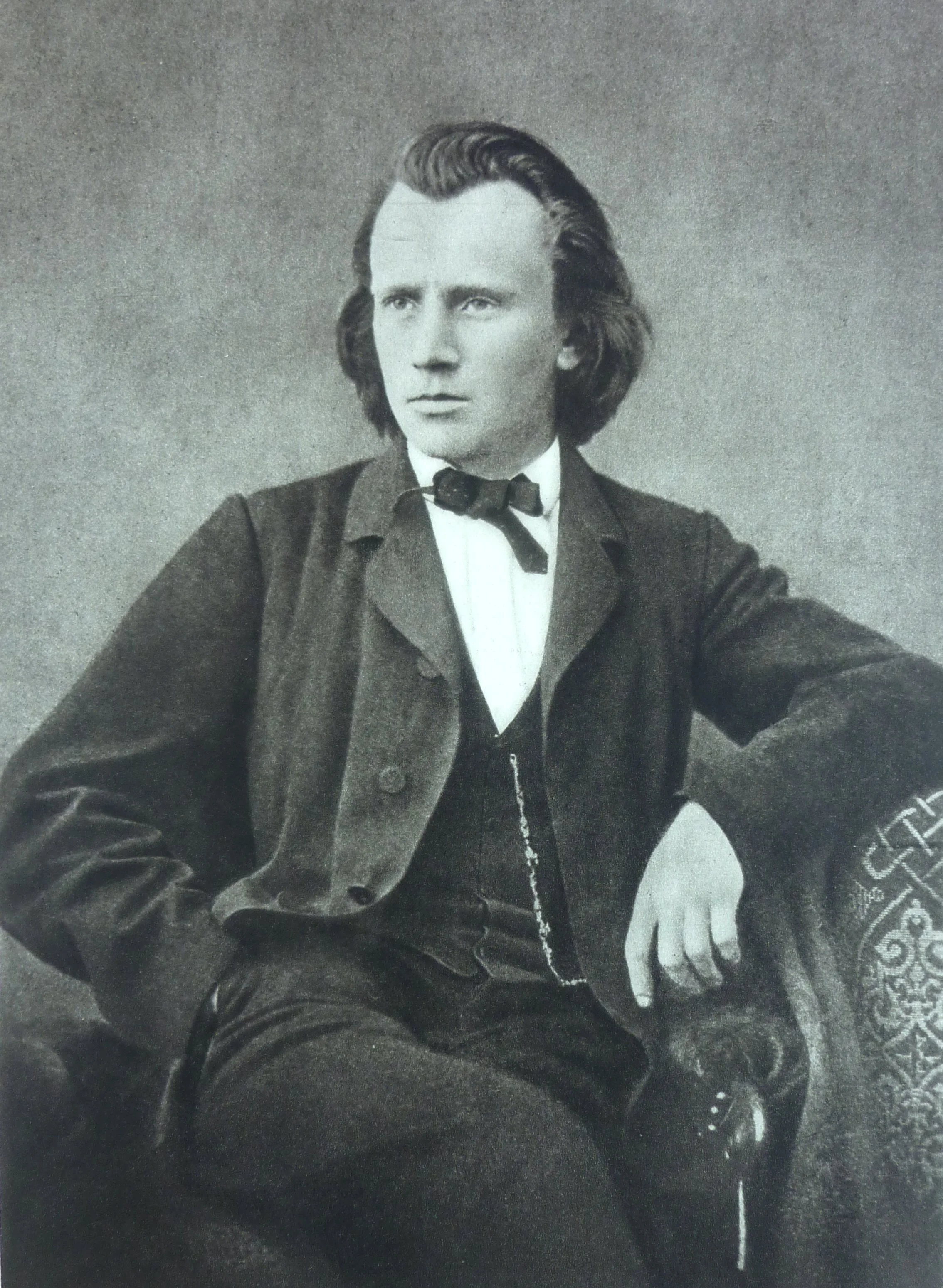
Johannes Brahms in 1866. Public domain photograph from the Wikipedia Commons.
At a New Haven Symphony rehearsal of Schoenberg’s 1937 orchestration of Brahms’s First Piano Quartet conducted by Murray Sidlin in February 1986, I looked up in shock when the xylophone entered — a moment so startlingly out of character that I turned to Alexander Platt (who I had only just meet) and, in youthful arrogance, observed, “That’s when Schoenberg’s temerity shows — a xylophone? Really?”
In the dream I stood in a beautiful, high-ceilinged, book-lined private salon the size and shape of Grand Central Station’s Campbell Apartment – only it was just off the main waiting room of the Wien Nordbahnhof. In the middle of the room sat a gleaming black Steinway. The sound of an arriving passenger train.
We’d been toying with the idea for years, so I wasn’t surprised when, nearly four decades later, over lunch, Alexander half‑admonished, “You promise not to add a xylophone, right?” Fork poised like a baton, he had just asked me to orchestrate Johannes Brahms’s Opus 34 — the Piano Quintet that emerged after he withdrew the original quartet, recast it as a sonata for two pianos, and at last arrived at the version premiered in 1866.
Schoenberg, who called himself the “Emancipator of Dissonance,” saw himself as the necessary heir of the Austro‑German tradition — a successor to Brahms and a “pupil of Mozart.” About three generations after Brahms’ death, my connection to his music is far humbler: I came to love it as a student at Curtis, hearing friends rehearse it and dissecting its structure for my theory teachers, though I felt a closer affinity to Haydn.
As a student and through the first decade of my career (working various music jobs, including teaching, to buy time for my own composition) I earned extra cash as a music copyist. I never minded that it enabled others to “down‑market” me; I cherished the monk‑like humility and ego-lessness of the work. By climbing inside the minds of the composers whose pieces I arranged, orchestrated, and copied, I gained a deep education in craft. In that spirit, orchestrating Brahms felt like a natural chance to commune with his music in a way that was already deeply familiar to me. So I told Alexander I’d do it.
I reached down to the keyboard and tentatively picked out DO FA SOL LA-flat FA RE-flat FA DO. As though in response, through the door strode a handsome man of thirty-three with straight, shoulder length blond hair combed straight back from his high forehead, exposing steep widow’s peaks.
“I’m on my way to Leipzig,” he said, running his hand through his hair as he barreled down on me. His eyes were a brilliant aquamarine. “I’m sorry!” I said, reflexively snatching my hand away from the keyboard and, to cover the movement, extending it out toward him. He shifted his portfolio from one hand to the other. The sound of a train leaving the station. “Mein Gott, ich brauche ein Bier!” he laughed, gripping my hand.
“Am I in your head; or, are you in mine?” I asked, pleasantly. “Yes,” he laughed, “why else would I be here? You are orchestrating my opus 34, yes? We play it in Leipzig tomorrow at the conservatory. How is it coming along?”
It’s a balancing act, I thought: you push the dissonant passing tones in the winds (as in bars 42-55 of the second movement) and it sounds like Mahler; you make the arpeggiated passagework in the strings too repetitive (and leave out the two-against-three that gives us a proper romantic sturm und drang rhythmic churn, say in the coda of the first movement) and it sounds like Harmonielehre; alternate instrumental choirs of the orchestra without enough timbral connective tissue and it sounds like Stravinsky; populate the lower octaves and Mussorgsky comes to mind.
“It sounds like it is you who could use a drink,” he mused. “I don’t drink anymore,” I sighed. “That’s good. It will make you fat,” he observed. But I was on a roll: add bass drum (as in bars 392-3 of the fourth movement) and you’ve got the Verdi Requiem. And then there is Death and the Maiden lurking in there, waiting to burst out—but you kept that under control, didn’t you? “It was hard to resist,” he admitted.
I impulsively picked out FA FA SOL-flat, the first three notes of the visionary “Poco sostenuto” opening of the final movement. “What is that?” I asked, excitement making me brash. “Is that some sort of ‘muss es sein?’ or something? Which century are you in there? What’s going on? It all makes sense contrapuntally—Dr. Lallerstedt would approve—but it’s Late Beethoven, or is it the beginning of Haydn’s Creation, a lucid couple of bars of Gesualdo, or a transitional passage in Mozart? The harmonies don’t add up: you’re a madman, a seer there; it’s like you’re looking into the future. It’s like you’re between trains: one’s headed backwards and the other forward; another keeps you here in Vienna and you end up maxing out with Gurrelieder!”
“Ahem,” he said, pulling out a few pages of manuscript from his portfolio and spreading them on the broad expanse of the closed piano lid in a surprisingly graceful, balletic manner. I’m working on a requiem of my own right now, which I’d like to show you. And don’t mention Gurrelieder: I can’t imagine what Arnold was thinking adding xylophone to my opus 25 when he orchestrated it. You’re not thinking of pulling any specious batshit moments like that, are you?”
“I’m sorry, I can’t look at the sketches of your Deutsches Requiem right now—I simply can’t bear it,” I said. I can’t without thinking of Borges and his short story, of how the magnificent chain of secondary dominants triggering a fall one to the next like dominos in the last movement that once thrilled me also make me think now of how Austrian Archduke Franz Ferdinand’s assassination triggered the fall of dominos that led to the Great War in 1914, and how my country played geopolitical post-colonial dominos in Southeast Asia when we took the French government’s place at the table after Dien Bien Phu in 1954. I just don’t seem to be able to escape the weight of history.
“That history is not in my head,” said Brahms, quickly retrieving the manuscript pages and putting them back into the portfolio. I had pushed the lucid dream too far. “None of that is in my head. You’ve brought all of that here with you. I can hear my train pulling into the station. I’ve got to go.” Brahms turned away and began walking briskly to the door. “Did you know how dangerous the political situation already was when you wrote this Piano Quintet of yours?” I asked his back. “In only thirty years, your friend Dvořák will pen his glorious New World Symphony, but, at the moment we Americans were in the middle of our Civil War, inventing faster and bloodier ways of killing more people than ever before.”
Sometime during the 90s I led the Orchestra Society of Philadelphia on a concert with several of my own pieces that opened with Richard Wagner’s Meistersinger Overture. I shall never forget how much I disliked rehearsing and conducting Wagner. I was repulsed by how, physicalizing it, the sheer power of the musical expression made me feel as though I was being ensnared and incorporated into it the way that Tasha Yar was killed off in the “Skin of Evil” episode of Star Trek: the Next Generation. (Now there’s a sentence Ned Rorem would never have written.)
Orchestrating Brahms, on the other hand, made me feel as though I were a pilgrim enmeshed in the warp and woof of a work saturated in the self-critical wisdom of a spirit conversing with his peers. I felt ennobled, not enlisted; invited by the music to take a knee as a colleague, not bend the knee as an executant. In Wagner I sensed (most likely projected, but still) the impulse that might drive the human-driven disasters that would soon sweep over Europe and the world. In Brahms I felt only wisdom, a vaguely poignant nostalgia, and agape.
He stopped, one hand outstretched, holding the door open. I heard “Fahrkarte, bitte!” from outside. “How close are you to having the orchestration finished?” he asked, not looking at me. “I have it in my head,” I answered. “I finish tomorrow.” His arm dropped to his side as he turned to me. From across the room, quietly, he asked, “Do you remember the day thirty years or so ago when a colleague who had written another octatonic orchestra piece asked you why the chords “glowed” in your orchestral music when theirs didn’t and you said it was because all you have to do is look at Brahms to see that a D-sharp is sharper than an E-flat?”
“Yes, maestro,” I said. He shook his head. “That wasn’t kind, was it?” A beat. “No, it wasn’t,” I answered quietly. Another beat. The train for Leipzig was being called. “Go home,” he said. “You are no longer welcome here.” Shostakovich silence after the door closed behind him. I had never had the chance to thank him for the honor, to express my respect. And then I woke up.