THEME:
What is a good composition teacher? One who leads a student to water and makes him drink. It helps if the teacher knows something about the water: is it pure H,0, or laced with salt and seaweed, as Debussy's ocean is laced with Rybakov and Wagner? A good teacher may actually be dumber than his pupil, but he has a knack for transferring his enthusiasms, and he provides a fresh stance that allows him to advise in sensible ways: thin out this chord, develop this section, double cellos with flute, don't take the tenor so high on a word like “squeak.”
With the creative arts, as distinct from the statistical crafts like math or botany, teaching comes only after the fact. The student must already be a composer before the teacher can tell him how not to compose: the composition must exist before it can be shredded. Eventually a student becomes his own teacher. Meanwhile. it is axiomatic that the mere fact of the student is as instructive to his instructor as the reverse.
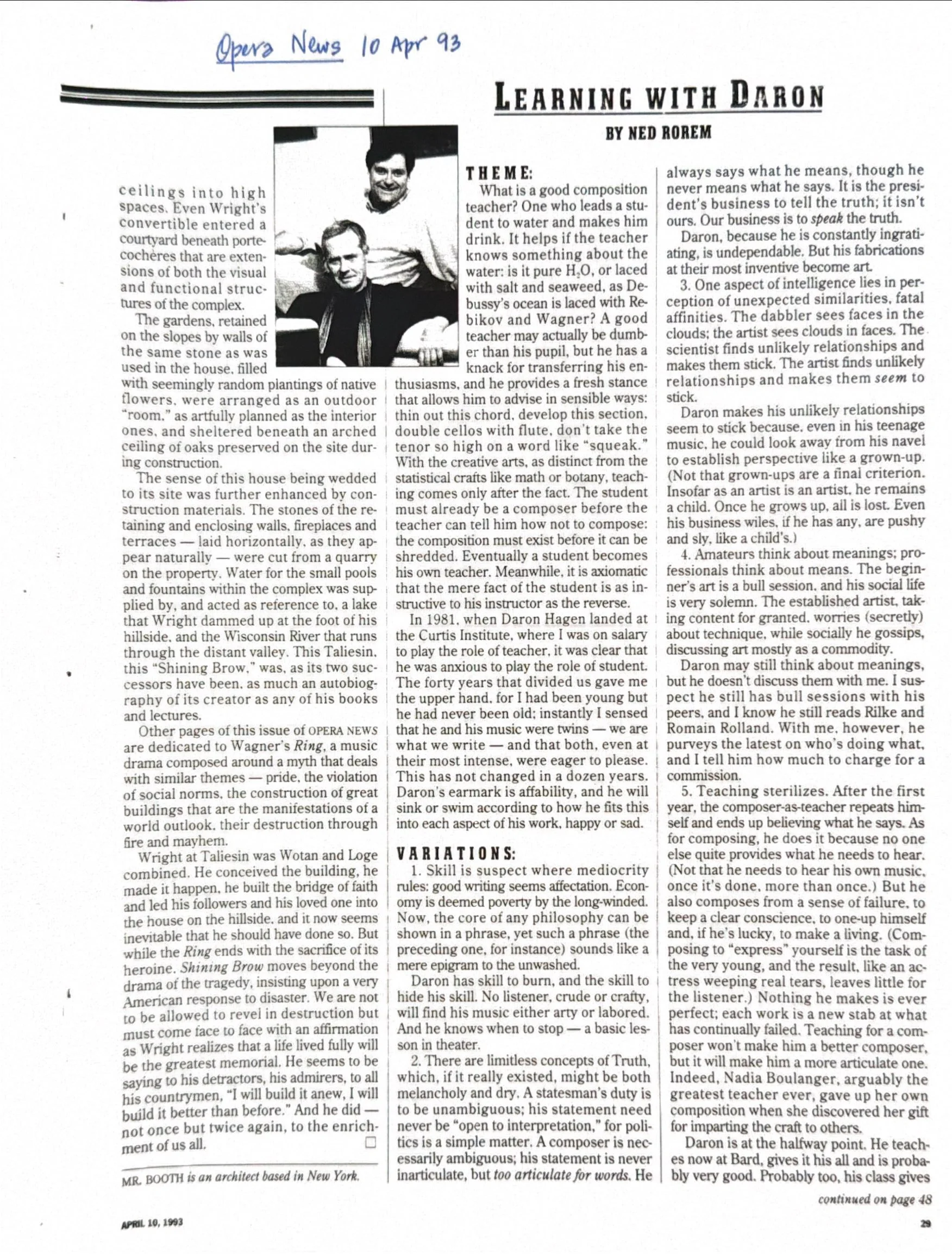
In 1981, when Daron Hagen landed at the Curtis Institute, where I was on salary to play the role of teacher. it was clear that he was anxious to play the role of student. The forty years that divided us gave me the upper hand, for I had been young but he had never been old: instantly I sensed that he and his music were twins – we are what we write – and that both, even at their most intense, were eager to please. This has not changed in a dozen years. Daron's earmark is affability, and he will sink or swim according to how he fits this into each aspect of his work, happy or sad.
VARIATIONS:
1. Skill is suspect where mediocrity rules: good writing seems affectation. Economy is deemed poverty by the long-winded. Now, the core of any philosophy can be shown in a phrase, yet such a phrase (the preceding one, for instance) sounds like a mere epigram to the unwashed. Daron has skill to burn, and the skill to hide his skill. No listener, crude or crafty, will find his music either arty or labored. And he knows when to stop-a basic lesson in theater.
2. There are limitless concepts of Truth, which, if it really existed, might be both melancholy and dry, A statesman's duty is to be unambiguous; his statement need never be "open to interpretation," for politics is a simple matter. A composer is necessarily ambiguous; his statement is never inarticulate, but too articulate for words. He always says what he means, though he never means what he says. It is the president's business to tell the truth; it isn't ours. Our business is to speak the truth. Daron, because he is constantly ingratiating, is undependable. But his fabrications at their most inventive become art.
3. One aspect of intelligence lies in perception of unexpected similarities, fatal affinities. The dabbler sees faces in the clouds; the artist sees clouds in faces. The scientist finds unlikely relationships and makes them stick. The artist finds unlikely relationships and makes them seem to stick. Daron makes his unlikely relationships seem to stick because. even in his teenage music, he could look away from his navel to establish perspective like a grown-up. (Not that grown-ups are a final criterion. Insofar as an artist is an artist, he remains a child. Once he grows up, al is lost. Even his business wiles, if he has any, are pushy and sly, like a child's.)
4. Amateurs think about meanings; professionals think about means. The beginner's art is a bull session, and his social life is very solemn. The established artist. taking content for granted. worries (secretly) about technique, while socially he gossips, discussing art mostly as a commodity. Daron may still think about meanings, but he doesn't discuss them with me. I suspect he still has bull sessions with his peers, and I know he still reads Rilke and Romain Rolland. With me. however, he purveys the latest on who's doing what, and I tell him how much to charge for a commission.
5. Teaching sterilizes. After the first year, the composer-as-teacher repeats himself and ends up believing what he says. As for composing, he does it because no one else quite provides what he needs to hear. (Not that he needs to hear his own music, once it's done, more than once.) But he also composes from a sense of failure, to keep a clear conscience, to one-up himself and, if he's lucky, to make a living. (Composing to "express" yourself is the task of the very young, and the result, like an actress weeping real tears, leaves little for the listener.) Nothing he makes is ever perfect; each work is a new stab at what has continually failed. Teaching for a composer won't make him a better composer, but it will make him a more articulate one. Indeed, Nadia Boulanger, arguably the greatest teacher ever, gave up her own composition when she discovered her gift for imparting the craft to others.
Daron is at the halfway point. He teaches now at Bard, gives it his all and is probably very good. Probably too, his class gives him (ever so rarely) ideas he can mangle and call his own. He knows nothing's perfect, which is why he's so prolific. Beside perfect, if it were attainable, would be horror in sheep's clothing. Perfection palls. Each new work of Daron's comes out the last. He doesn't necessarily “improve” whatever that means (Chopin and Ravel never improved, or even changed), but his scope widens.
6. I never had one mentor I especially admired, as Ravel had Fauré, or as many Americans had Boulanger. I cannot look back at this or that fellow citizen and say "Thank you." I learned mainly from the dead. Thus I am touched when a student stays with me for more than a year, even when that student doesn't interest me much. Most of what a composition teacher can give is given in the first lesson. Learning comes from imitation. Imitate what you love. Instruction is not offered. it is seized. Remember only that all music worthy of the name is "vocal," though not all music is conceived for the human voice.
Daron knows that all music sings. He can compose convincingly for the human voice and for instruments. He can compose inherently fast music and inherently slow. And he knows the difference between large-scale theater and the miniature drama called song. He is ripe for opera.
CODA: Since pupil and teacher are both in a constant state of becoming; since every opera makes its own rules; since in America those few operas that make an impression have been early works, whose composers' ensuing operas have grown increasingly flabby; and since I have dipped my toe into that treacherously fickle water (laced with more than salt and seaweed - laced with the deceptive glamour of mixed media, like the Catholic mass) with at best wistful results, it is not my purpose to prophesy about Daron's adventure with the oddly dramatic subject of Frank Lloyd Wright. (Yes, I've heard it, but operas are meant to be seen and not heard and anyway I won't spoil the fun.) I’ll say only that, in taking Wright's being as his subject, Daron defied Walter Pater's silly remark-“Architecture is frozen music” not by making music into liquid architecture but by proving that although the arts cannot represent each other (if they could, we'd need only one art), they can intensify each other.
I am waving now at Daron Hagen with a gesture filled with pride (and a faint twinge of jealousy). To say that he is a remarkable musician is to underrate him. Daron is music.
OPERA NEWS