
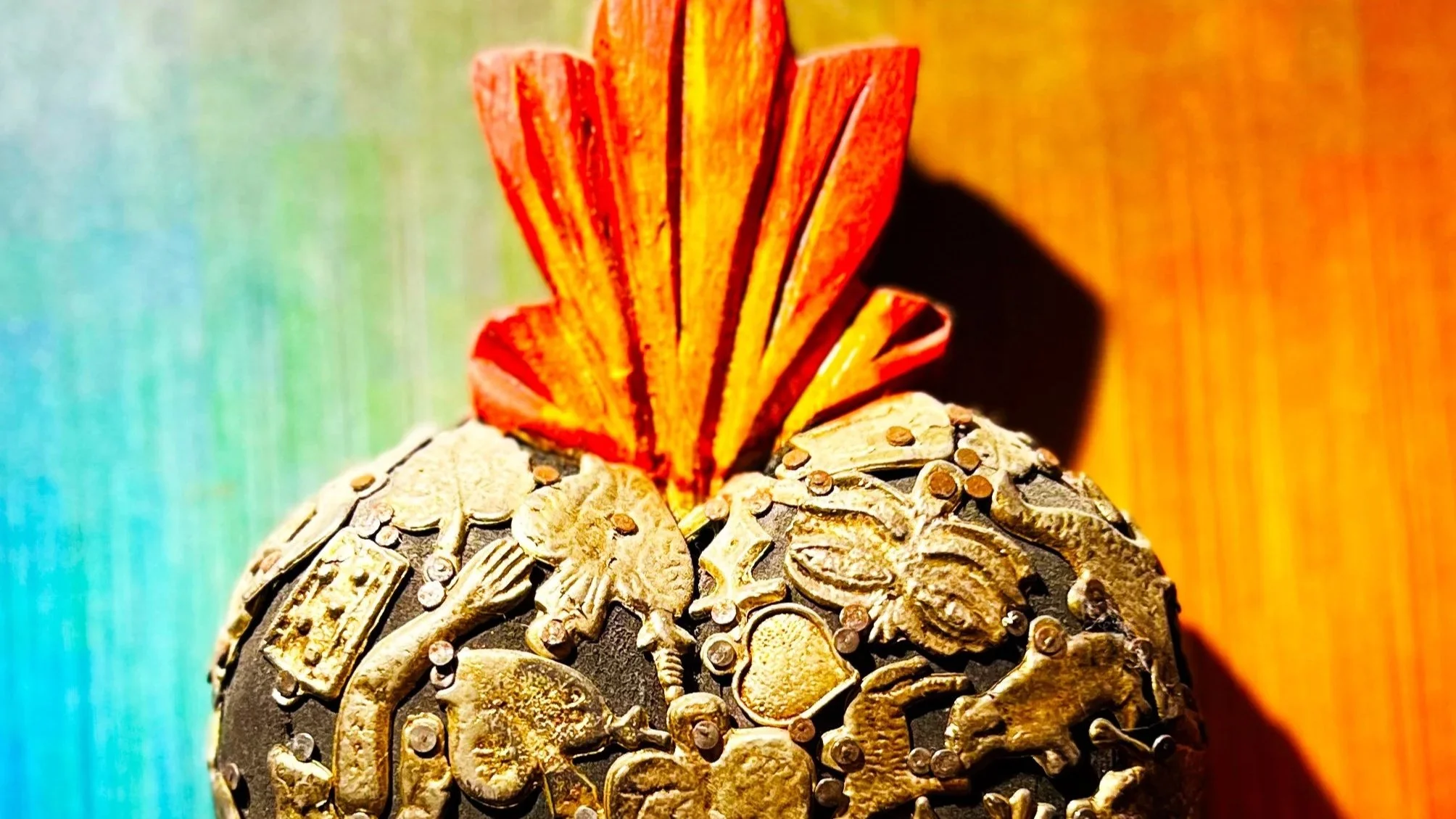
Maybe my life was scheduled for bizarre and fortuitous events more than most. To begin with, I am named for a child born with congenital heart disease, programmed, and then dead within days. Second, I was not meant to be born. My mother was aborting naturally in the fourth month and the doctor and she decided to frustrate nature with massive doses of progesterone to tighten the walls of the womb. She had to have injections throughout the pregnancy—this would have been in 1960. When I first made it to the coast and enrolled at Curtis in September of 1981, my mother wrote me a letter disclosing the medical intervention above, in which she concluded, “Ergo, somehow you were born out of the time continuum that would have given the first Daron a more sedate, predictable pattern.”
Then, at the age of fifteen, the sudden evolution of an interest and talent for music that seemed (according to my mother, at least) entirely unaccountable and self-generated. Its rapid development in about four years, from teaching myself the names of the notes by writing them in pencil next to them on the music to being accepted at Curtis, not to mention all the crazy coincidences like writing Helen Coates, and catching Leonard Bernstein’s ear—million-to-one shots, you’ve got to admit. I think I’m just one of those out-of-whack lives that occur sometimes and are as often a blessing as a curse.
I was born the sort of person for whom these junctures of coincidence were, especially early on, benign and happily resolved. The trauma of my mother’s early and painful death darkened my internal path, but I think that the humane and mostly happy person that I labor to be, half a century later (both because of the example and expectations that she set for me, and for my family’s sake) is not so obnoxious that I am universally disliked.
I’ve tried to express my gratitude properly to others, and to Providence, for the enormous generosity of spirit, forgiveness, and financial support people have given me over the years. I’ve tried to pay it forward. Mom noted in a letter to me shortly before she died, “You’re a gutsy little bastard who’s been swimming upstream against skepticism ever since you first decided to compose. That’s what makes the tough survive best.” Who knows? I have always felt five years older than I was, and was always treated as though I was five years younger. I never expected to live to thirty, then forty, then fifty, then through sixty, and open-heart surgery.
Diagnosed several years ago with the same congenital aortic atresia as my namesake, and informed that a surgical repair would need to be undertaken at some point, I (as most people do when preparing to undergo serious surgery) undertook the sort of mildly dissociative chore of wrapping up my affairs in case things went south. I arranged for my papers to go to the Wisconsin Music Project at the University of Wisconsin-Madison, finalized legacy publishing plans with Peermusic, and recorded the audiobook of the memoir while writing Exploring Operafilm at the Bogliasco Foundation in Umbria. Climbing the steep garden path from the composer’s studio up to the Villa each day for dinner, it became clear that the cold sweat, shallow breathing, and dizziness were not simply the toll of an obese sixty-something, but a final deepening of the disease.
When I was at Yaddo, I felt a steady, inescapable weight and warmth in my chest, like the motor of a hand-held electric eraser overheating, the angry buzzing of a disturbed beehive. Walking haltingly around the lakes I had run around forty years earlier, I felt it all. Back home, routine tests transformed within days to a drumbeat of CBCs, CMPs, EKGs, and MRIs, followed by chest X-rays and a heart catheterization. The thoracic surgeon’s verdict was blunt: "We’ll fit you in next week."
I asked them to play Mozart’s C Minor Mass in the operating room. I remember a few seconds of it before waking to the sensation of a breathing tube being pulled from my throat. The surgery was a success, but that night, as I am told is often the case with this procedure, my pulse became arhythmic. My “galloping heart” felt exactly as though I had two simultaneous, independent and competing pulses creating what Schillinger called “the interference of periodicities.” Literally, I was of two hearts.
Correlative Alert: The Mayans used the phrase kyeb awanima (being of two hearts) to describe existential ambivalence. In the third century BCE, the Confucian scholar Xunzi used the phrase "two hearts" to describe a mind divided by conflicting pathways. Catholic theology dictates the Alliance of the Two Hearts—the intersection of divine mercy and maternal compassion. Similarly, the artist-anthropologist Tobias Schneebaum once noted to me that the Urapmin of Papua New Guinea define a state of moral contradiction prior to clarity as aget alep (two hearts).
A year later, fully recovered, thanks to brilliant doctors, patient family, and supportive friends, I’m happy to be able to spare you the rest. Except to say that, although I have felt all my life somehow metaphysically slightly out of time, or, as my mother intuited it in her letter, slightly “out of the time continuum,” that night in the hospital I felt, for a time, literally out of time. Just as flagging my repetition of “out of time” as a stylistic tautology rather than a mimetic pulse would miss the point, it would take a monster to poo-poo Sondheim’s lyric “Make of our hearts one heart.” Maybe life is simply the way that independent pulses, lifetimes, moving at different tempos, occasionally fall into a symmetry so perfect that it feels like fate.